


Building a Supplement Routine Naturally for Peak Performance
Pushing through tough Hyrox training sessions in the United Kingdom can leave even the most dedicated athlete searching for ways to recover faster and improve performance. High-intensity workouts challenge your muscles, energy stores, and motivation, especially for women balancing fitness with busy lives. Choosing a natural supplement routine tailored to support training and recovery helps turn every session into progress, making each finish line feel more achievable and each setback less daunting.
Table of Contents
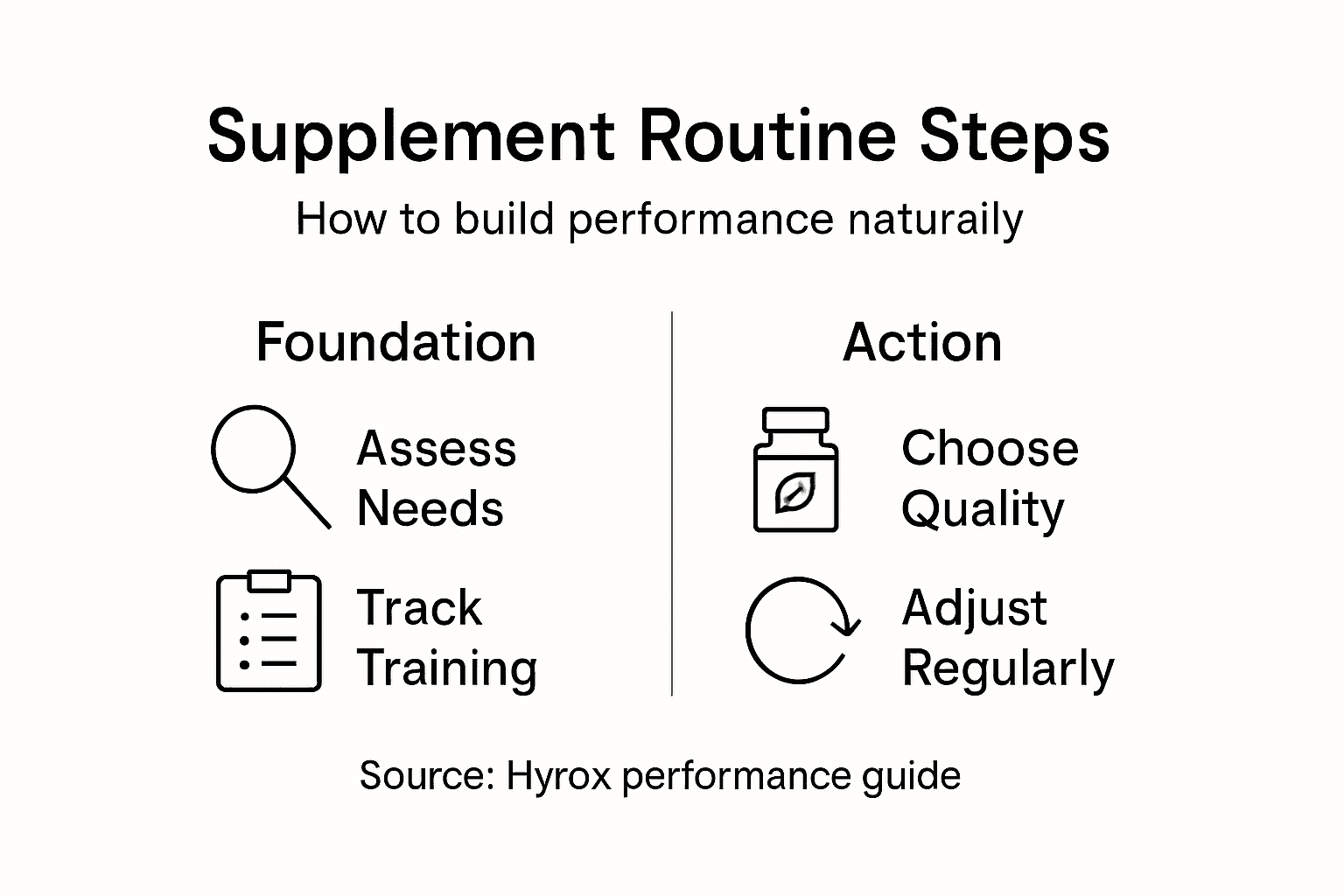
- Step 1: Assess Personal Training And Recovery Needs
- Step 2: Select Natural Supplements For Performance
- Step 3: Establish A Tailored Daily Supplement Schedule
- Step 4: Monitor Results And Adjust The Routine
Quick Summary
| Key Takeaway | Explanation |
|---|---|
| 1. Assess Training & Recovery Needs | Understand your personal training intensity and recovery capacity to select appropriate supplements for performance. |
| 2. Focus on Natural Supplements | Choose natural supplements that directly address identified performance gaps without relying on synthetic additives. |
| 3. Establish a Supplement Schedule | Plan your supplement timing around your training schedule for maximum effectiveness and absorption. |
| 4. Monitor Performance Metrics | Track specific performance indicators regularly to evaluate the effectiveness of your supplement routine. |
| 5. Make One Change at a Time | Adjust only one aspect of your supplement routine at a time to accurately assess its impact on your performance. |
Step 1: Assess personal training and recovery needs
Before you stock your supplement routine, you need to understand what your body actually requires. Your training intensity, frequency, and recovery capacity vary based on your age, experience level, and current fitness state. This assessment becomes your foundation for choosing the right supplements that will genuinely support your performance, not just add expense to your cupboard.
Start by mapping out your weekly training schedule. How many Hyrox sessions are you completing each week? Are these back-to-back training days or spread across the week? Track the intensity of each session, noting which ones leave you feeling completely drained versus moderately fatigued. Your recovery patterns matter just as much as your training load, so observe how many days you need between intense efforts to feel adequately recovered.
Next, examine your current nutrition and hydration habits. Proper fuelling and hydration directly impact your training adaptation and recovery capacity. Are you eating enough protein to support muscle repair? Are you drinking sufficient water throughout the day? These fundamentals must be sorted first, as no supplement can compensate for poor basic nutrition.
Look at your sleep quality and duration. Most athletes in your age range need seven to nine hours nightly for proper recovery. If you’re consistently sleeping less or waking frequently, this becomes a bigger priority than any supplement addition. Quality sleep influences everything from muscle repair to immune function, so assess this honestly before moving forward.
Finally, consider any specific performance gaps. Are you struggling with endurance during the obstacle portions? Do you recover poorly after consecutive training days? Does muscle soreness persist longer than you’d like? Understanding these gaps helps you choose supplements that address actual needs rather than perceived ones. Understanding how electrolytes support endurance performance can help you evaluate whether this area needs supplementation in your routine.
Pro tip: Write down your training schedule, sleep hours, and how you feel after each session for two weeks before selecting any supplements. This data prevents guesswork and helps you measure whether supplements actually work for your specific situation.
Step 2: Select natural supplements for performance
Now that you understand your specific training and recovery needs, you can choose supplements that actually address those gaps. Natural supplements offer a cleaner approach to performance enhancement without the synthetic additives many athletes want to avoid. The key is matching the right supplement to your identified needs rather than grabbing whatever is trending on social media.
Start by identifying which performance areas need support based on your assessment. Are you looking to boost energy during long obstacle courses? Do you need better recovery between intense sessions? Perhaps you want improved endurance for those gruelling final obstacles. Why natural supplements matter in sports nutrition becomes clear once you recognise how plant-based ingredients can enhance your performance without compromising your body’s natural systems.

Consider pre-workout options first if you’ve identified low energy or power output as a limiting factor. All-natural pre-workout supplements containing ingredients like beetroot extract, caffeine from natural sources, or beta-alanine can provide sustained energy throughout your Hyrox event without the crash that synthetic formulations cause. These work best when combined with proper carbohydrate intake beforehand, amplifying your endurance without relying on chemical stimulants.
Next, look at recovery support based on your training frequency. If you’re completing multiple intense sessions weekly, electrolytes become crucial for rehydration and muscle function. Natural electrolyte blends restore sodium, potassium, and magnesium lost during sweating, speeding up your recovery between sessions. Protein sources like plant-based or whey options support muscle repair when combined with whole foods.
Check ingredient labels carefully. Quality natural supplements list recognisable whole food sources rather than mysterious proprietary blends. Avoid products making outrageous performance claims or containing banned substances. Your choice should align with your training gaps identified in the previous step, not with marketing hype.
Here’s a summary of key supplement types and their targeted benefits for Hyrox athletes:
| Supplement Type | Primary Benefit | Best Timing | Common Natural Sources |
|---|---|---|---|
| Pre-workout | Boosts energy and endurance | 30-60 mins before training | Beetroot, natural caffeine |
| Protein | Supports muscle repair | Within 2 hours post-workout | Whey, pea protein |
| Electrolyte blend | Maintains hydration, muscle function | During or after sessions | Coconut water, sea salt |
| Carbohydrate | Replenishes glycogen stores | Before high-intensity efforts | Oats, fruit, rice syrup |
Pro tip: Start with one supplement addressing your most pressing performance need, use it for four weeks while tracking your performance metrics, then evaluate results before adding another supplement to your routine.
Step 3: Establish a tailored daily supplement schedule
Timing matters more than most athletes realise. Taking the right supplement at the wrong time reduces its effectiveness, whilst a proper schedule maximises how your body utilises each one. Your daily supplement routine should work alongside your training schedule, not exist separately from it.
Start by mapping your training sessions across the week, then plan when each supplement delivers the most benefit. Protein intake within two hours post-exercise supports muscle repair and recovery, making post-workout timing critical for your routine. If you’re training in the morning, take protein immediately after finishing. For evening sessions, consume it before bed to support overnight recovery.
Carbohydrates and pre-workout supplements work best taken 30 to 60 minutes before training begins. This timing allows your body to absorb the nutrients and convert them into usable energy. If you’re completing a high-intensity Hyrox session, taking carbohydrates beforehand replenishes glycogen stores and reduces fatigue during the event. Consider your individual digestion speed when planning this window.
Electrolytes require different timing. During training sessions lasting longer than 90 minutes, sip electrolyte solutions consistently throughout rather than consuming them all at once. This approach maintains hydration and electrolyte balance continuously. For recovery days or lighter training, a single electrolyte intake post-workout suffices. Monitoring how your body responds to supplement timing helps you fine-tune your schedule for maximum effectiveness.
Write your schedule down. Literally. Add it to your phone calendar or print it out. Include the supplement name, dose, and exact time. This prevents forgotten doses and ensures consistency. Your body adapts best to consistent routines, so sticking to the same times daily produces better results than sporadic timing.
Build flexibility into your schedule for rest days and lighter training weeks. On complete rest days, reduce or skip pre-workout and high-dose protein intake. Your body still needs basic nutrition support, but intense training supplements become unnecessary.
Pro tip: Prepare your supplements the night before in a pill organiser or containers labelled by time, then set phone reminders for each dose to eliminate guesswork and missed servings.
Step 4: Monitor results and adjust the routine
Your supplement routine is not a set-and-forget system. What works brilliantly in month one might need tweaking by month three as your body adapts and your training progresses. Regular monitoring ensures your supplements continue delivering results rather than becoming expensive habits.
Begin tracking specific performance metrics that relate directly to your chosen supplements. If you added a pre-workout supplement, measure your power output, speed, or endurance during training sessions. Note your completion times on benchmark workouts, how you feel during the obstacle course, and your perceived exertion levels. Write these down weekly so you have concrete data rather than vague impressions.
Monitor how your body responds physically and mentally. Observing supplement effects and any side effects allows you to distinguish between what’s working and what’s simply placebo effect. Track energy levels throughout the day, sleep quality, muscle soreness duration, and recovery speed between sessions. If you notice digestive discomfort, headaches, or unusual fatigue, these warrant investigation.
After four weeks, compare your baseline data from before supplementation against your current results. Did your performance metrics improve measurably? Are you recovering noticeably faster? Do you feel stronger during training? If the answer is yes to most questions, your current routine is working. If not, something needs adjustment.
To help monitor the effects of your supplement routine, compare these key performance metrics and indicators:
| Metric | What to Track | Why It Matters | Adjustment Signal |
|---|---|---|---|
| Workout completion time | Time per training session | Shows speed and stamina | Slower times may require change |
| Recovery speed | Time to feel fully recovered | Indicates supplement efficacy | Prolonged fatigue suggests review |
| Muscle soreness | Duration and intensity | Reflects recovery quality | Persistent soreness may need more protein |
| Sleep quality | Restfulness and duration | Influences all performance | Poor sleep means nutrition review |
Understanding how supplement interactions and repeated use affect performance helps you make informed adjustments. Your body may develop tolerance to certain ingredients over time, meaning you might need to cycle supplements rather than use them continuously. Alternatively, you might discover that combining supplements creates better results than using them individually.
Make one adjustment at a time. If you change your routine, alter only one element so you can identify what caused any performance shift. Perhaps you reduce the pre-workout dose, swap brands, or adjust timing. Give each change two weeks before evaluating results.
Pro tip: Use a simple spreadsheet tracking your workout performance, energy levels, and how you feel, then review it monthly to spot patterns and make evidence-based adjustments rather than guessing what works.
Elevate Your Hyrox Performance with Natural Supplement Solutions
Building a supplement routine naturally for peak performance means addressing your unique training and recovery needs with clean, effective products. If you are challenged by sustaining energy, optimising hydration, or speeding recovery during intense Hyrox sessions, focusing on natural ingredients can make the difference. Our range of Pre-workout supplements delivers sustained energy without the usual crash from synthetic stimulants. Coupled with our carefully formulated Electrolyte blends, you can maintain hydration and muscle function even during back-to-back workouts.
Seize control of your training outcomes by choosing supplements that fit your personal schedule and performance gaps. Visit Interval now to explore our natural supplements designed specifically for high-intensity athletes like you. Start your tailored supplement routine today and experience better endurance, faster recovery, and peak performance without compromise.
Frequently Asked Questions
How can I assess my personal training and recovery needs for a supplement routine?
To assess your personal training and recovery needs, start by mapping out your weekly training schedule, noting the intensity and fatigue levels of each session. Track your nutrition, hydration, sleep quality, and any specific performance gaps you experience. Use this data to identify what supplements will best support your unique requirements.
What types of natural supplements should I consider for peak performance?
Consider natural supplements that directly address the gaps in your performance. Focus on pre-workout options for energy, protein for muscle repair, and electrolyte blends for hydration and recovery. Start with one supplement that aligns with your most pressing need and monitor its effects over four weeks.
How do I create a daily schedule for taking my supplements?
Establish a daily supplement schedule by aligning it with your training sessions. For instance, take protein within two hours after exercise for muscle recovery and pre-workout supplements 30 to 60 minutes before training. Write down the exact times and doses to remain consistent.
How can I evaluate the effectiveness of my supplement routine?
Evaluate the effectiveness of your supplement routine by tracking performance metrics such as workout completion times, muscle soreness, and recovery speed. After four weeks, compare your current metrics with your baseline data to see if there are noticeable improvements. Adjust your routine based on what you observe.
What should I do if I experience side effects from my supplements?
If you experience side effects from your supplements, first identify which supplement may be causing the issue. Monitor your symptoms and consider adjusting the dosage or timing. If side effects persist, consult a knowledgeable source to evaluate your routine and make informed changes.
How often should I adjust my supplement routine?
Adjust your supplement routine every few months or as your training evolves. Regularly monitor your performance and recovery metrics to identify any declining effectiveness. Make changes gradually, focusing on one element at a time, and give each adjustment about two weeks for evaluation.
Recommended
- Natural Performance Boosters: Elevate High-Intensity Results – Interval
- How to Mix Supplements Properly for Natural Results – Interval
- 7 Best Natural Supplements for Muscle Gain in Hyrox Athletes – Interval
- Guide to All-Natural Pre-Workout for Enhanced Performance – Interval
- Building Workout Supplement Routine for Optimal Results – MyGymSupplements