


How to Enhance Athletic Focus Naturally for Intense Training
Long Hyrox sessions in the United Kingdom can turn even the strongest willpower into scattered thoughts. For many female athletes, mental distractions like work stress, poor sleep or fatigue often interrupt the best training plans. Identifying your unique focus barriers is the first step towards reclaiming control. This guide helps you pinpoint what derails your concentration and highlights how natural supplements and smart routines can support mental clarity and high-intensity performance in every session.
Table of Contents
- Step 1: Identify Personal Focus Barriers And Triggers
- Step 2: Integrate Natural Supplements To Optimise Mental Clarity
- Step 3: Refine Pre-Workout Routines For Sustained Concentration
- Step 4: Evaluate Focus Levels During And After Training
Quick Summary
| Key Insight | Explanation |
|---|---|
| 1. Identify personal focus barriers | Understand what hinders your concentration to address specific challenges. |
| 2. Use targeted natural supplements | Choose supplements based on your identified barriers for optimal mental performance. |
| 3. Optimise your pre-workout routine | Structure your routine to support mental focus through proper nutrition and hydration. |
| 4. Track and evaluate focus levels | Rate your concentration and gather data post-training to monitor improvements. |
| 5. Adjust based on results observed | Use collected data to refine strategies and ensure effective performance enhancement. |
Step 1: Identify personal focus barriers and triggers
Understanding what derails your concentration during training is half the battle. You cannot fix what you do not recognise, so this step requires honest self-observation and reflection about your mental and physical state before, during, and after intense sessions.
Start by tracking your training sessions over the next two weeks. Note what happens immediately before your focus drops and what you were thinking, feeling, or experiencing physically. Were you fatigued from poor sleep? Did stress about work creep in? Was your hydration status compromised?
Common focus barriers to watch for:
- Physical fatigue or inadequate recovery between sessions
- Mental distractions from work, family, or external stress
- Negative self-talk or doubt about your ability
- Hunger or dehydration affecting cognitive function
- Anxiety about performance or competition
Research on psychological states affecting athletic focus shows that cognitive anxiety and depression negatively impact concentration, whilst mindfulness and confidence support it. Your role is to identify which of these psychological states commonly affect you.
Here’s a summary of psychological states and their impact on athletic focus:
| Psychological State | Impact on Focus | Suggested Action |
|---|---|---|
| Cognitive anxiety | Reduces concentration | Practice relaxation techniques |
| Confidence | Enhances focus | Use positive self-affirmation |
| Depression | Impairs attention | Seek mental health support |
| Mindfulness | Supports mental clarity | Apply mindfulness exercises |
| Stress | Causes distraction | Implement stress management |
Beyond barriers, identify your focus triggers. These are the conditions where your mind locks in and you perform at your best. Did you have a particular warm-up routine? Were you well-rested? Had you consumed something specific? Notice the pattern.
Write down three focus barriers and three focus triggers unique to you. Be specific. “Tiredness” is vague; “fatigue after night shifts affecting sleep quality” is actionable.
Knowing your personal barriers and triggers transforms them from invisible obstacles into manageable factors you can address with targeted strategies.
Pro tip: Keep a simple training journal on your phone noting energy levels, sleep quality, stress levels, and focus quality after each session; patterns emerge within two weeks and guide your supplement and lifestyle choices.
Step 2: Integrate natural supplements to optimise mental clarity
Now that you understand your personal focus barriers, targeted supplementation can address the gaps between your current nutrition and optimal mental performance. Natural supplements work best when they align with your specific barriers and your overall training demands.
Start by identifying which barriers need nutritional support. If dehydration affects your focus, electrolytes become priority. If fatigue clouds your thinking, you might explore energy-supporting supplements. If anxiety derails concentration, certain adaptogens could help. Your barriers guide your choices.
Key natural supplements for mental clarity during intense training:
- Caffeine improves alertness and mental sharpness during high-intensity work
- Protein and amino acids support sustained cognitive function and recovery
- Creatine enhances mental resilience and concentration under fatigue
- Adaptogens help manage stress-induced focus loss
- Electrolytes prevent dehydration-related mental fog
Natural supplements affecting athletic focus include caffeine, protein, and creatine, each with different mechanisms for supporting mental clarity. The research emphasises that whole food nutrition remains your foundation, but supplementation fills genuine gaps when used strategically.
To clarify supplement choices, here’s how natural options target specific focus barriers:
| Supplement | Target Barrier | Typical Benefit |
|---|---|---|
| Caffeine | Physical and mental fatigue | Improved alertness |
| Protein/Amino | Recovery and brain function | Enhanced sustained focus |
| Creatine | Fatigue and resilience | Greater concentration under stress |
| Adaptogens | Stress and anxiety | Reduced mental distractions |
| Electrolytes | Dehydration | Sharper cognitive performance |
Start with one supplement addressing your primary barrier. Give it three to four weeks to assess its effect on your focus during training. Many women find that pre-workout formulations with natural ingredients provide consistent support for both mental clarity and training intensity. Track how your focus quality changes and whether your identified barriers diminish.
Timing matters significantly. Take mental-clarity supplements approximately thirty to forty-five minutes before your most challenging training sessions. This allows absorption and onset before you need peak concentration.
Natural supplementation works when it targets your actual barriers, not when you chase every trend you see other athletes using.
Pro tip: Start with a single supplement and track its effect for 3-4 weeks before adding another; this reveals what genuinely sharpens your focus versus what’s simply expensive urine.
Step 3: Refine pre-workout routines for sustained concentration
Your pre-workout routine is the foundation for mental clarity during intense training. Timing, nutrition composition, and hydration combine to either sharpen or cloud your focus when you need it most.

The goal is straightforward: fuel your brain with easily digestible energy whilst ensuring proper hydration. This prevents the mental fog that creeps in mid-session when glucose drops or dehydration sets in.
Build your pre-workout routine around these elements:
- Consume carbohydrates 60 to 90 minutes before training
- Include adequate fluids starting 2 to 3 hours beforehand
- Avoid high fat foods that slow digestion and cloud thinking
- Test your routine during lower-intensity sessions first
- Adjust timing based on your individual digestion and response
Carbohydrate intake before exercise directly supports sustained concentration and performance. Your brain relies on glucose, and easily digestible carbohydrates maintain that fuel source throughout your Hyrox training, preventing the concentration crashes that derail your performance.
Specific timing matters more than you might think. Eating too close to training causes stomach discomfort that fractures focus. Eating too early leaves you depleted mid-session. The 60 to 90 minute window works for most athletes, but your body might prefer different timing. Track what works during practice sessions.
Consider pre-workout drink ingredients designed for natural energy and hydration. These combine carbohydrates with electrolytes and sometimes amino acids, providing portable fuelling that absorbs quickly without digestive stress.
Hydration deserves equal attention. Start your day well hydrated, then drink 400 to 600 millilitres of fluid in the two to three hours before training. This prevents dehydration-induced mental fatigue during your most demanding sessions.
Your pre-workout routine is not random habit; it is a precision tool that either enables or prevents mental clarity.
Pro tip: Document your pre-workout timing, food choices, and resulting focus quality for five training sessions; you’ll identify the exact setup that sharpens your concentration every single time.
Step 4: Evaluate focus levels during and after training
Measuring your focus is not guesswork. You need concrete data showing whether your barriers have improved, your supplements are working, and your pre-workout routine is effective. Without evaluation, you cannot adjust what needs adjusting.
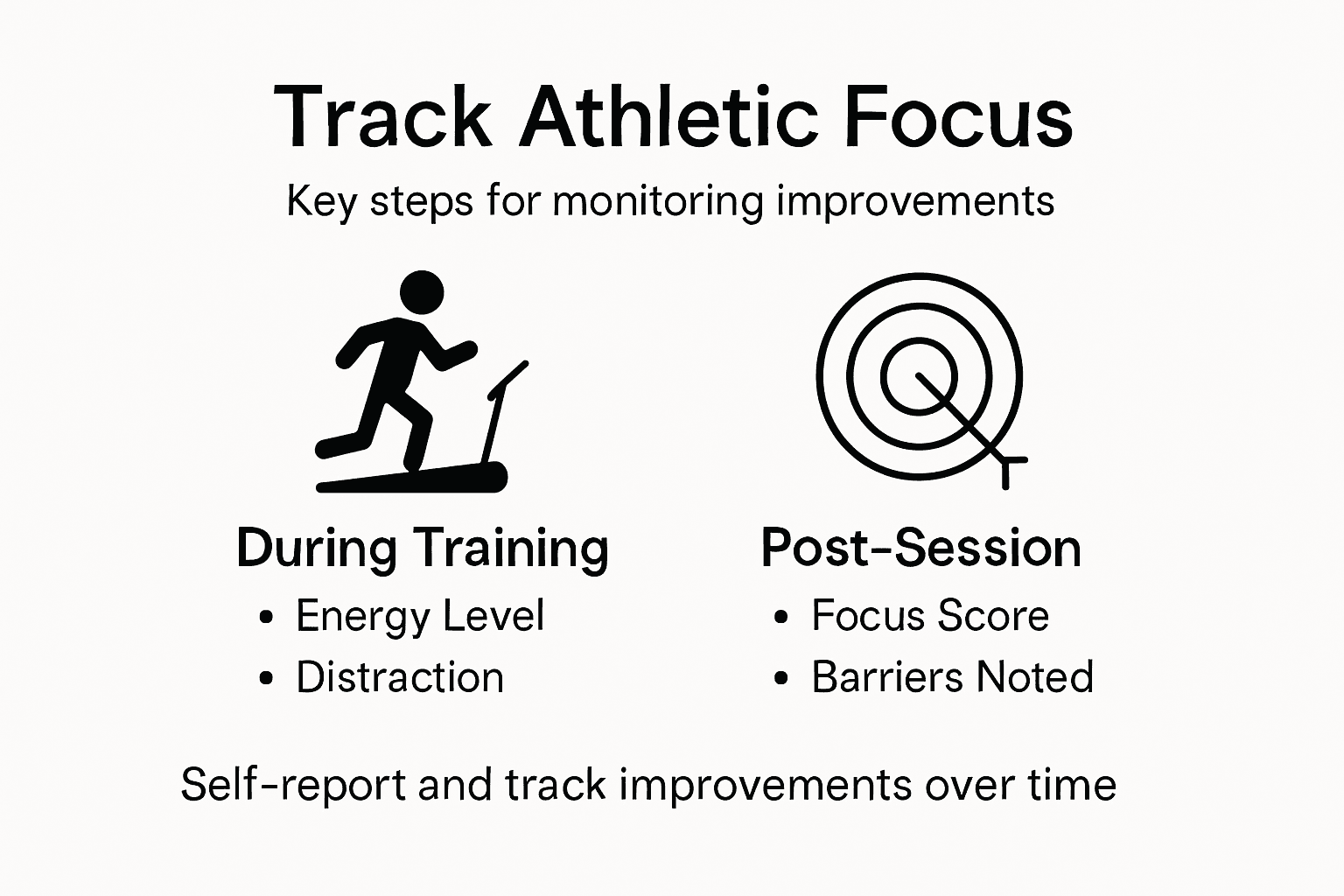
Start by rating your mental clarity during training on a simple scale. Use zero to ten, where zero means completely unfocused and ten means locked-in concentration throughout. Rate this immediately after your session whilst the experience is fresh.
Track these specific focus markers:
- Mental sharpness during the most demanding sections of your workout
- Recovery of focus after rest periods or transitions
- Ability to execute technique despite fatigue
- Absence of mental distractions or anxious thoughts
- Overall session quality compared to previous weeks
Post-training assessment methods include self-reports and observed behaviour changes. Your subjective ratings combined with objective performance data create a complete picture of your focus improvements.
Document three additional observations after each training session. Did your identified barriers show up? Which ones disappeared? Did your supplement timing help? These qualitative notes reveal patterns that numbers alone cannot capture.
After two to three weeks, compare your current focus scores to your baseline. You should see measurable improvement if your barriers, supplements, and pre-workout routine are working together. If scores remain flat, something needs adjustment. Perhaps your supplement choice does not suit you, or your pre-workout timing is wrong.
Involve objective markers too. Track your actual performance metrics. Better focus usually translates to improved split times, stronger technique execution, and fewer mistakes under fatigue. These tangible results validate what your focus ratings suggest.
Evaluation reveals what is working and what is wasting your time and money. Skip this step and you are training blind.
Pro tip: Create a simple spreadsheet with date, focus rating, barriers present, supplements taken, and performance notes; after four weeks, patterns emerge that guide your next refinements.
Boost Your Athletic Focus Naturally with Targeted Nutrition
Struggling with mental fatigue or stress during intense training sessions can feel overwhelming. This article highlights the need to identify specific focus barriers such as dehydration, anxiety, or low energy and strategically address them with natural support. Our range of carefully formulated products like Pre-workout – Interval and Electrolyte – Interval are designed to sharpen mental clarity and sustain concentration exactly when you need it most.
Experience the difference natural ingredients make to your focus, energy, and overall performance. Visit Use Interval today to explore supplements that complement your personalised training routine and overcome common barriers to peak concentration. Take control of your mental edge now with solutions tailored for high intensity sports athletes.
Frequently Asked Questions
How can I identify my personal focus barriers during training?
You can identify your focus barriers by tracking your training sessions for two weeks. Note your mental and physical state before, during, and after each session to reveal patterns that might affect your concentration, such as fatigue, hydration, or emotional stress.
What natural supplements can enhance focus for intense training?
Natural supplements like caffeine, adaptogens, and electrolytes can improve mental clarity during training. Start with one supplement that addresses your primary barrier and monitor its effects over three to four weeks to see how it influences your focus.
How do I create an effective pre-workout routine for better concentration?
To design an effective pre-workout routine, consume easily digestible carbohydrates 60 to 90 minutes before training, and ensure you are well-hydrated. Adjust timing based on your body’s response during practice sessions to find what optimises your focus.
What specific focus markers should I track during my training sessions?
Track your mental clarity by rating your focus on a scale from zero to ten immediately after each session. Document specific focus markers such as mental sharpness during challenging exercises, recovery of focus after breaks, and overall session quality.
How will evaluating my focus improve my training outcomes?
By evaluating your focus, you can determine if your barriers, supplements, and pre-workout routine are effective. Use concrete data to make adjustments as needed, aiming for measurable improvements in your focus levels and performance metrics over a few weeks.
What actions should I take to address any focus barriers that I identify?
Once you identify your focus barriers, you should implement targeted strategies, including adjusting your diet, supplementation, or mental preparation techniques. Take action by creating a simple training journal to monitor energy levels and stress factors, aiming to spot patterns and improve within two weeks.