


Understanding energy metabolism to boost Hyrox performance
Even the fittest female Hyrox athletes often underestimate how deeply energy metabolism controls not just stamina, but the ability to recover rapidly and perform at peak across every single race station. It is not simply about burning calories or eating enough carbs. Energy metabolism is the master switch that determines whether you power through that final sled push or hit a wall at station six. This guide breaks down the science clearly, cuts through the confusion, and gives you practical tools to compete stronger and smarter at every Hyrox event.
Table of Contents
- What is energy metabolism? Clear fundamentals for athletes
- The three energy systems explained: How your body powers Hyrox
- Female energy metabolism in high-intensity events: What’s unique?
- Why muscle glycogen, recovery, and metabolic flexibility matter
- Training and nutrition for energy efficiency: Strategies for Hyrox women
- Fuel your performance with Interval
- Frequently asked questions
Key Takeaways
| Point | Details |
|---|---|
| Energy metabolism fundamentals | Metabolism transforms food into usable energy (ATP), powering all aspects of Hyrox performance. |
| Three systems in action | ATP-PC, anaerobic, and aerobic systems work together; their dominance shifts with workout intensity and duration. |
| Female metabolic advantages | Women aged 30-50 generally have better fat burning and flexibility, offering a potential endurance edge in Hyrox. |
| Preserving muscle glycogen | Maintaining glycogen is essential for power through stations and quick recovery. |
| Training and nutrition matter | A science-backed mix of aerobic/anaerobic training and balanced nutrition enhances energy metabolism efficiency. |
What is energy metabolism? Clear fundamentals for athletes
Energy metabolism is the sum of biochemical processes converting nutrients into ATP, powering all muscle function. ATP (adenosine triphosphate) is the actual currency your muscles spend with every contraction, every sprint, every rep. Without a steady ATP supply, performance collapses fast.
There are three main biochemical pathways your body uses to produce ATP:
- Glycolysis: Breaks down carbohydrates rapidly, works without oxygen (anaerobic), and is the go-to system for high-intensity bursts.
- Beta-oxidation: Converts fatty acids into ATP, slower but highly efficient for sustained, lower-intensity effort.
- Citric acid cycle (Krebs cycle): An aerobic process that uses carbohydrates, fats, and proteins to generate large amounts of ATP over time.
A common myth among Hyrox athletes is that performance is purely a carbohydrate game. Fat and protein play critical roles too, particularly in recovery and in sustaining energy during longer aerobic segments. Understanding energy metabolism mechanisms at this level helps you make smarter fuelling decisions, not just on race day but across your entire training block.
“Your body does not choose one fuel source. It blends them constantly, shifting the ratio based on intensity, duration, and what you have eaten.”
If you want to boost workout energy naturally, understanding these pathways is the essential first step.
The three energy systems explained: How your body powers Hyrox
Now that you know what energy metabolism is, let’s see exactly how your body delivers power at every stage of a Hyrox competition.
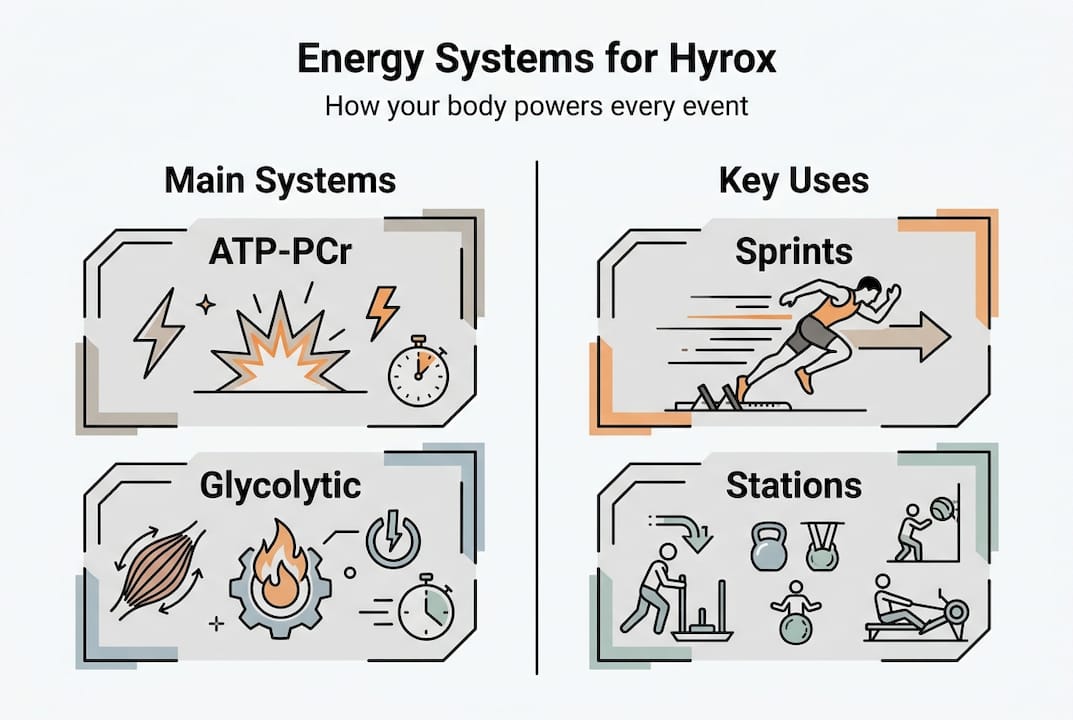
All three energy systems are involved in a Hyrox event, but their dominance shifts by segment. Here is how they break down:
| Energy system | Duration | Primary fuel | Hyrox example |
|---|---|---|---|
| ATP-PC (phosphocreatine) | 0 to 10 seconds | Phosphocreatine | Sled push, sprint start |
| Anaerobic glycolysis | 10 seconds to 2 minutes | Muscle glycogen | Wall balls, burpee broad jumps |
| Aerobic system | Over 2 minutes | Carbs, fats, proteins | 1km running segments |
During a Hyrox race, you cycle through all three systems repeatedly. The running segments are predominantly aerobic, while the functional stations spike into anaerobic glycolysis territory almost immediately. Here is the order in which these systems activate under increasing effort:
- ATP-PC fires first, providing instant explosive power for the opening seconds of any station.
- Anaerobic glycolysis takes over as effort continues beyond ten seconds, producing lactate as a byproduct.
- The aerobic system sustains you through the running kilometres and supports recovery between stations.
Understanding heat balance in metabolism also matters here. As intensity rises, your body generates more heat, which is why pacing and hydration are so tightly linked to energy output.
Pro Tip: Pair your performance nutrition for Hyrox strategy with your energy system knowledge. Eating a carbohydrate-rich meal two to three hours before a race primes your glycogen stores for those anaerobic station efforts.

Female energy metabolism in high-intensity events: What’s unique?
Understanding the general systems, let’s dig into how being a female Hyrox athlete brings unique energy advantages and some minor hurdles, too.
Women aged 30 to 50 show slightly higher fat oxidation and unique energy dynamics across the menstrual cycle. This is a genuine performance advantage in endurance-heavy events like Hyrox, where the ability to tap into fat stores efficiently can preserve glycogen for the hardest stations.
Key female-specific energy factors to understand:
- Menstrual cycle and REE: Resting energy expenditure rises slightly (roughly 40 kcal per day) during the luteal phase. This is not dramatic, but it does mean your body is working slightly harder at rest.
- Fat oxidation advantage: Women consistently oxidise more fat relative to carbohydrates at the same exercise intensity compared to men. This metabolic flexibility is a real asset in longer Hyrox events.
- Body composition: Lower body fat percentage correlates with faster Hyrox performance times, but the relationship is nuanced. Muscle mass and aerobic capacity matter more than simply being lean.
- Perimenopause and beyond: Women approaching or past menopause may notice shifts in low-intensity energy use and a slight reduction in metabolic rate. Resistance training and adequate protein intake become even more important during this phase.
| Age range | Estimated BMR (kcal/day) | Primary fuel at moderate intensity |
|---|---|---|
| 30 to 35 | 1,450 to 1,600 | Carbohydrate dominant |
| 36 to 42 | 1,380 to 1,520 | Mixed carb and fat |
| 43 to 50 | 1,300 to 1,460 | Increasing fat reliance |
Pro Tip: Track how your energy feels across your cycle for two to three months. You may find that balancing nutrition for Hyrox around your luteal phase, with slightly more carbohydrates, helps maintain training quality without overhauling your entire diet.
For more on boosting stamina for female athletes, cycle-aware training is one of the most underused tools available.
Why muscle glycogen, recovery, and metabolic flexibility matter
With these female-specific dynamics in mind, it is crucial to get clear on how to preserve your internal fuel and bounce back between sessions.
HIIT and Hyrox-style training drive major changes in glycolysis and the TCA cycle, and muscle glycogen is key for peak performance across all eight race stations. When glycogen runs low, your body shifts toward fat and protein for fuel. Fat is slower to convert. Protein breakdown means muscle tissue is being used as energy, which is the last place you want to draw from mid-race.
Metabolic flexibility is the ability to switch efficiently between burning carbohydrates and fats depending on what the moment demands. Athletes with high metabolic flexibility maintain more consistent power output even as fatigue accumulates. This is a trainable quality, not a fixed trait.
“Metabolic flexibility is not about being fat-adapted or carb-dependent. It is about having both options available and switching between them without a performance dip.”
Strategies to protect glycogen and support recovery:
- Consume 30 to 60 grams of carbohydrate within 30 minutes post-training to begin glycogen resynthesis.
- Include protein (20 to 30 grams) in your post-workout meal to support muscle repair without drawing on glycogen stores.
- Avoid training fasted before high-intensity Hyrox sessions. Save fasted training for low-intensity aerobic work.
- Prioritise sleep. Glycogen restoration and metabolic adaptation to metabolic demand both accelerate during deep sleep.
To optimise muscle recovery effectively, glycogen management and natural recovery enhancement strategies work best when combined.
Training and nutrition for energy efficiency: Strategies for Hyrox women
Armed with an understanding of energy stores and recovery, here is how you can fine-tune both your workouts and nutrition for optimal Hyrox performance.
VO2max, endurance volume, and lower body fat correlate most strongly with Hyrox performance, more so than raw strength. This tells you exactly where to focus your training energy.
Key nutrition principles:
- Prioritise carbohydrates around training sessions to keep glycogen stores topped up.
- Use fat as your primary fuel source during lower-intensity aerobic work and rest days.
- Do not neglect protein. Aim for 1.6 to 2.0 grams per kilogram of bodyweight daily to support muscle repair and metabolic health.
- Electrolytes matter. Sodium, potassium, and magnesium support the enzymatic reactions that drive ATP production.
Stepwise training adjustments for better energy efficiency:
- Follow the 80/20 rule: 80% of your weekly training volume should be aerobic or moderate intensity, with 20% at true high intensity. This builds your aerobic base without burning out your glycogen stores chronically.
- Schedule your hardest sessions during the follicular phase of your cycle, when energy and recovery tend to be at their best.
- Use energy systems training principles to structure interval sessions that target all three systems progressively.
- Taper carbohydrate intake on rest days and increase it on heavy training days. This simple adjustment improves metabolic flexibility over time.
Pro Tip: Review your pre-workout approach for Hyrox before every hard session. A well-timed, natural pre-workout can prime your ATP-PC and glycolytic systems without spiking cortisol or disrupting sleep later. And if you are building toward a race, use a structured Hyrox event preparation plan to align your training phases with your energy system goals.
Fuel your performance with Interval
Everything you have read here points to one truth: your energy systems need the right raw materials to perform. At Interval, we formulate our pre-workout and electrolyte products specifically for athletes doing high-intensity sport. Every ingredient is natural, every dose is purposeful, and every formula is built around the science of how your body actually produces and uses energy.

Our pre-workout supports ATP production and delays fatigue during those critical anaerobic station efforts. Our electrolytes keep your enzymatic reactions firing through every kilometre. Whether you are mid-training block or two weeks out from race day, explore the Interval range and give your metabolism the support it deserves. Real ingredients. Real performance.
Frequently asked questions
How does energy metabolism differ between men and women in Hyrox?
Women tend to oxidise more fat at the same exercise intensity, giving them a slight endurance advantage, but lactate and glucose patterns post-workout are broadly similar between sexes.
What is the main fuel during Hyrox stations vs running?
Stations rely primarily on muscle glycogen and the anaerobic glycolytic system, while running segments are aerobic dominant and draw more heavily on fat oxidation.
Can energy metabolism be improved with training?
Yes. Concurrent aerobic and anaerobic training improves the efficiency of all three energy systems, boosting both endurance capacity and the speed at which you recover between efforts.
How much does the menstrual cycle impact energy metabolism for training?
The impact is modest. The luteal phase raises REE by roughly 40 kcal per day compared to the follicular phase, which is not enough to require major dietary changes for most athletes.
Recommended
- Natural ways to boost workout energy for Hyrox athletes – Interval
- Natural Performance Enhancement Steps for Hyrox Athletes – Interval
- Role of Nutrition in Hyrox – Boosting Female Performance – Interval
- Performance Nutrition for Hyrox – Unlocking Endurance & Recovery – Interval
- 7 ползи от кафе със суперхрани за фокус и енергия – Neurofuel™️