


How to measure workout success as a female Hyrox athlete
TL;DR:
- Measuring progress for female Hyrox athletes requires tracking aerobic capacity, recovery speed, and strength under fatigue through specific metrics. Using wearable technology, body circumferences, and consistent performance tests helps monitor adaptations accurately over time. Combining physiological data with subjective well-being scores ensures a holistic view of progress, emphasizing trends over individual data points.
You train hard. You show up, you push through the sleds, the ski ergs, the burpee broad jumps — and then you wonder if any of it is actually working. For female Hyrox athletes, knowing how to measure workout success is genuinely difficult because the obvious markers (weight, how you look in the mirror) often tell the least interesting story. Real progress lives in your aerobic capacity, your recovery speed, your strength under fatigue, and whether your body is adapting the way your training demands. This guide gives you the metrics, tools, and frameworks to find out.
Table of Contents
- Preparing to measure success: essential tools and metrics
- Executing consistent performance tests and tracking progress
- Integrating physiological and subjective recovery metrics
- Using pacing and perceived exertion to evaluate real-time effort during Hyrox
- Tracking holistic well-being and body composition for sustained success
- Why focusing on multiple consistent trends beats chasing single metrics
- Enhance your Hyrox training with Interval’s starter bundle
- Frequently asked questions
Key Takeaways
| Point | Details |
|---|---|
| Consistent trend tracking | Observe multiple key metrics over weeks, not day-to-day changes, to assess true workout success. |
| Integrate physiological and subjective data | Combine wearable recovery measures with well-being scores to personalise training and avoid overtraining. |
| Use repeatable performance tests | Standardise strength and aerobic tests to generate reliable progress data reflecting real adaptations. |
| Leverage diverse pacing methods | Blend heart rate, pace, and perceived exertion for accurate effort management during hybrid Hyrox events. |
| Value non-scale victories | Track energy, sleep, mood, and body measurements to capture holistic improvements beyond weight. |
Preparing to measure success: essential tools and metrics
Before you can assess anything, you need to decide what you are actually measuring. Tracking fitness progress without defined markers is like racing without a finish line. You need a small but focused toolkit.
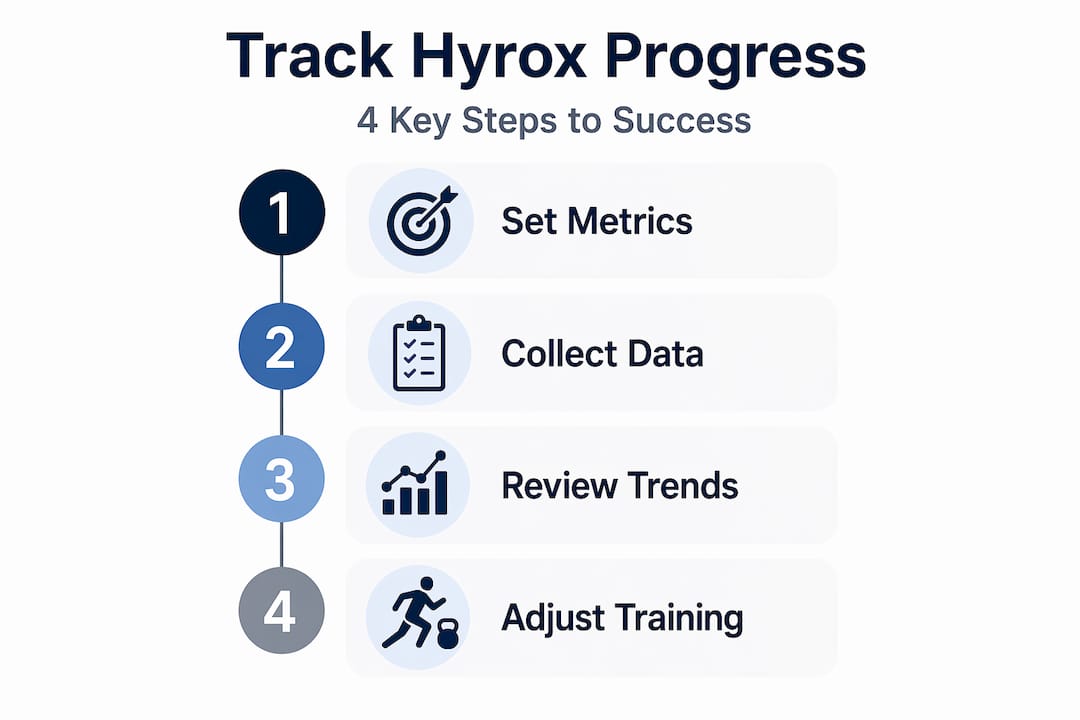
Wearable technology is now genuinely useful for Hyrox athletes. Devices that track heart rate variability (HRV) and resting heart rate give you a window into your autonomic nervous system, which reflects how well your body is recovering between sessions. HRV trends over weeks are meaningful; daily readings are just noise. Do not panic because your HRV dropped on a Tuesday. Look at the three-week slope.
Beyond wearables, a measuring tape costs less than a protein shake and tells you more than a scale ever will. Non-scale victories alongside weekly body circumferences — waist, hips, arms, chest — give you objective, body-composition data that the scale will never capture. If your waist is dropping and your shoulders are broader, your training is working. Full stop.
Here is a practical overview of the core metrics worth tracking:
| Metric | Tool needed | Review frequency |
|---|---|---|
| HRV (heart rate variability) | Wearable (e.g. Garmin, WHOOP) | Weekly trend |
| Resting heart rate | Wearable or manual | Weekly trend |
| VO2 max estimate | Wearable or lab test | Every 6–8 weeks |
| Body circumferences | Measuring tape | Weekly |
| Strength benchmarks | Training log | Every 4–6 weeks |
| Sleep quality score | Wearable or journal | Weekly average |
| Energy and mood rating | Self-reported (1-10 scale) | Daily log |
Understanding Hyrox’s unique physical demands matters here because the sport requires both aerobic endurance and strength under fatigue. Your metrics should reflect both. A purely aerobic tracker misses the picture. A purely strength-focused log ignores your engine. You need both columns filled.
Pro Tip: Set your measurement conditions once and keep them identical every time. Weigh yourself, take HRV readings, and log energy scores at the same time of day, ideally first thing in the morning before coffee or food.
Executing consistent performance tests and tracking progress
The most common mistake athletes make when measuring gym performance is changing the test. You switch from box squats to goblet squats. You retest your 2km row on a different ergo at a warmer gym temperature. The data becomes worthless. Strength progress genuinely requires identical testing conditions to reflect real improvement rather than circumstantial variation.
Here is a simple framework for conducting reliable performance retests:
- Choose three to five benchmark lifts or movements relevant to Hyrox. Sled push load, farmer carry weight and distance, sandbag lunges, and a rowing benchmark are all excellent choices.
- Log every session detail — weight, reps completed, technique notes, and your RPE (Rate of Perceived Exertion, rated 1 to 10). If you hit the same weight at an RPE of 6 instead of an RPE of 9, that is measurable progress even if the number did not change.
- Retest formally every four to six weeks, not weekly. Retesting too often picks up day-to-day variation rather than genuine adaptation.
- Run a VO2 max test at the start of your training block and then again at the midpoint. VO2 max testing before and midway through training gives you a concrete aerobic development snapshot that steady-state feel never will.
- Photograph your log entries or keep them in a spreadsheet. Visual trend lines over six to twelve weeks are far more convincing than memory.
For ways to assess workout effectiveness in real terms, strength benchmarks combined with a VO2 max estimate are probably the two highest-signal measures available to you without lab access. They capture your two primary Hyrox performance engines: power and aerobic capacity.
Improving workout stamina does not show up overnight. The value is in balancing your nutrition for performance alongside consistent, repeatable testing so you can separate training adaptation from fuelling variation.
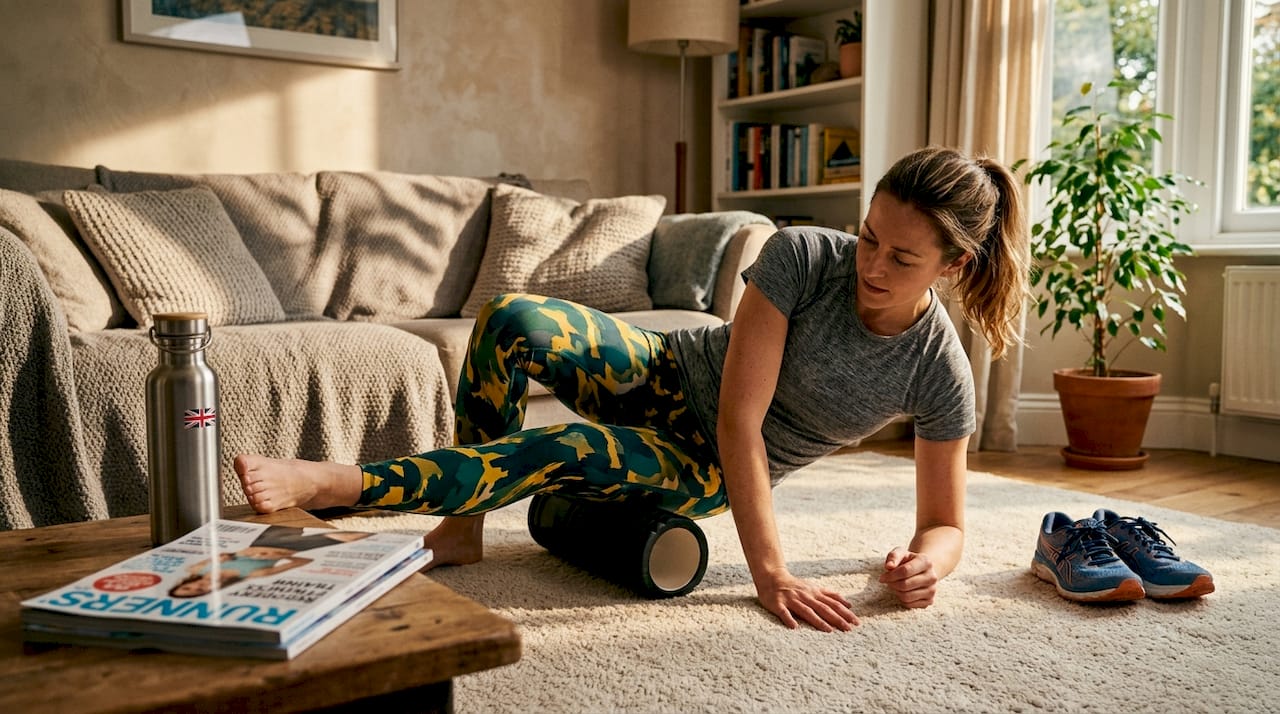
Pro Tip: If your performance drops on a retest day, check what happened in the 48 hours prior before concluding your programme is not working. Poor sleep, low carbohydrate intake, or a hard session the day before will suppress your output regardless of true fitness level.
Integrating physiological and subjective recovery metrics
Performance data without recovery data is only half the story. Indicators of workout improvement do not just show up in what you can do — they show up in how quickly you bounce back from what you just did.
Combining HRV with resting heart rate and well-being scores has been shown to enhance training adaptation monitoring compared to using HRV alone. The practical implication: do not read your HRV score in isolation. Read it alongside your resting heart rate and your self-reported sleep quality.
Key recovery metrics to monitor daily:
- HRV score compared against your personal baseline (not population norms)
- Resting heart rate, noting elevations above your 7-day average
- Subjective sleep quality rated 1 to 5 each morning
- Fatigue level on waking (1 to 10)
- Stress score the night before (1 to 10)
- Muscle soreness localised or general (note affected areas)
“HRV interpretation is most useful when compared to an individual’s own established baseline under consistent measurement conditions, not against population averages.” — Sensai Fit
The reason subjective data matters as much as physiological data is this: your wearable cannot feel your stress. It cannot know you had a work crisis at 10pm or that you are under-eating. When your HRV is suppressed but your subjective fatigue score is also a seven out of ten, you have confirmation. When HRV drops but you feel completely fine, you might simply be in a hard training block and adapting normally.
Optimising muscle recovery between sessions is where the real progress is built. Monitoring both channels, physiological and subjective, is what lets you train hard without tipping into overtraining.
Using pacing and perceived exertion to evaluate real-time effort during Hyrox
Performance tests and recovery data tell you how you are doing across weeks. But evaluating exercise results during a race or a hard session requires a different toolkit.
The best Hyrox pacing approach blends heart rate, pace, and RPE because each metric has a different lag time and a different sensitivity to the hybrid demands of the sport. Here is how each one functions:
- Heart rate is most useful in the early stages of a race or workout, when your body has not yet accumulated metabolic fatigue. Use it to keep yourself honest on the 1km running splits and to monitor recovery between stations.
- Pace gives you rhythm and consistency, but it degrades in usefulness as fatigue accumulates and terrain or station transitions break the flow. Track it but do not chase it blindly.
- RPE becomes your most reliable tool in the later stages when heart rate lags behind true effort and your watch is telling you things that do not match how your legs feel.
| Metric | Best used when | Limitation |
|---|---|---|
| Heart rate | Early race, aerobic control | Lags under high-intensity bursts |
| Pace | Flat running splits | Affected by terrain and fatigue |
| RPE | Mid to late race or session | Subjective; requires calibration |
Understanding Hyrox race pacing strategies in depth will change how you interpret your in-race data. Many athletes focus entirely on running pace and then blow up on the sled or wall balls because they ignored what their body was telling them via RPE. Learning to read your own effort level accurately is a training skill in itself.
Tracking holistic well-being and body composition for sustained success
Weight is a lagging, noisy, and often misleading indicator for Hyrox athletes. You are building muscle, shifting body composition, and managing fluid retention all at once. The scale does not have enough resolution to tell you anything useful week to week.
Tracking energy, sleep, mood, and body circumferences reduces your overreliance on scale changes and gives you a far more accurate read on whether your programme is working. Non-scale victories are not a consolation prize. They are often the most accurate early signal of real adaptation.
Track these weekly:
- Energy levels during workouts (are you lasting longer before fade?)
- Mood stability across the week (less irritability often signals better hormonal balance and recovery)
- Sleep onset and quality (are you falling asleep faster and waking less?)
- Strength in daily tasks (stairs, carrying, posture)
- Waist, hip, arm, and chest circumferences
| Wellbeing indicator | What it signals | How to log it |
|---|---|---|
| Energy during training | Aerobic and nutritional adaptation | 1–10 self-rating pre and post session |
| Mood and stress | Recovery quality, hormonal balance | 1–10 evening journal entry |
| Sleep quality | CNS recovery, programme load | Wearable or 1–5 morning rating |
| Body circumferences | Composition shift | Tape measure, same weekly day and time |
Performance nutrition plays a direct role in many of these indicators. When your energy and sleep improve together, that is your training and fuelling working in sync.
Why focusing on multiple consistent trends beats chasing single metrics
Here is the thing most athletes do not hear enough: one bad data point means almost nothing. Adaptations manifest as pattern shifts across multiple metrics, not single-day changes. Obsessing over your HRV on a particular Thursday, or panicking because your sled time regressed at week three, is a reliable way to make bad decisions about your training.
Daily data is inherently noisy. Sleep quality, hydration, caffeine timing, travel, stress, and even ambient temperature all affect your readings on any given day. What you are looking for is the direction of the line across four to six weeks. Is your resting heart rate trending down? Is your RPE at a given pace decreasing? Are your circumferences shifting? Are you sleeping better? Those trends are your truth.
Changing your testing conditions invalidates your progress data entirely. This is one of the most common and least-discussed measurement errors. Athletes swap exercises, change gyms, test on different days of the week, or retest when they are fresh after a deload. All of it introduces noise. Standardisation is not optional if you want data you can trust.
The athletes who stay motivated through long training blocks are not the ones who feel good every day. They are the ones who understand that natural performance enhancement is a cumulative game. They trust the trend, not the Tuesday.
If you are tempted to overhaul your programme after a single bad week, step back and look at your full four-week dataset first. More often than not, you will see that one outlier week surrounded by genuine progress. React to trends. Not to moments.
Enhance your Hyrox training with Interval’s starter bundle
Knowing how to measure workout success is one thing. Having the nutritional foundation to actually perform, recover, and adapt consistently is another. Natural pre-workout and electrolyte support directly affects the metrics you are tracking: energy scores, training output, recovery speed, and how you feel at the end of a hard block.
Interval’s Starter Bundle is built specifically for high-intensity athletes who take their training seriously. It combines natural pre-workout to sharpen focus and sustain output with electrolytes to maintain hydration and reduce fatigue-related performance drops. Everything in it is designed for athletes who measure their results and want the right support to make those numbers move in the right direction.
Frequently asked questions
How often should I measure my workout metrics for reliable progress?
Aim to track recovery metrics daily but review for meaningful trends every four to six weeks. Most people need four to six weeks before real physiological change becomes visible in the data.
Can I rely on heart rate alone to measure my Hyrox workout success?
Heart rate is valuable but insufficient on its own. Heart rate alone can lag behind real effort during hybrid events, so combining it with pace and RPE gives you a far more complete picture.
Why is it important to measure subjective well-being alongside physiological data?
Because your wearable cannot account for life stress, under-fuelling, or poor sleep context. Integrating HRV with well-being scores improves adaptation monitoring beyond what HRV alone provides.
How can I avoid false signals from workout tracking data?
Keep your testing conditions identical every time and focus on trends rather than individual readings. Changing exercises or testing conditions makes your data meaningless for genuine progress assessment.
What non-scale indicators suggest my workouts are successful?
Better energy during sessions, improved sleep quality, more stable mood, increased strength, and shrinking body circumference measurements are all strong signals. Tracking these alongside weekly circumferences removes the guesswork that scale-only tracking creates.