


Natural Caffeine: Enhancing Performance for Hyrox Women
Tackling a demanding Hyrox routine often leaves you searching for that extra edge, especially when every second matters. Natural caffeine, found in everyday favourites like coffee, tea, and cacao, offers a proven way to support energy and focus for high-intensity competition. Unlike synthetic alternatives, natural sources come packed with unique plant nutrients that can positively influence how your body performs and recovers. Discover how choosing the right caffeine source can be your secret weapon during training and race day.
Table of Contents
- What Is Natural Caffeine And Where It’s Found
- Natural Caffeine Vs. Synthetic: Key Differences
- How Natural Caffeine Supports Performance
- Safe Use, UK Laws, And Recommended Intake
- Risks, Side Effects, And Best Practices
Key Takeaways
| Point | Details |
|---|---|
| Natural Caffeine Sources | Key sources include Coffee Beans, Tea Leaves, Cacao Beans, Guarana Berries, and Yerba Mate, each offering varying caffeine levels and phytonutrients. |
| Performance Benefits | Natural caffeine enhances mental focus, endurance, and recovery for athletes, improving both physical and psychological capabilities. |
| Safe Consumption Guidelines | A daily intake limit of 400 mg is recommended for healthy adults, with considerations for individual sensitivity and pregnancy. |
| Potential Risks | Side effects may include anxiety, sleep disruption, and digestive issues; personalised management is essential for optimal performance. |
What Is Natural Caffeine and Where It’s Found
Caffeine is a powerful natural stimulant found in various plant sources that can enhance physical and mental performance. As a natural compound, caffeine acts as a central nervous system stimulant, delivering increased energy and alertness through its interaction with adenosine receptors in the brain.
Natural caffeine sources are diverse and rich in different plant species. These sources include:
- Coffee beans: Primary source of caffeine worldwide
- Tea leaves: Contains moderate caffeine levels
- Cacao beans: Found in chocolate products
- Guarana berries: Native to Amazon regions
- Yerba mate: Traditional South American herbal drink
The molecular structure of natural caffeine remains consistent across these diverse sources, providing similar physiological effects for Hyrox athletes seeking performance enhancement. Each plant source offers unique concentration levels and accompanying phytonutrients that can subtly influence caffeine’s impact.

Here is a quick reference guide to caffeine content in common natural sources:
| Plant Source | Typical Caffeine per Serving | Other Beneficial Compounds |
|---|---|---|
| Coffee beans | 80-120 mg per cup | Polyphenols, antioxidants |
| Tea leaves | 30-50 mg per cup | L-theanine, catechins |
| Cacao beans | 10-30 mg per 50g chocolate | Flavanols, magnesium |
| Guarana berries | 40-70 mg per 5g extract | Saponins, tannins |
| Yerba mate | 60-90 mg per cup | Vitamins, saponins |
Natural caffeine provides a more balanced and sustained energy release compared to synthetic alternatives, making it ideal for endurance athletes.
Caffeine’s absorption and effectiveness depend on individual metabolism, with genetic factors playing a significant role in how quickly and intensely a person responds to this natural stimulant. For Hyrox women, understanding personal caffeine sensitivity becomes crucial in optimising training and competition strategies.
Pro tip: Start with smaller natural caffeine doses and gradually increase to understand your individual tolerance and performance response.
Natural Caffeine vs. Synthetic: Key Differences
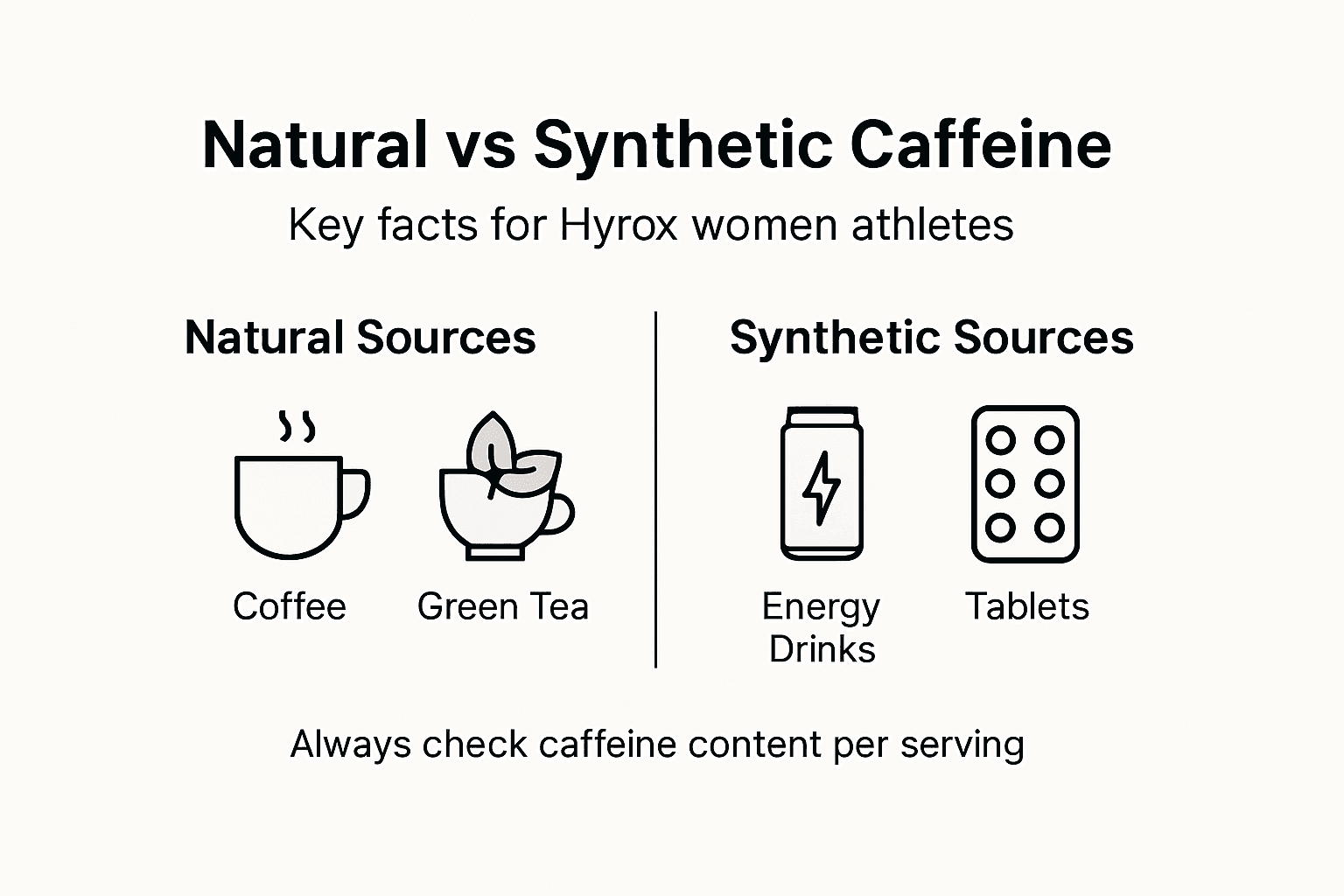
Understanding the nuanced differences between natural and synthetic caffeine is crucial for Hyrox women seeking optimal performance enhancement. While chemically identical at the molecular level, natural and synthetic caffeine demonstrate subtle yet significant variations in their origin, extraction, and potential physiological impacts.
The primary distinctions between natural and synthetic caffeine include:
- Source: Natural caffeine extracted from plants; synthetic caffeine manufactured in laboratories
- Extraction process: Natural caffeine involves plant-based extraction techniques
- Accompanying compounds: Natural sources contain additional bioactive molecules
- Manufacturing consistency: Synthetic caffeine offers more standardised concentration
- Metabolic interaction: Potential variations in absorption and physiological response
Natural caffeine contains complex phytonutrients that may modulate its metabolic effects, potentially offering a more holistic performance enhancement.
Synthetic caffeine, commonly used in energy drinks and supplements, is produced through chemical synthesis without the plant matrix. Laboratory extraction methods allow for precise caffeine isolation, ensuring consistent molecular structures across different batches. However, this process eliminates the additional plant-derived compounds found in natural sources.
For Hyrox athletes, the choice between natural and synthetic caffeine depends on individual metabolic responses, performance goals, and personal preferences. While both forms provide similar fundamental stimulant effects, the subtle nuances in bioactive compounds might influence energy release and overall athletic performance.
Pro tip: Experiment with both natural and synthetic caffeine sources to determine which provides the most consistent and effective performance enhancement for your unique physiological profile.
How Natural Caffeine Supports Performance
Natural caffeine emerges as a powerful performance enhancer for Hyrox women, offering a multifaceted approach to improving athletic capabilities. [Caffeine functions as an ergogenic aid that strategically impacts both physiological and psychological aspects of high-intensity training and competition.
The performance benefits of natural caffeine include:
- Central Nervous System Stimulation: Increases alertness and reduces perceived effort
- Endurance Enhancement: Improves aerobic and anaerobic performance
- Metabolic Activation: Supports cellular energy regulation
- Cognitive Focus: Sharpens mental clarity during intense workouts
- Recovery Support: Potentially aids post-exercise muscle recovery
Natural caffeine offers Hyrox athletes a holistic performance boost that extends beyond simple energy enhancement.
Recent scientific research reveals that caffeine’s impact goes deeper than immediate performance gains. Cellular energy regulation mechanisms demonstrate how caffeine activates AMPK, a critical metabolic sensor that improves stress responses and potentially supports long-term cellular health. This means natural caffeine doesn’t just provide a short-term energy spike, but may contribute to more resilient physiological adaptations.
For Hyrox women, understanding these nuanced performance benefits allows for more strategic caffeine consumption. The key lies in personalised approach, recognising that individual metabolic responses can vary significantly.
This table summarises performance benefits of natural caffeine for Hyrox athletes:
| Benefit Type | Effect on Athletes | Strategic Value for Training |
|---|---|---|
| Mental Focus | Improved concentration | Better technique under pressure |
| Metabolic Activation | Enhanced energy utilisation | Delayed fatigue during endurance |
| Recovery Support | Reduced post-exercise soreness | Faster turnaround between sessions |
| Endurance Boost | Increased physical output | More consistent race performance |
Pro tip: Experiment with natural caffeine intake timing and dosage during training to discover your optimal performance enhancement strategy.
Safe Use, UK Laws, and Recommended Intake
Understanding the regulatory landscape and safe consumption guidelines for natural caffeine is crucial for Hyrox women seeking optimal performance enhancement. UK food safety regulations provide clear guidelines to ensure responsible caffeine consumption across different population groups.
Key considerations for safe caffeine intake include:
- Daily Limit: Maximum 400 mg per day for healthy adults
- Pregnancy Restrictions: Reduced intake to 200 mg daily
- Individual Sensitivity: Metabolic responses vary between individuals
- Supplement Labelling: Accurate caffeine content disclosure required
- Potential Side Effects: Monitoring for adverse reactions
Responsible caffeine consumption requires understanding personal tolerance and adhering to established health guidelines.
The European Food Safety Authority (EFSA) recommends specific intake parameters that protect consumer health while allowing performance benefits. These guidelines account for variations in individual metabolism, age, and overall health status. Hyrox women should consider factors such as training intensity, body weight, and personal caffeine sensitivity when determining their optimal intake.
Beyond quantity, the timing and source of caffeine consumption play critical roles in maximising performance benefits while minimising potential negative impacts. Natural caffeine sources often provide more balanced and sustained energy release compared to synthetic alternatives.
Pro tip: Start with lower caffeine doses and gradually adjust, tracking your personal performance and physiological response to find your optimal intake level.
Risks, Side Effects, and Best Practices
Navigating the potential risks and side effects of caffeine consumption requires a nuanced understanding for Hyrox women seeking optimal performance. Food safety guidelines highlight critical considerations for responsible caffeine intake.
Potential side effects and risk factors include:
- Anxiety: Increased nervousness and jitteriness
- Sleep Disruption: Insomnia and reduced sleep quality
- Cardiovascular: Elevated heart rate and blood pressure
- Digestive Issues: Potential stomach discomfort and acid reflux
- Dehydration: Increased risk during high-intensity training
Individual caffeine sensitivity varies significantly, making personalised approach crucial for Hyrox athletes.
Complex physiological responses mean that caffeine’s impact differs dramatically between individuals. Some athletes may experience heightened performance benefits, while others might encounter more pronounced side effects. Factors such as genetic predisposition, overall health, and training intensity play significant roles in determining individual tolerance.
To minimise potential negative impacts, Hyrox women should adopt a strategic approach to caffeine consumption. This includes monitoring intake, understanding personal sensitivity, and timing caffeine consumption strategically around training and competition schedules.
Pro tip: Maintain a detailed caffeine intake journal to track your body’s unique responses and identify your personal optimal consumption strategy.
Boost Your Hyrox Performance with Natural Ingredients You Can Trust
Navigating the balance between energy, endurance, and recovery is a key challenge for Hyrox women. If you are seeking a natural caffeine boost that combines effective central nervous system stimulation with balanced metabolic activation and sustained energy release, then understanding your personal caffeine tolerance is just the beginning. Our naturally formulated pre-workout supplements at UseInterval are crafted specifically for high intensity athletes who demand clean, plant-based ingredients to support focus, performance, and recovery without the jittery side effects.
Experience the power of natural caffeine alongside vital electrolytes in our products designed to enhance your Hyrox training and competition. Start with a personalised approach to caffeine intake using our trusted supplements at UseInterval and discover how strategic natural nutrition can take your performance to the next level. Don’t wait to optimise your training regimen with scientifically-backed natural compounds. Visit UseInterval now to fuel your next workout with confidence and precision.
Frequently Asked Questions
What is natural caffeine and how does it enhance performance?
Natural caffeine is a stimulant derived from various plant sources, such as coffee beans, tea leaves, and cacao. It enhances performance by increasing energy, alertness, and reducing perceived effort during high-intensity training or competitions.
How does natural caffeine compare to synthetic caffeine?
While both natural and synthetic caffeine are chemically identical, natural caffeine is extracted from plant sources and contains additional bioactive compounds that may enhance its effects. Synthetic caffeine is manufactured in laboratories and lacks these accompanying phytonutrients.
What are the recommended limits for caffeine intake?
The maximum recommended caffeine intake for healthy adults is 400 mg per day, while pregnant individuals should limit their intake to 200 mg daily. It’s essential to consider individual sensitivity and metabolism when determining personal intake.
What are the potential side effects of natural caffeine?
Potential side effects of natural caffeine include anxiety, sleep disruption, elevated heart rate, digestive issues, and dehydration. Individual responses may vary, so it’s crucial to monitor personal tolerance and adjust intake accordingly.
Recommended
- Role of Nutrition in Hyrox – Boosting Female Performance – Interval
- Sports Nutrition: Enhancing High-Intensity Results – Interval
- Performance Nutrition for Hyrox – Unlocking Endurance & Recovery – Interval
- Pre-Workout Supplement Guide for Hyrox Female Athletes – Interval
- Suplimente Fitness pentru Femei – Protein4Life
- Biostarks | Nutrition