


Pre-event hydration guide: boost Hyrox performance
TL;DR:
- Proper hydration before Hyrox is crucial to prevent fatigue, decision-making issues, and slow recovery.
- The 24-hour pre-hydration routine with electrolytes and sodium significantly improves performance.
- Menstrual cycle phase influences hydration needs, making cycle tracking essential for female athletes.
You’ve trained hard, your kit is packed, and race day nerves are kicking in. But if you’re among the 40-50% of athletes who arrive at the start line already dehydrated, your preparation counts for far less than it should. For female Hyrox athletes aged 30 to 50, poor pre-event hydration doesn’t just slow you down. It causes early muscle fatigue, impairs decision-making, and drags out recovery. The good news is that evidence-based hydration strategies, tailored to your physiology, can meaningfully transform both your performance and how you feel crossing that finish line.
Table of Contents
- Understand your hydration needs as a female Hyrox athlete
- How to prepare: 24-hour pre-hydration strategy
- Morning of and immediate pre-event hydration routine
- Advanced strategies and troubleshooting for female athletes
- Our perspective: what most guides miss about pre-event hydration
- Next steps and hydration solutions for Hyrox athletes
- Frequently asked questions
Key Takeaways
| Point | Details |
|---|---|
| Pre-hydration timing crucial | Starting hydration 24 hours before a Hyrox event delivers greater performance benefits than race-day fixes. |
| Combine fluids and sodium | Balanced electrolyte and sodium intake prevents dehydration and optimises fluid absorption in competition. |
| Tailor to menstrual cycle | Adjusting hydration strategy around your cycle ensures more effective fluid retention and reduced sweat loss. |
| Monitor urine and body mass | Check urine colour and body weight for simple, reliable hydration status before race start. |
| Use hydrating foods and avoid caffeine | Incorporate water-rich foods and minimise caffeine excess to support steady hydration. |
Understand your hydration needs as a female Hyrox athlete
Hyrox is relentless. You’re running, rowing, sled pushing, and burpee broad jumping across a single session that can last anywhere from 60 to 120 minutes. That kind of sustained output means your body is under serious fluid stress from the very first minute. Understanding what your body actually needs, rather than guessing, is the first step to performing at your best.
Athletes lose 1-1.5 litres of fluid per hour during a Hyrox event, and the guidance is to replace 150% of that loss post-event (1.5 litres per kilogram of body weight lost). That’s a significant deficit to manage, which is why proactive pre-loading matters so much more than reactive drinking.
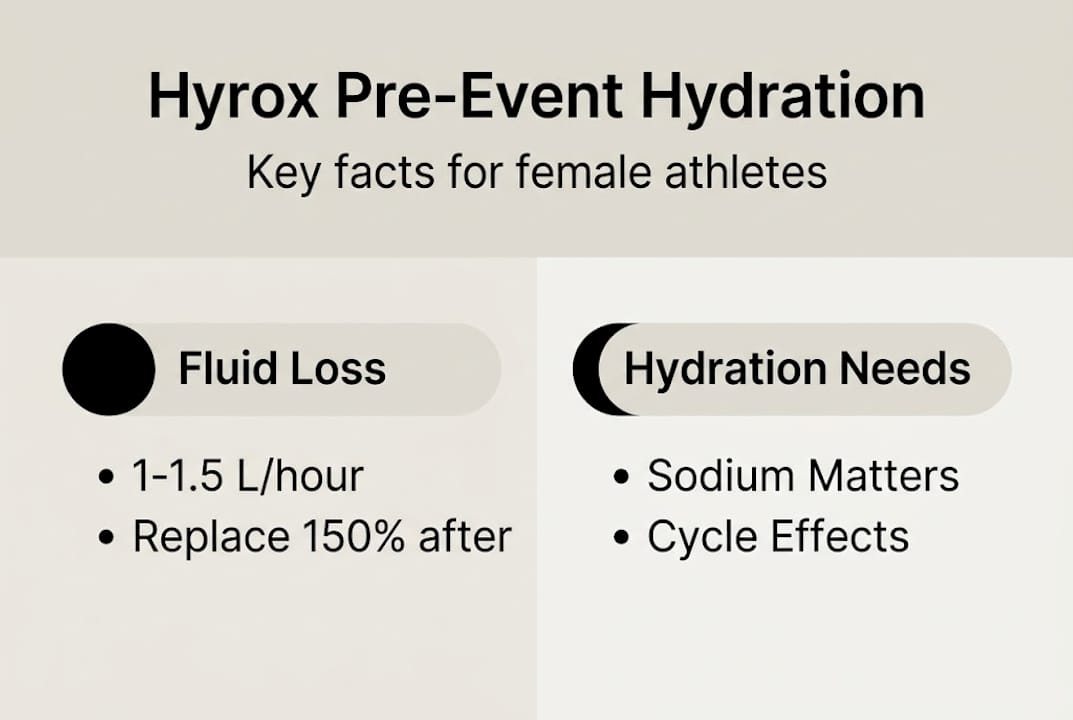
For women aged 30 to 50, there’s an additional layer of complexity. Menstrual cycle phase affects hydration responses, and sodium hyperhydration is particularly effective for this group. Hormonal fluctuations across the cycle influence how your body retains fluid, responds to sodium, and regulates sweat rate. This isn’t a minor variable. It can meaningfully shift how much you need to drink and when.
| Metric | Typical range | Replacement target |
|---|---|---|
| Fluid loss per hour | 1.0 to 1.5 litres | 150% of loss post-event |
| Sodium loss per hour | 500 to 1,000 mg | 500 to 800 mg per litre of fluid |
| Body mass loss (acceptable) | Up to 2% | Aim to limit to under 2% |
| Urine colour target | Pale yellow | Pale yellow at start |
Cycle-related hydration nuances to keep in mind:
- Luteal phase: Core body temperature rises, increasing sweat rate and fluid demand.
- Follicular phase: Sodium hyperhydration tends to produce greater body mass reduction benefits.
- Peri-menopause: Hormonal variability can make sweat responses less predictable; consistent preloading becomes even more important.
- Sodium sensitivity: Women in this age group may be more responsive to sodium-based strategies than plain water approaches.
Pro Tip: Keep a simple cycle tracking note alongside your training log. Even rough phase awareness helps you adjust fluid and sodium intake in the days before a competition.
For a full breakdown of what to prioritise before race day, the female Hyrox athlete checklist covers the key preparation steps in one place. You can also find structured guidance on workout prep for Hyrox to build this into your wider routine.
How to prepare: 24-hour pre-hydration strategy
Now that you understand your needs, here’s how to proactively prepare your body for peak performance. The 24 hours before a Hyrox event are arguably more important than what you drink on race morning. Your tissues, blood plasma, and cells need time to absorb and retain fluid properly. Rushing it on the day is too late.
The target is 35 to 45 ml of water per kilogram of body weight across the day prior, with 500 to 800 mg of sodium added per litre of fluid. For a 65 kg athlete, that’s roughly 2.3 to 2.9 litres of fluid, spread across the day, not consumed in one sitting.

| Strategy | Plain water only | Electrolyte approach |
|---|---|---|
| Fluid retention | Lower | Significantly higher |
| Sodium balance | Unaddressed | Actively managed |
| Risk of over-dilution | Higher | Lower |
| Performance impact | Moderate | Measurably better |
| Ease of implementation | Simple | Requires planning |
Your step-by-step pre-hydration routine for the day before:
- Morning: Start with 500 ml of water plus electrolytes as soon as you wake. Include sodium-rich foods at breakfast such as eggs or smoked salmon.
- Mid-morning: Continue sipping fluids steadily. Aim for another 500 to 700 ml by late morning.
- Lunch: Include hydrating foods. Cucumber, melon, and oranges are excellent choices, providing both water and natural electrolytes.
- Afternoon: Avoid excessive caffeine or alcohol. Both act as diuretics and will undermine your preloading effort.
- Evening meal: Keep sodium intake moderate but present. A light, well-salted meal with vegetables supports overnight fluid retention.
- Before bed: Consume 400 to 500 ml of a strong electrolyte drink to support overnight balance.
Pro Tip: Avoid alcohol entirely the night before a Hyrox event. Even one or two drinks can increase urine output significantly and leave you starting race day already behind on fluids.
Understanding your electrolyte needs for performance gives you a clearer picture of why sodium matters so much beyond just drinking more water. If you want faster uptake, rapid absorption electrolytes can make a practical difference to how quickly your body responds to preloading.
Morning of and immediate pre-event hydration routine
Now that your body is primed, here’s how to execute the morning routine for maximum performance. Race morning isn’t the time to experiment. Stick to a clear, timed plan that matches what you’ve practised in training.
Following ACSM-aligned guidance, the recommended fluid targets are:
- Four hours before start: Drink 5 to 7 ml per kilogram of body weight. For a 65 kg athlete, that’s roughly 325 to 455 ml.
- Two to three hours before start: Top up with 500 to 600 ml, ideally with electrolytes included.
- Ten to twenty minutes before start: Take a final 200 to 300 ml of fluid to top off without causing discomfort.
“Consuming adequate fluid in the hours before exercise, rather than trying to catch up during it, is one of the most consistently supported performance strategies in sports science.” ACSM hydration facts
Readiness signals to check before you step up to the start:
- Urine colour: Aim for pale yellow. Dark urine means you’re behind. Clear urine may indicate over-hydration.
- Thirst: Mild thirst is acceptable. Significant thirst at the start line is a warning sign.
- Body mass: If you weighed yourself the morning before, a drop of more than 1% suggests inadequate preloading.
Common mistakes to avoid on race morning:
- Chugging large volumes of plain water in one go, which can dilute sodium levels rapidly.
- Skipping electrolytes entirely and relying solely on water.
- Drinking nothing until you feel thirsty, by which point performance is already affected.
- Trying a new electrolyte product on race day that your gut hasn’t encountered in training.
Key stat: Pale yellow urine at the start line is one of the simplest and most reliable indicators that your pre-event hydration has worked.
For more on timing your intake correctly, pre-event timing tips and pre-event nutrition tips are worth reading alongside this guide.
Advanced strategies and troubleshooting for female athletes
For those wanting an extra edge or to fix mistakes quickly, these advanced strategies make all the difference. Even with the best intentions, things don’t always go to plan. Here’s how to handle the most common scenarios.
Sodium hyperhydration reduces sweat rate and body mass loss during events, and cycle phase influences how well it works. Specifically, early-follicular phase tends to produce greater body mass reduction benefits with sodium loading, making it a particularly effective window to practise this strategy.
Troubleshooting common scenarios:
- GI distress from electrolytes: Switch to a lower-concentration product or dilute further. Consume with food rather than on an empty stomach.
- Missed preloading the night before: Increase fluid and sodium intake at breakfast, but don’t overcompensate with huge volumes in a short window.
- Cycle fluctuations causing unpredictable thirst: Track your phase and adjust sodium upward during the luteal phase when sweat rate tends to be higher.
- Bloating from over-drinking: Reduce volume and increase electrolyte concentration so you retain more from less fluid.
- Arriving at the venue already thirsty: Sip steadily with electrolytes for the next hour rather than drinking large amounts quickly.
Pro Tip: Use a high-strength electrolyte product like PH 1500 for your night-before preloading session. The elevated sodium content supports overnight fluid retention far more effectively than standard sports drinks.
“Milk consumed post-event outperforms plain water for rehydration due to its protein, sodium, and lactose content, which slow gastric emptying and improve net fluid retention.”
Monitoring your hydration status doesn’t require expensive kit. Urine colour, morning body mass, and how thirsty you feel upon waking are three practical, free signals that tell you a great deal about where you stand. Build the habit of checking all three in the days before a competition.
For deeper reading on managing fluids across longer efforts, electrolytes for endurance is a useful next step. You’ll also find practical ideas in natural pre-workout strategies that complement a solid hydration plan.
Our perspective: what most guides miss about pre-event hydration
Most mainstream hydration guides focus almost entirely on what to drink on race morning. That’s understandable. It’s the most visible part of the process. But in our experience, it’s also where the advice is least useful, because by race morning, the window for meaningful change has largely closed.
The athletes who perform most consistently are those who treat the 24 hours before an event as the real hydration window. They’re not scrambling with a bottle at the start line. They’ve already done the work.
What’s also consistently overlooked is the hormonal dimension for female athletes. Cycle phase isn’t a minor footnote. It actively changes how your body responds to sodium, how much you sweat, and how effectively you retain fluid. Ignoring it means leaving a genuine performance variable unmanaged.
Consistent sodium preloading, timed to your cycle, delivers measurably better outcomes than any last-minute fix. We’ve seen this reflected in how athletes feel during and after events when they take this approach seriously.
“The textbook says drink water. Experience says know your sodium, know your cycle, and start two days out.”
For more on sustaining performance across a full event, rehydration for Hyrox endurance is worth your time.
Next steps and hydration solutions for Hyrox athletes
With the strategies covered, here’s how you can take the next step in your hydration journey with practical support.
If you’re ready to put this into practice, Interval’s hydration Starter Bundle is designed specifically for athletes like you. It brings together natural-ingredient electrolytes formulated for high-intensity output, giving you a simple starting point for the pre-loading routine outlined in this guide.
You don’t need to overhaul everything at once. Start with the 24-hour preloading strategy and track how you feel on race day. The difference is often noticeable from the first event. Explore the full range of Interval hydration resources to find the products and guides that fit your training schedule and goals.
Frequently asked questions
How do I know if I’m hydrated enough before a Hyrox event?
Urine colour, thirst, and body mass are your most reliable readiness signals. Aim for pale yellow urine, no significant thirst, and a stable body weight compared to the previous morning.
Is sodium hyperhydration safe for women aged 30-50?
When dosed correctly, sodium hyperhydration is safe and improves fluid retention. Cycle phase influences response, with early-follicular phase typically producing the strongest results, so tracking your cycle adds an extra layer of precision.
Should I preload with electrolytes the night before Hyrox if I sweat heavily?
Yes. Consuming 400 to 500 ml of a strong electrolyte drink before bed supports overnight fluid and sodium balance. Night-before loading with PH 1500 is a practical and effective approach for heavy sweaters.
What hydrating foods help most before a Hyrox event?
Cucumber, melon, and oranges are particularly useful in the 24 hours before competition. They contribute both water and natural electrolytes without adding unnecessary bulk to your digestive system.
How does my menstrual cycle affect hydration needs for Hyrox?
Cycle phase affects body mass loss and sweat rate, meaning your sodium and fluid requirements genuinely shift across the month. Tracking your cycle and adjusting your preloading strategy accordingly gives you a meaningful performance advantage.
Recommended
- Step by Step Workout Prep for Hyrox Athletes UK – Interval
- Natural Performance Enhancement Steps for Hyrox Athletes – Interval
- Why Hyrox Athletes Need Electrolytes for Performance – Interval
- 7 Essential Pre-Workout Nutrition Tips for Hyrox Athletes – Interval
- Evidence of Cordyceps For High-Intensity Endurance Performance – LongevityBotanicals