


Role of amino blends for Hyrox athletes: 2026 guide
TL;DR:
- Amino blends support muscle repair, reduce fatigue, and improve athletic performance through multiple physiological pathways.
- They outperform single amino acids by sustaining muscle protein synthesis, promoting blood flow, and enhancing recovery during high-intensity training.
Amino blends are combinations of essential amino acids formulated to support muscle repair, reduce fatigue, and improve athletic performance. For Hyrox athletes aged 30–50, the role of amino blends goes well beyond basic recovery. These formulations bring together amino acids like Leucine, Isoleucine, Valine, Arginine, and Citrulline, each targeting a specific physiological process. Where a single amino acid hits one pathway, a well-designed blend hits several at once. That synergy is what separates a good supplement from a genuinely useful one.
What are the benefits of amino blends over single amino acids?
Amino blends outperform isolated amino acids because they work across multiple recovery and performance pathways simultaneously. A single amino acid like Leucine can trigger muscle protein synthesis, but it cannot sustain it. BCAAs act as the ignition key for muscle synthesis but require the complete set of essential amino acids to keep that process running. That distinction matters enormously for Hyrox athletes completing back-to-back training blocks.
Full essential amino acid blends also protect against muscle breakdown in a way that BCAAs alone cannot. When your training volume is high and calorie intake is tight, the body will cannibalise muscle tissue for fuel. A complete blend provides the substrate needed to prevent that. Amino acid supplementation supports muscle repair and delays fatigue, particularly for those with intense training demands.
Whole food protein sources like chicken, eggs, and Greek yoghurt remain the foundation of any athlete’s diet. Supplements do not replace them. The practical advantage of amino blends is speed and precision. A powder or drink delivers targeted amino acids into the bloodstream faster than digesting a chicken breast, which matters when you have 45 minutes between a morning session and work.
Comparison: amino blends vs. single amino acids vs. whole protein
| Source | Muscle protein synthesis | Absorption speed | Fatigue reduction |
|---|---|---|---|
| Single BCAAs | Initiates but does not sustain | Fast | Moderate |
| Full EAA blend | Initiates and sustains | Fast | Strong |
| Whole food protein | Sustained | Slow | Strong |
| Whey protein isolate | Sustained | Moderate | Strong |
- Full EAA blends sustain muscle protein synthesis where BCAAs alone fall short.
- Amino blends deliver targeted amino acids faster than whole food digestion.
- Synergistic blends including BCAAs with Arginine and Methionine clear metabolic waste more effectively than BCAAs alone.
- Whole food protein remains the dietary base. Blends fill the gaps around training.
Pro Tip: If you are already hitting 1.6–2.2g of protein per kilogram of body weight through food, a full EAA blend around training adds more value than a standalone BCAA product.
How do amino blends work to enhance performance and recovery?
The physiological mechanisms behind amino blends are specific and well-documented. Leucine directly activates the mTOR pathway, the primary signal for muscle protein synthesis. Without adequate Leucine, the anabolic signal is weak regardless of total protein intake. A complete blend ensures Leucine is present alongside the other essential amino acids needed to build and repair tissue.

Arginine and Citrulline operate through a different but equally important route. Both amino acids drive nitric oxide production, which widens blood vessels and increases blood flow to working muscles. Synergistic amino blends improve nitric oxide and muscle recovery in clinical and athletic settings. For a Hyrox athlete running 1km intervals between sled pushes and ski ergs, that improved blood flow translates directly to sustained output.
The metabolic benefits extend further. Specific EAA blends increase GLUT4 protein levels and improve glucose uptake in muscle cells, with over 50% intestinal absorption efficiency. Higher glucose uptake means muscles refuel faster during and after effort. That is the difference between recovering in 24 hours and recovering in 48.
Fatigue reduction is the third major mechanism. Amino blends combined with antioxidants activate pathways that accelerate lactate clearance and improve mitochondrial biogenesis. More mitochondria means more energy production capacity per muscle cell. For endurance athletes, that is a structural adaptation worth pursuing.
The key physiological pathways amino blends activate:
- mTOR activation via Leucine, initiating muscle protein synthesis after training.
- Nitric oxide production via Arginine and Citrulline, improving blood flow and oxygen delivery.
- GLUT4 upregulation, increasing glucose uptake and muscle glycogen replenishment.
- NRF2/PGC-1α pathway activation, enhancing lactate clearance and mitochondrial growth.
- Antioxidant defence, reducing oxidative stress from high-intensity training.
What are the best amino blends for Hyrox athletes?
Hyrox demands both strength and endurance across eight functional stations. No single amino acid covers that range. The most effective blends for this format combine BCAAs for muscle synthesis, Citrulline malate for power output, Arginine for blood flow, and Proline and Lysine for connective tissue repair.
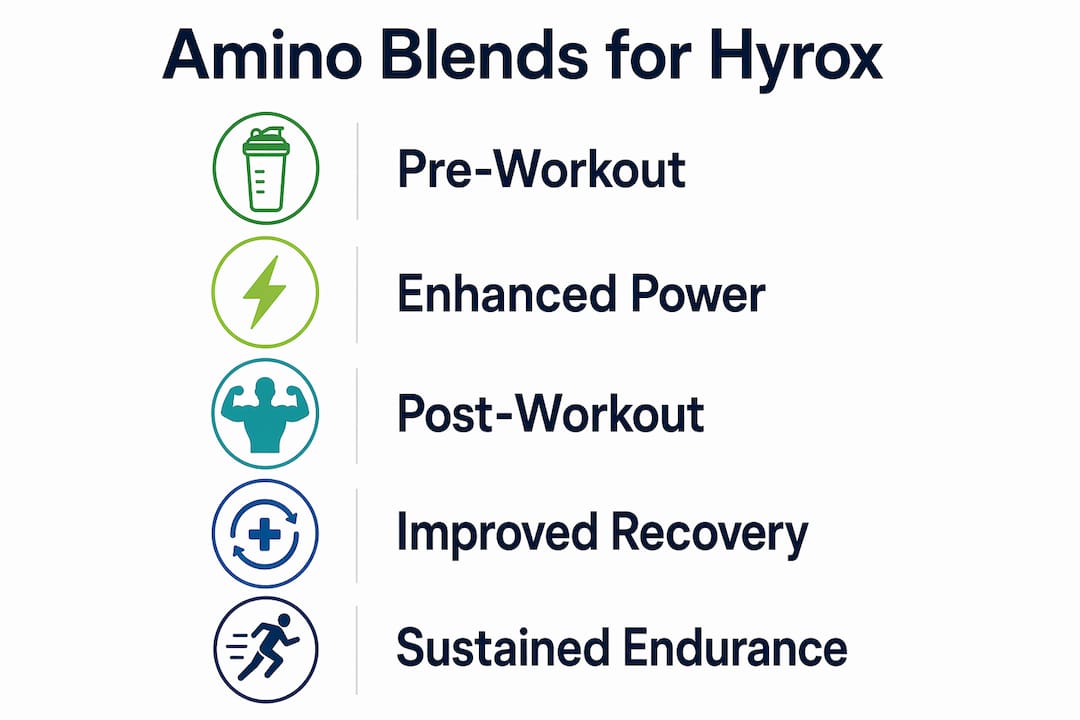
Acute supplementation with 8g citrulline malate and 6g L-arginine one hour before exercise improves peak power and agility in trained athletes. That combination is particularly relevant for the explosive demands of Hyrox wall balls, burpee broad jumps, and sled pushes. The nitric oxide boost from this pairing sustains muscular output when fatigue would otherwise cause a drop in pace.
For muscle recovery between sessions, a full EAA blend post-workout is more effective than BCAAs alone. Proline and Lysine support collagen synthesis, which matters for tendons and ligaments under repeated loading. Athletes over 35 in particular benefit from this, as connective tissue repair slows with age.
Key amino acids and their roles for Hyrox athletes:
- Leucine, Isoleucine, Valine (BCAAs): Initiate muscle protein synthesis and reduce muscle soreness.
- L-Arginine: Drives nitric oxide production for improved blood flow and power output.
- Citrulline malate: Extends the nitric oxide effect and delays muscular fatigue. Read more on citrulline malate and Hyrox performance.
- Proline and Lysine: Support collagen production for tendon and ligament repair.
- Glutamine (Gln) and Cysteine (Cys): Reduce oxidative stress and support immune function during heavy training blocks.
Pro Tip: Take 8g citrulline malate combined with 6g L-arginine 60 minutes before your Hyrox session. Post-session, switch to a full EAA blend to sustain muscle protein synthesis through the recovery window.
How should Hyrox athletes integrate amino blends into their nutrition plan?
Timing is the variable most athletes get wrong. Amino blends are most effective when taken around training, not as a general daily supplement taken at random. The pre-workout window (60–90 minutes before) suits Citrulline malate and Arginine. The post-workout window (within 30–60 minutes after) suits full EAA blends to drive muscle repair.
Athletes should consume 5–10g BCAAs around workouts and maintain 1.6–2.2g of protein per kilogram of body weight daily for optimal muscle growth during intense training. That protein target is the foundation. Amino blends fill the gaps that whole food cannot cover quickly enough around sessions.
Practical integration steps for Hyrox athletes:
- Audit your protein intake first. If you are consistently hitting 1.6–2.2g/kg through food, your baseline is solid. Blends then serve as precision tools around training.
- Choose the right form. Powders mixed into water are the most practical for pre and post-workout use. Drinks with electrolytes suit intra-workout use during longer sessions.
- Prioritise quality. Look for blends with transparent labelling, no proprietary blends that hide individual doses, and third-party testing.
- Monitor your response. Track soreness, sleep quality, and performance across a four-week block. Adjust dosing based on real feedback from your body.
Amino acid supplements should complement a protein-rich diet, not replace it. Athletes who already eat well gain the most from targeted blends around training. Those with poor dietary habits gain less, because the foundational deficit is too large for supplements to overcome. Overuse beyond dietary protein needs can stress kidneys through nitrogen waste, particularly in those with existing renal concerns.
Pro Tip: If you train twice a day, prioritise your EAA blend after the first session. That window is where muscle breakdown risk is highest and where a targeted blend delivers the most return.
Key takeaways
Amino blends work because they target multiple recovery and performance pathways simultaneously, making them significantly more effective than single amino acids for high-intensity athletes.
| Point | Details |
|---|---|
| Blends beat single amino acids | Full EAA blends sustain muscle protein synthesis where BCAAs alone cannot. |
| Timing drives results | Take Citrulline malate and Arginine pre-workout; full EAAs post-workout. |
| Citrulline malate and Arginine combo | 8g citrulline malate plus 6g L-arginine one hour pre-session improves power and agility. |
| Diet comes first | Blends complement a 1.6–2.2g/kg daily protein intake; they do not replace it. |
| Overuse carries risk | Excess amino acid intake increases nitrogen load, relevant for those with kidney concerns. |
What I have learned from using amino blends in high-intensity training
Most athletes approach amino blends the same way they approach protein powder: more is better, timing is optional, and the label does the work. That thinking costs results.
The biggest shift I made was treating amino blends as precision tools rather than insurance policies. Citrulline malate and Arginine before a hard session genuinely change how the back half of a workout feels. The drop-off in power output that normally hits around station five in a Hyrox race is measurably smaller when nitric oxide production is primed. That is not a placebo. It is blood flow.
The second thing I learned is that BCAAs alone are overrated for anyone eating enough protein. The research is clear: BCAAs start the process but cannot finish it. A full EAA blend costs a little more and delivers substantially more for muscle repair. For athletes over 35, where recovery is the limiting factor more often than fitness, that distinction is worth paying for.
The third lesson is patience. Amino blends do not produce overnight transformations. The mitochondrial adaptations and connective tissue support from Proline and Lysine build over weeks. Athletes who assess their response across a four-week block get accurate data. Those who quit after ten days get nothing useful.
Use blends intelligently, keep your diet solid, and treat supplementation as the final layer of a well-built training plan. That approach works. The shortcut version rarely does.
— Tom
Useinterval’s Starter Bundle for Hyrox athletes
Useinterval builds supplements specifically for high-intensity athletes who want natural ingredients without compromise. The Starter Bundle brings together pre-workout and electrolyte formulations designed to support the amino acid and energy demands of Hyrox training.
The Starter Bundle is formulated for athletes who train hard and recover harder. It pairs naturally with the amino blend principles covered here, giving you the pre-session and recovery support your training demands. If you are serious about natural performance gains through evidence-backed supplementation, the Starter Bundle is a practical starting point.
FAQ
What is the role of amino blends in muscle recovery?
Amino blends supply the full range of essential amino acids needed to repair muscle tissue after training. Full EAA blends sustain muscle protein synthesis and reduce soreness more effectively than BCAAs alone.
How do amino blends work differently from protein powder?
Amino blends deliver free-form amino acids that absorb faster than digested protein. They target specific pathways like nitric oxide production and glucose uptake that whole protein sources do not address as directly.
What are the best amino blends for Hyrox athletes?
The most effective combinations for Hyrox include BCAAs for muscle synthesis, Citrulline malate and L-Arginine for blood flow and power output, and Proline and Lysine for connective tissue repair. Taking 8g citrulline malate with 6g L-arginine one hour before training improves peak power and agility.
When should Hyrox athletes take amino blends?
Take Citrulline malate and Arginine 60–90 minutes before training. Use a full EAA blend within 30–60 minutes after training to drive muscle repair during the recovery window.
Are amino blends safe for daily use?
Amino blends are safe for most healthy athletes when used at recommended doses. Excess intake beyond dietary protein needs increases nitrogen waste and can stress kidneys, particularly in those with existing renal conditions.