


The role of beetroot in exercise: 2026 guide
TL;DR:
- Beetroot is a natural source of dietary nitrate that enhances nitric oxide production, improving blood flow, oxygen efficiency, and recovery for endurance and high-intensity sports. Its benefits are maximized when taken 2-3 hours before exercise, with doses between 300-500 mg nitrate, and when oral bacteria are preserved by avoiding antibacterial mouthwash. While most effective for endurance athletes, beetroot offers little advantage for maximal strength training if not used with proper timing and protocol.
Beetroot is defined as one of the most effective natural sources of dietary nitrate available to athletes, and its role in exercise is to drive nitric oxide production that improves oxygen delivery, reduces the metabolic cost of effort, and sharpens muscular efficiency. Research published in 2026 confirms that nitrate enhances vasodilation and lowers the oxygen cost of submaximal exercise, making beetroot one of the few whole-food ergogenic aids with consistent scientific backing. Whether you are a recreational runner or a competitive footballer, understanding how beetroot works mechanically will help you use it with precision rather than guesswork.
How does beetroot improve exercise performance?
The mechanism behind beetroot’s ergogenic effect is the nitrate–nitrite–nitric oxide pathway. When you consume dietary nitrate from beetroot, bacteria on the tongue reduce it to nitrite, which the body then converts to nitric oxide under low-oxygen conditions. Nitric oxide causes blood vessels to dilate, increasing blood flow and oxygen delivery to working muscles. This is why beetroot’s effect on endurance is stronger than its effect on maximal strength. More oxygen reaching active muscle fibres means less metabolic strain per unit of effort.
Beyond vasodilation, nitric oxide also improves mitochondrial efficiency. It reduces the amount of oxygen each mitochondrion needs to produce a given quantity of ATP, which directly lowers the oxygen cost of sustained effort. Studies report submaximal oxygen cost reductions of 1.5 to 5.0%, with time-to-exhaustion improving by roughly 15.7% in recreational athletes. That is not a marginal gain. For a 40-minute threshold run, a 5% reduction in oxygen cost translates to a meaningfully lower heart rate or a faster pace at the same perceived effort.
There is also an effect on muscle fibre contractility. Nitric oxide modulates calcium handling within fast-twitch fibres, which may explain why some studies observe improvements in short, repeated high-intensity efforts, not just prolonged aerobic work. The enterosalivary cycle, where nitrate is swallowed, absorbed, secreted in saliva, and reduced by oral bacteria, is the critical bottleneck. Disrupt that cycle and the whole pathway stalls.
Pro Tip: Avoid using antibacterial mouthwash on the day you train with beetroot. The oral microbiome is responsible for converting nitrate to nitrite, and killing those bacteria with mouthwash can blunt the ergogenic effect entirely.
Key physiological effects of dietary nitrate from beetroot:
- Vasodilation via nitric oxide, improving muscle blood flow
- Reduced oxygen cost of submaximal exercise (1.5 to 5.0%)
- Improved mitochondrial efficiency and ATP production per oxygen molecule
- Enhanced calcium handling in fast-twitch muscle fibres
- Facilitated phosphocreatine resynthesis during recovery intervals
Which athletes benefit most from beetroot supplementation?
The honest answer is that beetroot benefits for athletes vary considerably depending on training status, sport type, and individual physiology. The clearest and most consistent gains appear in aerobic and endurance-based activities. Cyclists, distance runners, rowers, and triathletes regularly show measurable improvements in time trials and time-to-exhaustion tests following nitrate supplementation. The underlying reason is straightforward. Endurance sport is oxygen-dependent, and anything that improves oxygen delivery efficiency produces a direct performance dividend.
The picture changes for strength-based training. A controlled study found that nitrate supplementation at 400 mg before resistance training showed no significant improvement in repetitions to failure, mean power, or peak power during bench press and leg press at 80% of one-repetition maximum. Maximal strength and hypertrophy work are not primarily limited by oxygen delivery. They are limited by neuromuscular output and mechanical load tolerance, neither of which nitric oxide addresses directly.
The table below summarises the current evidence by athlete type and training modality.
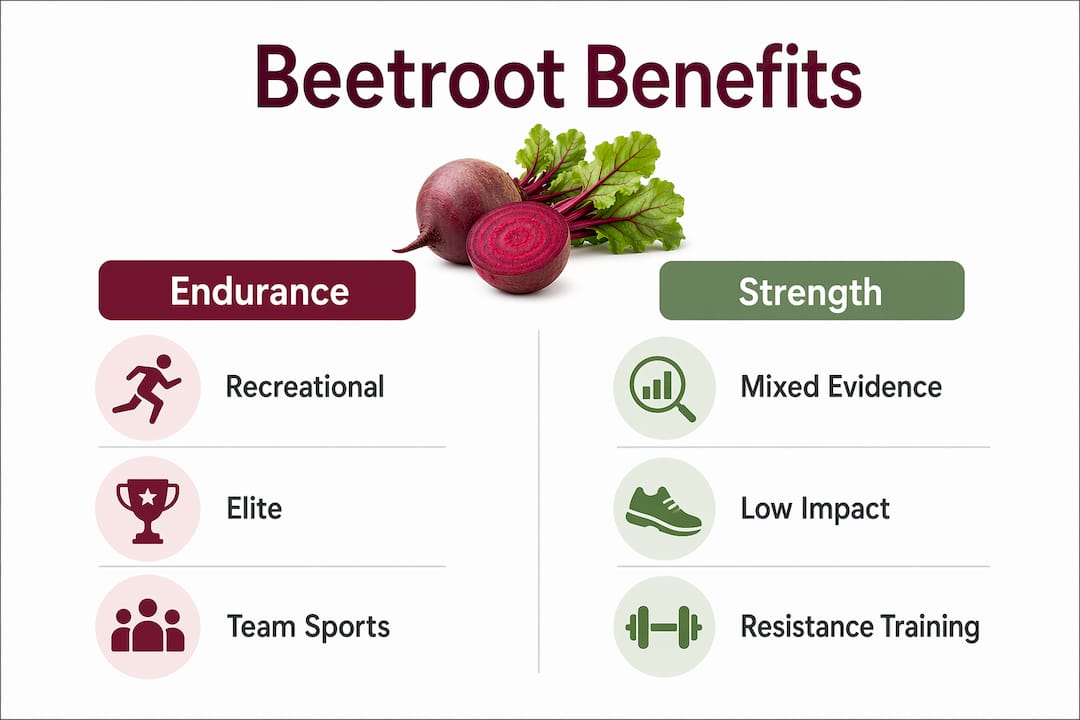
| Athlete type | Training modality | Expected benefit | Notes |
|---|---|---|---|
| Recreational endurance athlete | Aerobic, submaximal | High | Largest oxygen cost reductions observed |
| Competitive cyclist or runner | Aerobic, threshold | Moderate to high | Chronic loading recommended |
| Team sport athlete (football, rugby) | Intermittent sprint | Moderate | Agility and cognitive gains post-sprint |
| Strength or powerlifting athlete | Maximal resistance | Low | No significant effect on 1RM or repetitions |
| Elite endurance athlete | Aerobic, high intensity | Moderate (with loading) | Ceiling effect requires multi-day protocol |
Elite athletes present a specific challenge. Higher baseline nitric oxide levels create a ceiling effect, meaning a single acute dose often produces little measurable change. Chronic nitrate loading over three to seven days at doses above 8 mmol per day is what consistently moves the needle in trained individuals. Recreational athletes, by contrast, typically respond well to acute dosing because their baseline nitric oxide status is lower and the relative improvement is larger.
What does the evidence say about recovery and high-intensity efforts?
Recovery is an underappreciated area of beetroot research. A study on trained male football players found that acute beetroot juice supplementation increased peak and mean anaerobic power output and accelerated post-exercise muscle reoxygenation following a 30-second Wingate test, without affecting heart rate or blood pressure. Faster muscle reoxygenation matters enormously in repeated-sprint sports. If your muscles recover oxygen saturation more quickly between efforts, your second and third sprint are closer in quality to your first.
The cognitive dimension is equally striking. A study involving 21 male soccer players found that beetroot juice improved choice response time and change-of-direction speed immediately after repeated maximal sprinting, even though simple response time remained unchanged. Choice response time reflects decision-making under fatigue, which is precisely what degrades in the final 20 minutes of a football match. The fact that a 70 mL dose of beetroot juice preserved that capacity post-sprint is a genuinely useful finding for team sport athletes.
Here is a summary of the key recovery and high-intensity findings:
- Post-exercise muscle reoxygenation was faster in football players supplemented with beetroot juice compared to placebo following maximal sprint efforts.
- Choice response time and change-of-direction speed improved after acute beetroot intake in soccer players, suggesting cognitive and neuromuscular benefits under fatigue.
- Phosphocreatine resynthesis during recovery intervals may be facilitated by nitric oxide, supporting repeated high-intensity efforts in sports like rugby, basketball, and hockey.
- Simple response time showed no significant improvement, indicating that beetroot’s cognitive benefits are specific to complex, decision-based tasks rather than pure reaction speed.
- Strength-endurance protocols, such as multiple sets at 80% of one-repetition maximum, showed negligible effects from nitrate supplementation, confirming that resistance training is not the primary application.
How should you optimise beetroot supplementation for best results?
Dosing and timing are where most athletes leave performance on the table. A 2026 dose-response study found that plasma nitrate increased across 200, 400, and 800 mg doses, but endothelial function only improved at 400 mg and systolic blood pressure only dropped at 800 mg, both peaking around 2.5 hours after ingestion. This tells you two things. First, different physiological endpoints respond to different doses. Second, timing your intake two to three hours before training is not arbitrary. It aligns with the peak conversion window.

For most recreational athletes, a single acute dose of 300 to 500 mg of dietary nitrate, roughly equivalent to 500 mL of concentrated beetroot juice or a standardised beetroot powder, is sufficient to produce measurable effects. Elite athletes training at high volumes should consider a three to seven day loading protocol to overcome the ceiling effect. The inter-individual variability in response is real and influenced by your oral microbiome, training status, and baseline nitric oxide levels, so tracking your own response over several sessions is worth doing.
Practical guidelines for optimising beetroot supplementation:
- Timing: Take your dose two to three hours before training or competition to align with peak plasma nitrate conversion.
- Dose: Aim for 300 to 500 mg nitrate for acute use. Elite athletes should load at above 8 mmol per day for three to seven days.
- Oral hygiene: Skip antibacterial mouthwash on training days. It disrupts the enterosalivary cycle and reduces nitric oxide availability.
- Format: Concentrated beetroot juice, standardised powder, or capsules all work. Whole beetroot is less reliable due to variable nitrate content by batch.
- Sport matching: Prioritise beetroot for endurance sessions, interval training, and team sport match days. It is less relevant for pure strength days.
Pro Tip: If you want to understand how dietary nitrate works at a mechanistic level before committing to a supplementation protocol, reading the underlying science will help you set realistic expectations and avoid wasting money on poorly timed doses.
Key takeaways
Beetroot improves exercise performance through dietary nitrate driving nitric oxide production, with the strongest and most consistent benefits in endurance, aerobic, and high-intensity intermittent sports.
| Point | Details |
|---|---|
| Core mechanism | Nitrate converts to nitric oxide, reducing oxygen cost and improving blood flow to muscles. |
| Best application | Endurance and intermittent sprint sports show the clearest gains; strength training shows little benefit. |
| Dosing strategy | 300 to 500 mg nitrate acutely; elite athletes need three to seven days of chronic loading. |
| Timing matters | Take two to three hours before exercise to align with peak plasma nitrate conversion. |
| Oral microbiome | Avoid antibacterial mouthwash on training days to preserve nitrate-reducing bacteria in the mouth. |
Why I think most athletes are using beetroot wrong
Tom here. After years of working with athletes across endurance and team sports, the pattern I see most often is this: someone buys beetroot juice, drinks it 20 minutes before a session, gets no noticeable effect, and concludes it does not work. The problem is not the beetroot. It is the protocol.
The two-to-three-hour timing window is non-negotiable, and the mouthwash issue is genuinely underappreciated. I have spoken to competitive cyclists who use antibacterial mouthwash every morning out of habit, then wonder why their nitrate supplementation produces nothing. The oral bacteria responsible for nitrate reduction are the same ones that get wiped out by standard antiseptic rinses. You cannot have it both ways.
I also think the responder variability conversation needs more airtime. Not everyone responds equally to dietary nitrate, and that is not a failure of the supplement. It reflects differences in baseline nitric oxide status, gut microbiome composition, and training adaptation. The athletes I have seen get the most from beetroot are recreational to intermediate level, training four to six times per week, doing a mix of aerobic and interval work. They are not elite enough to have a ceiling problem, and they are fit enough for the oxygen efficiency gains to translate into real performance differences.
My honest recommendation: treat beetroot as part of a broader nutritional strategy, not a standalone fix. Pair it with consistent training, adequate carbohydrate fuelling, and proper recovery. Use it strategically for your hardest sessions and race days. Track your response over four to six weeks before drawing conclusions. And for team sport athletes, the agility and cognitive benefits post-sprint are worth taking seriously. That is an area where the evidence is newer and less discussed, but the practical implications are significant.
— Tom
Ready to put this into practice with Useinterval?
If you train hard and want a supplement protocol built around the science covered in this article, the Useinterval Starter Bundle is the logical starting point. It combines a beetroot-derived nitrate pre-workout with electrolytes formulated for high-intensity output, covering both the performance and hydration demands of serious training.
The bundle is designed for athletes who train four or more times per week and want natural ingredients with a clear mechanistic rationale. Every product in the range is built around the same principle: use what the research actually supports, at the doses that work, timed correctly. If you want to explore the full science behind the formulations, the Useinterval journal covers the latest findings on nitrate, electrolytes, and recovery in plain language.
FAQ
How much beetroot juice should I drink before a workout?
A dose of 300 to 500 mg of dietary nitrate, roughly 500 mL of concentrated beetroot juice, is effective for most recreational athletes. Take it two to three hours before exercise to align with peak plasma nitrate conversion.
Does beetroot improve strength training performance?
Current evidence suggests it does not. Studies using approximately 400 mg of nitrate before resistance training found no significant improvement in repetitions to failure or power output during bench press and leg press at 80% of one-repetition maximum.
Why does antibacterial mouthwash reduce beetroot’s benefits?
Antibacterial mouthwash kills the oral bacteria responsible for converting dietary nitrate to nitrite, which is the first step in producing nitric oxide. Without this conversion, the ergogenic pathway is blocked and the nitrate-to-nitrite conversion cannot proceed effectively.
Do elite athletes benefit from beetroot supplementation?
Elite athletes can benefit, but they typically need a chronic loading protocol of three to seven days at above 8 mmol nitrate per day. Higher baseline nitric oxide levels create a ceiling effect that a single acute dose cannot overcome.
Is beetroot useful for team sport athletes?
Yes, particularly for repeated sprint efforts. Research on soccer players found that acute beetroot juice intake improved choice response time and change-of-direction speed after maximal sprinting, making it relevant for football, rugby, and basketball players.