


Allergen-free supplements for better Hyrox performance
TL;DR:
- Many athletes overlook allergen-free supplements, risking gut discomfort that hampers training and performance. Food sensitivities, even without allergies, can cause physiological disruptions during high-intensity exercise, affecting consistency and progress. Choosing well-formulated, allergen-free options and tailoring supplement routines enhances long-term training stability and competition readiness.
Most athletes assume allergen-free supplements are only relevant if they carry an EpiPen or have been formally diagnosed with coeliac disease. If that sounds familiar, you’re not alone, and you might be leaving a significant performance advantage on the table. 65.5% of tested endurance athletes showed moderate-to-high whey sensitivity and experienced meaningful symptom reduction when switching to plant-based protein, even when headline performance numbers didn’t shift dramatically in short-term studies. For female Hyrox athletes training hard across multiple sessions a week, that symptom reduction can be the difference between consistent progress and a week spent recovering from an avoidable GI flare-up.
Table of Contents
- The role of food sensitivities in high-intensity sport
- Why supplement tolerability is about more than just ‘free-from’ labels
- Personalisation: Building your ideal allergen-free supplement strategy
- What most Hyrox athletes get wrong about allergen-free choices
- Our take: Why consistency and comfort trump performance hype
- Ready to optimise your Hyrox journey?
- Frequently asked questions
Key Takeaways
| Point | Details |
|---|---|
| Sensitivity matters | Even minor food sensitivities can affect Hyrox performance and training comfort. |
| More than ‘free-from’ | GI response depends on formulation traits like texture and FODMAP content, not just allergen status. |
| Prioritise personal trials | Trialling supplements and recording your symptoms help tailor the best regime for your needs. |
| Consistency drives gains | Reducing GI disruptions supports uninterrupted training and long-term performance. |
| Expert guidance helps | Work with evidence, practical trials, and reliable products to maximise health and results. |
The role of food sensitivities in high-intensity sport
The conversation around allergen-free supplements in sport often gets stuck at the extremes: either you have a clinical allergy and need to avoid everything, or you’re fine and it doesn’t matter. The reality for most Hyrox athletes sits in a much murkier middle ground.
Food sensitivities and intolerances differ from true allergies in one critical way: they don’t produce an immediate immune response measurable in a blood test, but they can absolutely wreck your training schedule. A sensitivity might show up as bloating during a sled push, excessive fatigue in the second half of a ski erg effort, or that inexplicable off-day that leaves you questioning your training programme. These are real, physiological disruptions, even if they’re harder to diagnose.
Endurance athletes show surprisingly high prevalence of undiagnosed food sensitivities, and the finding that symptoms improve even when performance metrics don’t immediately shift is actually more relevant than it first appears. Symptom management is performance management. If you’re spending less energy fighting gut discomfort and recovering from inflammatory flare-ups, you have more capacity for the actual work.
“Symptom reduction is a legitimate performance outcome. You cannot separate how you feel during training from how you perform during competition.”
Here’s a quick reference to help clarify what we’re actually talking about:
| Term | Mechanism | Timing of symptoms | Diagnosis |
|---|---|---|---|
| Food allergy | IgE immune response | Immediate (minutes) | Blood/skin test |
| Food sensitivity | Non-IgE immune response | Delayed (hours to days) | Elimination diet |
| Food intolerance | Enzyme deficiency or gut reaction | Variable | Trial and observation |
For a Hyrox athlete, all three categories matter, but sensitivity and intolerance are the silent performance disruptors that rarely get addressed. If you want a broader look at how supplements fit into your overall Hyrox strategy, our Hyrox supplement guide covers the full picture.
Key reasons to consider allergen-free options even without a formal diagnosis:
- Gut stress increases with training load. High-intensity work diverts blood flow away from the digestive system, making it more reactive to problematic ingredients.
- Female athletes aged 30 to 50 often experience hormonal shifts that increase gut sensitivity, particularly around menstrual phases or perimenopause.
- Cumulative exposure matters. A supplement that causes no obvious problems at rest may trigger symptoms at race intensity when your gut is under maximum stress.
- Training frequency is non-negotiable. Missing even one or two sessions per month due to GI upset compounds over a full Hyrox training cycle.
Brands like View Sport on TriEye have built loyal followings in the endurance community precisely because athletes value gear and products that remove variables, and supplement choice should follow the same logic.
Now that we’ve established why allergen-free might matter even in the absence of an obvious allergy, let’s look at the athlete-specific challenges of supplement selection.
Why supplement tolerability is about more than just ‘free-from’ labels
Here’s something the supplement industry rarely wants to admit: a product can be completely free from the top 14 allergens and still cause significant GI distress during a Hyrox training session. The reason comes down to formulation factors that have nothing to do with allergens.
GI distress from supplements is heavily influenced by FODMAP content (fermentable oligosaccharides, disaccharides, monosaccharides, and polyols), osmolality (the concentration of dissolved particles in a solution), and the physical form of the supplement. Research confirms that solid carbohydrate sources worsen symptoms compared with gels or beverages at the same dose, particularly under exercise conditions. This has direct implications for how you choose your intra-workout nutrition during Hyrox training.

Osmolality is worth understanding in simple terms: a supplement drink that is too concentrated draws water into your gut to dilute it, causing cramps and urgency at precisely the wrong moment. Electrolyte drinks formulated at an appropriate osmolality (typically isotonic, meaning similar to blood plasma) are absorbed efficiently without that gut-wrenching pull.
Knowing this, how do you go beyond simply reading the allergen declaration? Here’s a practical screening process:
- Check the sweetener profile. Sugar alcohols like sorbitol and mannitol are high-FODMAP and common in “sugar-free” supplement ranges. They ferment in the colon and cause gas and bloating in sensitive individuals.
- Look at the carbohydrate sources. Fructose-dominant blends (including many fruit-flavoured drinks) are high-FODMAP. Glucose or maltodextrin-based options are generally better tolerated during exercise.
- Assess the serving size relative to gut capacity. More is not always better. A lower dose of a well-formulated supplement often outperforms a larger dose of an aggressive formula under race conditions.
- Test formulation type. During high-intensity Hyrox blocks, liquid or gel-format supplements are usually more reliably tolerated than bars or chews.
- Trial at training intensity, not rest. Your gut at rest gives you almost no information about how it will behave at 90% effort. Always trial new supplements during a hard session, not on a recovery day.
Pro Tip: Build a simple supplement log. Record the product, the dose, the training intensity, and any symptoms (including subtle ones like unusual thirst, mid-session fatigue, or minor bloating). After four to six sessions, patterns will emerge that you simply cannot detect by feel alone.
You can also cross-reference your current supplement choices against the advice in our article on avoiding supplement mistakes, and dial in your intake windows using our guidance on nutrition timing for Hyrox.
Personalisation: Building your ideal allergen-free supplement strategy
Theory only takes you so far. The real gains come from building a supplement routine that is tailored to your body, your training block, and your competition calendar. Here’s how to approach that practically.
Step one: Establish your baseline. Before adding or removing anything, spend two weeks logging what you currently take, when you take it, and how you feel during and after training. This gives you a reference point for comparison.
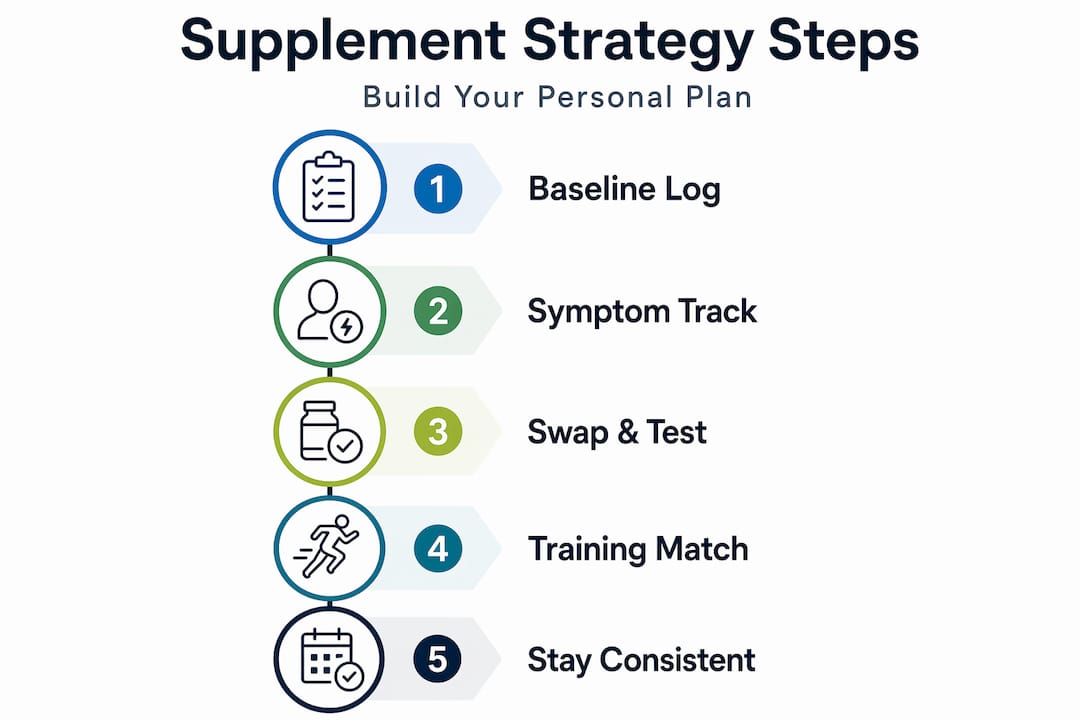
Step two: Introduce one change at a time. The biggest mistake athletes make is overhauling everything simultaneously. If you change three supplements at once and feel better (or worse), you have no idea which change made the difference. Swap one product, observe for two to three weeks, then move to the next.
Step three: Identify hidden allergens in your current stack. Common culprits that hide in supplement labels include:
- Lactose in flavouring agents or coating agents on tablets
- Soy lecithin used as an emulsifier in protein blends
- Gluten-containing thickeners in pre-workout powders
- Nut-derived oils in softgel capsules
- Egg-derived ingredients in some amino acid complexes
Step four: Prioritise the supplements closest to your training window. Pre-workout and intra-workout supplements have the greatest impact on GI comfort because they’re consumed when blood flow to the gut is reduced. Start allergen-free trials here first, then work outward to recovery nutrition.
Step five: Maintain consistency over optimisation. In high-intensity training contexts like Hyrox, allergen avoidance is fundamentally about minimising GI disruptions and supporting sustained performance across weeks and months, not just single sessions.
The compounds that deserve most attention in your allergen-free audit are synergistic supplementation for Hyrox combinations, particularly those pairing electrolytes with carbohydrates. Getting this right matters enormously. Electrolytes formulated for rapid absorption support fluid balance during sled work and burpee broad jumps without the gastric discomfort of poorly formulated drinks. And if your training includes back-to-back days, your recovery supplement stack deserves equal scrutiny for allergen content.
Pro Tip: Create a one-page supplement checklist that lists every product you use, its allergen status, FODMAP risk level (low, medium, high), and your personal tolerance rating from your training log. Review it at the start of every new training block.
What most Hyrox athletes get wrong about allergen-free choices
There are two predictable mistakes athletes make when they first start thinking about allergen-free supplementation, and both lead to frustration.
The first is expecting an immediate, measurable performance boost. Research consistently shows that symptom management rather than ergogenic gains is the primary benefit of switching to allergen-free options. If you trial a dairy-free protein for three weeks and your squat numbers haven’t gone up, that does not mean it isn’t working. What you should be measuring is training continuity, energy levels across the week, digestive comfort, and sleep quality. These are harder to quantify but far more predictive of your Hyrox finish time than any single session PB.
The second mistake is trusting label claims without scrutiny. “Free-from” labelling in the UK follows EU retained law, which mandates declaration of 14 major allergens. However, manufacturing cross-contamination, trace amounts, and non-listed ingredients (such as high-FODMAP sweeteners) are not captured in allergen declarations. The label tells you what is intentionally present. It does not guarantee what is actually absent in every batch.
Common pitfalls to watch for:
- Assuming “natural flavourings” are safe. This catch-all term can include dairy, nut, or other derivatives depending on the source.
- Ignoring the base of a product. Some plant-based proteins use soy or pea as their base, which can trigger sensitivity in their own right.
- Confusing allergen-free with low-FODMAP. These are entirely separate considerations, and a supplement can fail one while passing the other.
- Overlooking GI response at competition intensity. Many athletes test supplements during moderate-effort sessions and are caught out on race day when gut stress is at its peak.
Statistic to note: Research suggests that over 65% of endurance athletes may be carrying an undiagnosed sensitivity to at least one common supplement ingredient. Most have never connected their recurring training disruptions to their supplement stack.
Building awareness around these traps is the first step toward a more effective approach. Our guidance on natural performance enhancement covers complementary steps that go hand in hand with cleaner supplementation choices.
Our take: Why consistency and comfort trump performance hype
Here’s the contrarian view that most supplement brands won’t tell you, because it’s not as exciting to market: the biggest performance factor for female Hyrox athletes in the 30 to 50 age bracket is almost never the supplement that gives you 3% more power output on a Tuesday. It’s the supplement routine that means you train on Thursday when you would otherwise have been sidelined by gut cramps.
We’ve seen it over and over again. Athletes who chase the marginal ergogenic gains from cutting-edge formulations but continually battle GI issues plateau or regress. Athletes who build a boring, consistent, well-tolerated supplement routine from allergen-free, clean-ingredient products make steady year-on-year progress that genuinely compounds.
For women specifically in the 30 to 50 age range, this matters even more. Hormonal fluctuations across the menstrual cycle and into perimenopause increase gut reactivity. What was tolerable at 32 may cause problems at 44. The supplement strategy that served you in your first Hyrox season may need a rethink by your third. Building in allergen-free choices from the start creates a more stable foundation that ages better with your physiology.
The data on boosting Hyrox VO2 max through endurance training makes it clear: aerobic capacity built over consistent training cycles is what drives performance. You cannot build those cycles if you’re constantly managing the fallout from a poorly tolerated supplement stack.
Our honest take? Stop thinking of allergen-free as a constraint or a medical necessity. Start thinking of it as the most reliable path to an unbroken training block, race after race, year after year.
Ready to optimise your Hyrox journey?
If this article has prompted you to take a closer look at what’s actually in your supplement stack, the next step is straightforward. At Interval, every product we formulate starts with a clean, allergen-free base built from natural ingredients. No unnecessary additives, no hidden gut disruptors, no label claims that obscure rather than clarify.
Our Starter Bundle is the simplest way to trial a fully allergen-free pre-workout and electrolyte combination designed specifically for the demands of high-intensity sport. Whether you’re four weeks out from your first Hyrox event or deep into a competitive season, it’s formulated to support training consistency and genuine comfort from the very first session. Take a look and see whether it fits your training plan.
Frequently asked questions
What are the most common allergens in sports supplements for Hyrox athletes?
The most common allergens include dairy (whey and casein protein), soy, gluten, and sometimes nuts or egg-derived ingredients. Moderate-to-high whey sensitivity is particularly prevalent among endurance athletes, making dairy-free alternatives worth considering.
Can allergen-free supplements improve athletic recovery?
Allergen-free supplements can meaningfully support recovery by reducing GI upset, which allows you to maintain a regular training schedule and arrive at each session properly fuelled. Allergen avoidance in Hyrox nutrition is primarily about reducing schedule disruptions rather than producing standalone recovery gains.
Should I choose allergen-free if I’ve never had symptoms before?
If you’re genuinely symptom-free, allergen-free options aren’t mandatory, but they’re worth trialling during periods of increased training load or if new symptoms appear. Food sensitivities are common even among athletes with no prior formal diagnosis, particularly at higher training intensities.
Do allergen-free supplements guarantee no GI discomfort?
No. Factors like FODMAP content, osmolality, and supplement formulation can still trigger GI symptoms independently of allergen content. Supplement tolerability depends on multiple formulation properties, not allergen status alone.