


Supplement absorption: optimise your Hyrox performance
TL;DR:
- Supplement absorption involves multiple biological stages that determine how much nutrients your body actually uses.
- Different nutrients require specific forms and food pairings to optimize absorption, especially for minerals and fat-soluble vitamins.
- Barriers like low stomach acid, gut inflammation, and nutrient competition can impair absorption, affecting athletic performance despite supplement intake.
You follow the plan, take the supplements, and train hard every session. Yet your energy, recovery, and race-day performance keep falling short of what you expect. Before you blame the product or double the dose, consider this: the problem is rarely what you take, it is how much of it your body actually absorbs and uses. Supplement absorption is the invisible factor that separates athletes who get results from those who just get expensive urine. This guide unpacks the biology, identifies the barriers, and gives you a practical framework to actually benefit from every gram you put in your body.
Table of Contents
- The science of supplement absorption explained
- Different nutrients, different absorption rules
- Common barriers to optimal supplement absorption
- Practical strategies for Hyrox athletes: maximising supplement benefit
- Looking beyond the label: what most Hyrox athletes miss about supplement absorption
- Supercharge your results with optimised nutrition
- Frequently asked questions
Key Takeaways
| Point | Details |
|---|---|
| Absorption is the key | How much your body actually uses from supplements determines your real benefits. |
| Nutrient types matter | Fat- and water-soluble nutrients follow different absorption pathways for effectiveness. |
| Beat common blockers | Gut health, food pairing, and supplement timing all influence whether nutrients actually work. |
| Apply athlete-specific tactics | Hyrox athletes see best results by pairing, sequencing, and timing intakes based on current evidence. |
The science of supplement absorption explained
Absorption is not a single event. It is a sequence of biological stages, and each one is a potential point of failure. Understanding these stages is the first step towards getting real value from your pre-workout and electrolyte routine.
The journey begins in the mouth, but the real work happens further down. A supplement must first dissolve in the stomach, then survive the acidic environment without breaking down entirely. After that, it crosses the intestinal wall and enters the bloodstream, before being transported to the specific tissues where it does its job. Supplement absorption covers all of these stages, from dissolution and stomach survival through to intestinal uptake and tissue transport.
Bioavailability is the term that captures how much of a nutrient actually completes this journey. A supplement might contain 500 mg of magnesium on the label, but if your body only absorbs 30% of it, you are working with 150 mg in practice. This gap between the label and reality is where most athletes go wrong.
There are two main pathways through the intestinal wall. Paracellular absorption moves nutrients between cells, which is faster but less selective. Transcellular absorption moves nutrients through cells, which is slower but allows for active transport and better regulation. Many vitamins and electrolytes depend on protein carriers for transcellular uptake, meaning the transport system can become saturated if you take too much at once.
“Understanding bioavailability shifts the conversation from how much you take to how much your body can actually use.”
Here is a quick overview of what the stages mean in practice:
- Dissolution: The supplement breaks down in the stomach. Capsule type and coating affect this.
- Stomach survival: Acid degrades some nutrients; others are activated by it.
- Intestinal uptake: The nutrient crosses from the gut lumen into intestinal cells.
- Transport: Nutrients travel via bloodstream or lymph to target tissues.
| Stage | Key variable | What can go wrong |
|---|---|---|
| Dissolution | Formulation type | Poor-quality binders slow breakdown |
| Stomach survival | pH and acid levels | High acid destroys some probiotics |
| Intestinal uptake | Carrier protein availability | Saturation limits how much crosses |
| Transport | Blood flow and tissue health | Poor circulation reduces delivery |
For Hyrox athletes managing high training volumes, understanding supplement timing for Hyrox adds another layer of precision to this process.
Different nutrients, different absorption rules
Not all supplements follow the same absorption route. The type of nutrient determines which pathway it takes, how fast it works, and what you need alongside it to get the most out of it.
Fat-soluble vitamins (A, D, E, and K) require dietary fat and bile for absorption. Without fat in the same meal, these vitamins pass through largely unabsorbed. Bile, produced by the liver and stored in the gallbladder, emulsifies fat and allows these vitamins to be packaged into structures called micelles for transport. Fat-soluble vitamins need dietary fat to absorb properly, whilst water-solubles like B vitamins and vitamin C are absorbed directly into the blood without any dietary fat requirement.
Water-soluble vitamins move directly into the bloodstream through the intestinal wall. They are generally more forgiving in terms of timing, but because they are not stored in fat tissue, they need to be replenished regularly. Taking large doses at once provides limited extra benefit because the transport carriers become saturated.
Minerals are where it gets most complicated. Their absorption depends heavily on the form they come in. Chelated minerals, where the mineral is bound to an amino acid, are generally far better absorbed than inorganic salts. Magnesium glycinate, for example, absorbs significantly better than magnesium oxide.
Here is a comparison of common supplement forms:
| Nutrient | High-absorption form | Low-absorption form |
|---|---|---|
| Magnesium | Glycinate, malate | Oxide |
| Iron | Ferrous bisglycinate | Ferric sulphate |
| Zinc | Picolinate | Oxide |
| Vitamin D | D3 with K2 and fat | Standalone D2 tablet |
For Hyrox athletes, this has direct implications for electrolyte choices. Not all sodium, potassium, and magnesium products are equally effective. The form and pairing matter more than the milligram count.
Practical steps for smarter nutrient pairing:
- Take fat-soluble vitamins with a meal containing healthy fats such as avocado, nuts, or olive oil.
- Separate iron from calcium supplements by at least two hours to avoid competitive inhibition.
- Take water-soluble vitamins in the morning or pre-training when hydration is active.
- Choose chelated minerals over inorganic salts wherever possible.
Exploring whole-food supplements for athletes or real food supplement strategies can help you apply these principles beyond isolated products.
Common barriers to optimal supplement absorption
Even with the best supplements in the right forms, your body can still underabsorb them. These barriers are invisible until you know what to look for, and they are especially relevant for athletes in the 30 to 50 age bracket.
Reduced stomach acid becomes increasingly common with age and is one of the most significant barriers. Stomach acid is essential for breaking down proteins and activating minerals like B12 and zinc. Without adequate acid, these nutrients pass through partially unprocessed. Low stomach acid, gut inflammation, nutrient competition, and compounds called phytates in plant foods all impair mineral absorption in ways that accumulate silently over time.

Gut inflammation reduces the surface area of your intestinal wall. The villi, tiny finger-like projections that increase absorption surface area, can become blunted in a chronically inflamed gut. Less surface area means lower absorption rates across the board, regardless of what you are taking.
Nutrient competition is something many athletes overlook entirely. Calcium and iron share the same transport proteins, so taking them together means they compete for uptake and both lose. Zinc and magnesium have a similar conflict. Timing your supplements in sequence rather than all at once resolves this immediately.
“Your gut is the gateway. No supplement strategy works around a compromised digestive system.”
Other key barriers to watch for:
- Phytates and oxalates in foods like spinach and legumes bind to minerals and reduce their absorption when consumed together.
- Certain medications including proton pump inhibitors and metformin impair specific nutrient uptake, particularly B12.
- Chronic dehydration slows gut transit and reduces the efficiency of passive absorption.
- High training loads without recovery can elevate gut permeability, reducing absorption efficiency.
Pro Tip: If you suspect absorption issues, start by auditing your supplement timing before changing the products themselves. Separating competing nutrients by two hours, and supporting gut health with fermented foods, can improve uptake without changing a single formula.
Making a considered transition to natural supplements can also reduce the burden of synthetic binders and fillers on your digestive system.
Practical strategies for Hyrox athletes: maximising supplement benefit
Knowing the barriers is useful. Knowing how to act around them is what actually improves your Hyrox performance. Here are the strategies that translate absorption science into race-day and training gains.
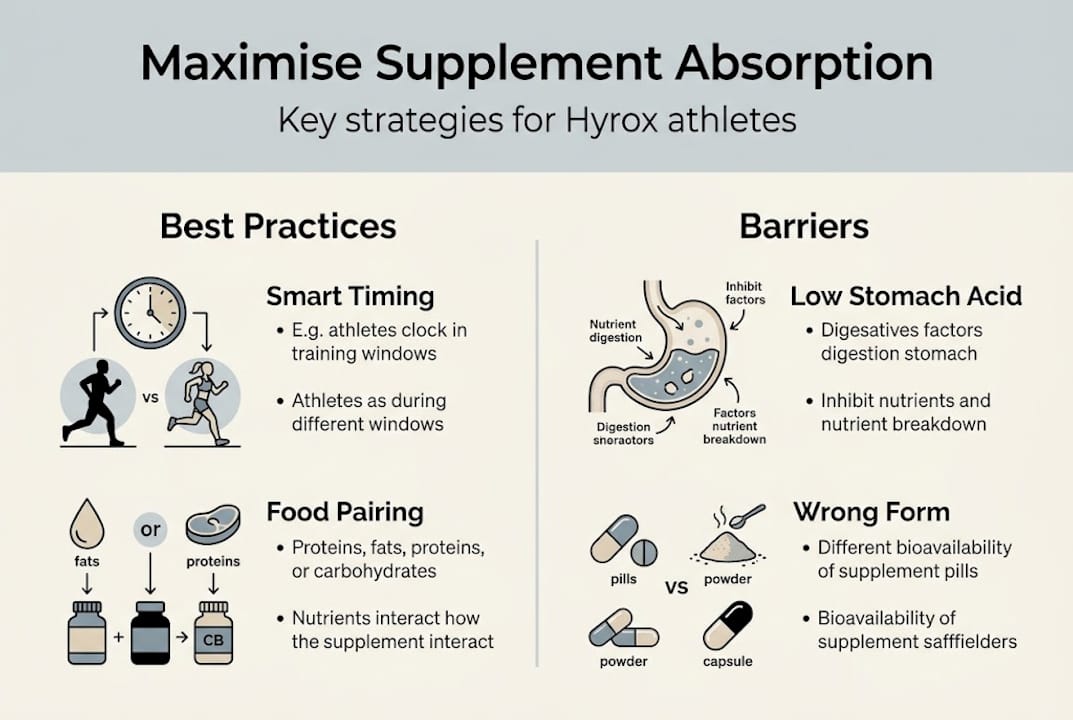
Timing is the highest leverage variable. Take your pre-workout 30 to 45 minutes before training to allow absorption and onset of effect. Post-exercise protein and carbohydrate consumed immediately after training can boost muscle recovery by 20 to 50% compared with delayed intake, making the post-training window one of the highest-value moments in your entire nutrition strategy.
Food pairing multiplies your return. Whole foods often deliver superior bioavailability compared with isolated supplements in many contexts, though targeted forms like liposomal vitamin C or chelated minerals can close this gap meaningfully.
Pro Tip: Track your sweat rate by weighing yourself before and after a hard session. For every kilogram lost, you need approximately one litre of fluid replacement. Use this to calibrate your electrolyte intake rather than guessing from generic serving suggestions.
Actionable steps for Hyrox athletes:
- Take your pre-workout 30 to 45 minutes before the session begins, not on an empty stomach if gut sensitivity is a concern.
- Consume a carbohydrate and protein combination within 30 minutes of finishing training.
- Take fat-soluble vitamins with your largest meal of the day, which typically contains the most dietary fat.
- Hydrate with electrolytes that include sodium and carbohydrates together, since sodium actively drives glucose co-transport across the gut wall.
- Separate competing minerals (calcium, iron, zinc, magnesium) into different parts of the day.
- Prioritise chelated mineral forms and liposomal delivery for nutrients that have historically poor absorption rates.
For more on this, the guides on boosting pre-workout absorption, timing supplement intake, and mixing supplements effectively are worth reading alongside your training plan.
Looking beyond the label: what most Hyrox athletes miss about supplement absorption
Here is the uncomfortable reality: the supplement industry is built around dose anxiety. More milligrams, more capsules, more scoops. But the actual performance variable is not dose. It is absorption. You could spend three times as much on a high-dose product and get less benefit than a simpler, well-formulated option taken at the right time with the right food.
We see this repeatedly. Athletes stacking multiple pre-workouts, doubling up on electrolytes, or taking broad-spectrum multivitamins at the wrong time, then wondering why their results have plateaued. The honest answer is that absorption issues are invisible. You cannot feel low bioavailability. You just stop progressing.
Food synergy is real and undervalued. Nutrients in whole foods come packaged with cofactors that improve absorption without any extra effort. The real food absorption advantage is not marketing spin. It reflects genuine biochemistry. Supplements should work alongside food, not replace the absorption benefits that food provides.
Start with less, absorb more, and measure what actually changes in your performance. That approach will always outperform the “more is more” mindset.
Supercharge your results with optimised nutrition
Understanding absorption is one thing. Acting on it with the right products is where Hyrox athletes genuinely pull ahead. At Interval, we formulate our pre-workout and electrolyte products with absorption in mind, using natural ingredients chosen for their bioavailability, not just their label appeal.
Our Starter Bundle is designed specifically for high-intensity athletes who want to stop guessing and start performing with purpose. Every formulation considers timing, pairing, and real-world absorption principles so you do not have to start from scratch. If you are ready to build a supplement strategy that actually works, explore everything Interval offers and take your next Hyrox performance seriously.
Frequently asked questions
What does supplement absorption actually mean?
Supplement absorption is the process by which nutrients travel from your digestive tract into the bloodstream and cells, making them available for the body to use. Without adequate absorption, even high-quality supplements deliver limited benefit.
Does taking more supplements guarantee better results?
No. Bioavailability varies significantly between nutrients and formulations, meaning excess doses are often not absorbed and simply excreted. Optimising absorption gives far greater returns than increasing dose alone.
What impairs supplement absorption most for athletes aged 30 to 50?
Ageing gut lining, low stomach acid and phytates, poor food pairings, and nutrient competition are the most common culprits in this age group, often working together to compound the problem.
How can Hyrox athletes improve supplement absorption?
Timing supplements thoughtfully around training, pairing them with the appropriate foods, and supporting gut health through diet and hydration are the three highest-leverage strategies available to athletes in this context.