


The role of magnesium in performance and recovery
TL;DR:
- Magnesium is essential for over 300 enzymatic reactions, supporting energy production, muscle relaxation, and recovery. While it can reduce delayed onset muscle soreness and improve sleep, evidence for cramp prevention is weak, and proper recovery depends on addressing electrolyte balance. Athletes should supplement 300–400 mg daily with bioavailable forms like glycinate or citrate, split into doses, and maintain consistent use over weeks for optimal benefits.
Magnesium is one of those minerals that gets credited for everything from eliminating cramps to unlocking peak power output. The reality is more nuanced. The role of magnesium in performance is not about overnight transformation. It is about foundational biochemistry. Without sufficient magnesium, your muscles cannot contract properly, your energy systems underperform, and your recovery drags. Get it right, though, and the difference is real. This guide cuts through the noise to give you the evidence-based picture, practical dosing guidance, and honest perspective on what magnesium can and cannot do for your training.
Table of Contents
- Key takeaways
- The role of magnesium in performance: what the biochemistry tells us
- Magnesium supplementation: what the evidence actually shows
- Cramping myths and what actually causes them
- How to supplement magnesium effectively
- Recognising magnesium deficiency in athletes
- My honest take on magnesium
- Support your recovery with Useinterval
- FAQ
Key takeaways
| Point | Details |
|---|---|
| Foundational, not a booster | Magnesium supports over 300 enzymatic reactions; benefits appear mainly when correcting deficiency. |
| Recovery evidence is solid | Around 350 mg daily for 10 days or more can meaningfully reduce DOMS and soreness markers. |
| Cramps are multifactorial | Sodium, potassium, and hydration are more critical for cramp prevention than magnesium alone. |
| Form matters significantly | Glycinate and citrate absorb far better than oxide; split doses beat a single large dose. |
| Athletes deplete faster | Sweat losses and high training volumes increase magnesium requirements beyond standard dietary intake. |
The role of magnesium in performance: what the biochemistry tells us
Before discussing supplements, you need to understand what magnesium actually does inside your body during hard training.
Magnesium acts as a cofactor for over 300 enzymatic reactions, including every step of ATP synthesis. ATP is your cellular currency. No ATP, no contraction. No contraction, no performance. When magnesium levels drop, even marginally, your energy production becomes less efficient at exactly the moment you need it most.
Beyond energy, magnesium regulates the interplay between calcium and muscle fibres. Calcium triggers contraction. Magnesium facilitates relaxation. When this balance is disrupted, the results show up as stiffness, twitches, and the kind of fatigue that lingers well past your cool-down. Magnesium also governs neuromuscular transmission, meaning the speed and clarity with which your nervous system signals your muscles to fire.
Here is where the importance of magnesium in fitness becomes concrete for high-intensity athletes:
- ATP synthesis: Magnesium is required to stabilise ATP molecules. Without it, energy transfer slows.
- Muscle relaxation: Magnesium opposes calcium’s contracting effect, allowing full release between contractions.
- Protein synthesis: Magnesium activates enzymes responsible for building and repairing muscle tissue.
- Electrolyte regulation: It works alongside sodium, potassium, and calcium to maintain fluid balance across cell membranes.
- Nerve signalling: Magnesium helps modulate the excitability of motor neurons, reducing neuromuscular fatigue over prolonged effort.
Pro Tip: If you are regularly training twice a day or doing back-to-back sessions, your magnesium demand is higher than the standard dietary reference value suggests. Do not assume a normal diet covers it.
Magnesium supplementation: what the evidence actually shows
This is where a lot of athletes get misled. The marketing around magnesium promises cramp-free legs and turbo-charged recovery. The science is more selective.
The most practically useful finding comes from a 2024 systematic review on muscle soreness, which found that consistent daily supplementation of around 350 mg elemental magnesium can reduce DOMS markers at 24 to 48 hours post-exercise. This is a meaningful finding. Reducing soreness in that window matters enormously when you are training five or six days a week and cannot afford two days of impaired movement quality.
The cramp picture, however, is considerably less convincing. A Cochrane review of 11 trials involving 735 participants found no significant reduction in cramp frequency or intensity from magnesium supplementation. That is a hard finding to ignore. The evidence simply does not support magnesium as a reliable cramp preventative, at least not for people without confirmed deficiency.
| Outcome | Evidence quality | Practical use |
|---|---|---|
| Reducing DOMS (24–48 hrs) | Moderate, supported by RCTs | Yes, consistent 10+ day use at 350 mg |
| Cramp prevention | Weak, no significant effect in reviews | Only if deficiency is confirmed |
| Sleep quality improvement | Moderate, mechanism-supported | Yes, pre-bedtime dosing beneficial |
| Energy and stamina | Indirect, via ATP support | Primarily when correcting deficiency |
| Muscle repair enzymes | Moderate, synergistic with protein | Yes, pairs well with post-workout nutrition |
Magnesium improves sleep quality by activating the parasympathetic nervous system and regulating GABA. For athletes, this is not a soft benefit. Sleep is when hormonal adaptation occurs, when growth hormone peaks, and when your nervous system recalibrates after the stress of hard effort. If magnesium helps you sleep deeper and longer, the downstream effects on recovery and performance are real.
Pro Tip: Tracking soreness and sleep quality over a two-week supplementation period is the most practical way to assess whether magnesium is working for you. Waiting to feel a dramatic performance boost will leave you disappointed.
Cramping myths and what actually causes them
This section might challenge something you have held as fact. Magnesium and cramps are almost synonymous in sporting culture. Coaches hand out magnesium tablets like sweets. Athletes swear by spray-on magnesium oil. But exercise-associated cramps are multifactorial, and magnesium deficiency is rarely the primary driver.
The research consistently points to neuromuscular fatigue and electrolyte imbalances, particularly sodium and potassium, as the dominant causes. When you sweat heavily, you lose significant sodium. Sodium governs fluid distribution and nerve firing thresholds. Potassium is critical for the repolarisation of motor neurons after each contraction. When these are depleted, the threshold for an involuntary cramp drops sharply.
Where does magnesium fit? It is in the mix, but it is not the headline act. Here is a more accurate picture of what actually contributes to cramping:
- Neuromuscular fatigue: Sustained effort disrupts motor neuron control, making muscles more prone to spontaneous firing.
- Sodium depletion: Heavy sweating strips sodium faster than most athletes replace it. Electrolyte drinks that cover only water are insufficient.
- Potassium imbalance: Low potassium slows muscle recovery between contractions and increases excitability.
- Dehydration: Even mild dehydration concentrates nerve signals and reduces the threshold for cramp.
- Magnesium deficiency: A contributing factor, but rarely sufficient on its own to cause or prevent cramps.
Relying solely on magnesium to prevent cramps ignores the complexity entirely. If you are cramping regularly, start with hydration and sodium. Review your electrolyte balance across all the relevant minerals. Magnesium supplementation may help, particularly if deficiency is present, but it should not be your only strategy.
How to supplement magnesium effectively
Knowing that magnesium matters is one thing. Supplementing it correctly is where many athletes fall short, buying whatever is on the shelf at the pharmacy and wondering why nothing changes.
Form first
Not all magnesium is equal. Magnesium oxide has a bioavailability of roughly 4%. That means 96% of what you swallow does very little. It is cheap to manufacture, which is why it appears in most budget supplements. Magnesium glycinate and magnesium citrate are meaningfully more absorbable and far better tolerated by the digestive system. Glycinate is particularly suited to athletes who are sensitive to the laxative effect that higher doses of citrate can produce.

Dosing and timing
For athletes, the practical range sits between 300 and 400 mg elemental daily. Do not exceed 400 mg without medical guidance. The key to maximising absorption is splitting your dose rather than taking it all at once. Your gut absorbs magnesium better in smaller quantities, and split doses improve uptake significantly. A common approach is 150 to 200 mg mid-afternoon and another 150 to 200 mg before bed.
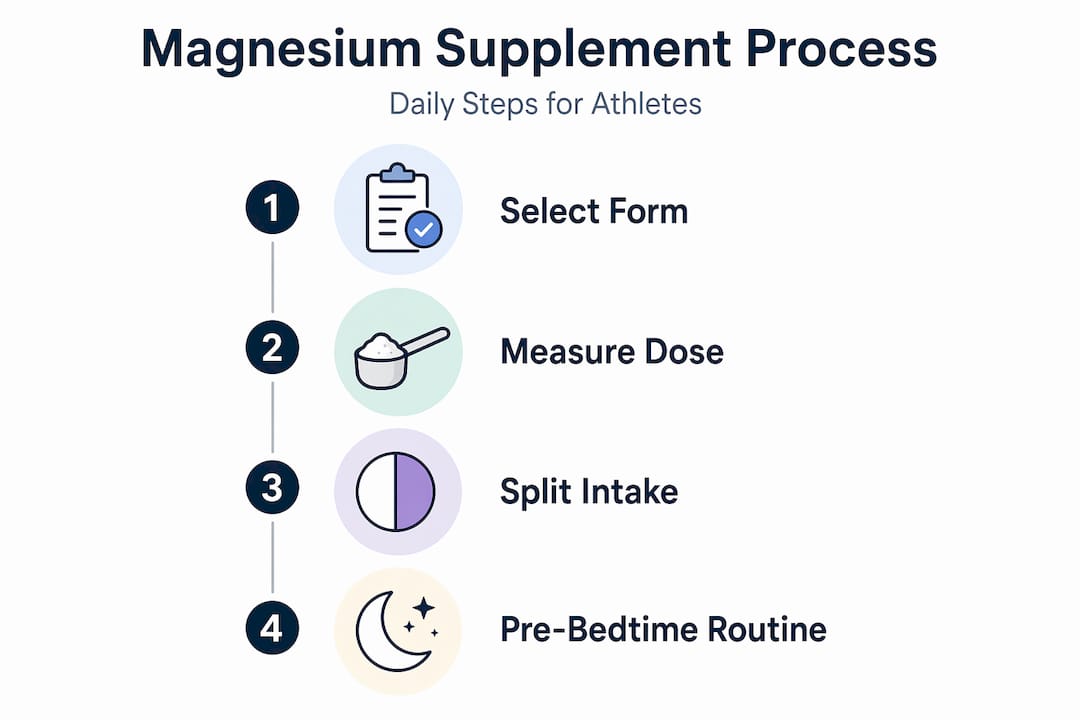
Pre-bedtime dosing works particularly well because of the GABA-regulation mechanism. Taking magnesium 30 to 60 minutes before sleep positions it to support your nervous system’s transition into deep recovery.
Avoiding absorption competition
Zinc and calcium compete with magnesium for the same absorption pathways. If you are taking a zinc supplement or a calcium-heavy protein blend, separate those from your magnesium by at least two hours. This is not optional. The competition is real and can render your magnesium supplementation largely ineffective.
Magnesium also pairs well with your existing recovery stack. It does not compete with creatine or protein. In fact, magnesium complements creatine and protein by activating muscle repair enzymes and supporting the sleep that underpins adaptation.
Recognising magnesium deficiency in athletes
Athletes commonly have lower magnesium levels than sedentary individuals. Hard training depletes magnesium through sweat, and most athletes do not fully compensate through diet, even with reasonably varied eating.
Here is how deficiency tends to show up:
- Persistent muscle cramps or twitches that occur even outside of training sessions and are not fully explained by dehydration.
- Poor sleep quality including difficulty staying asleep, restlessness, or waking feeling unrecovered despite adequate hours.
- Elevated resting fatigue where general energy and motivation are lower than expected relative to your training load.
- Prolonged soreness that extends significantly beyond 48 hours after moderate sessions. This can indicate impaired muscle repair enzyme activity.
- Increased injury susceptibility around tendons and soft tissue, which can correlate with disrupted electrolyte regulation and poor tissue hydration.
If several of these apply consistently, you are likely running low. The effects of magnesium on athletic performance are most tangible at this point, because you are bringing a depleted system back to baseline. The post-workout recovery process improves noticeably when you address this gap through consistent supplementation over two to four weeks rather than a single loading dose.
The key word is consistent. Magnesium builds in tissue gradually. One evening of supplementation before a race does nothing. Four weeks of 350 mg daily, split and timed intelligently, gives you a genuine foundation to work from.
My honest take on magnesium
I have followed athlete supplementation closely for a long time, and my view on magnesium has settled into something fairly specific. I think it is one of the most important supplements in an athlete’s toolkit, but for reasons that have nothing to do with performance enhancement in the traditional sense.
I have watched athletes chase magnesium as a cramp cure and walk away frustrated when it does not work. That frustration is understandable, but it is the wrong expectation. What I have seen work is treating magnesium as infrastructure, the kind of support that keeps every other system running cleanly. When athletes I speak with start sleeping better, recovering faster between sessions, and feeling less dragged through their third training day, magnesium is often part of what shifted.
Where I think the conversation goes wrong is when magnesium gets positioned alongside caffeine and beta-alanine as a direct performance driver. It is not that. It is the substrate that everything else runs on. Remove it and your performance degrades quietly over weeks. Restore it and the improvement is real but subtle.
My practical advice: stop looking for the dramatic signal. Look at your sleep, your soreness trend, and your energy across training weeks. Those are the metrics magnesium moves. And for athletes with magnesium supplementation for Hyrox or high-intensity sport specifically, the demands are higher than general population guidance suggests.
— Tom
Support your recovery with Useinterval

Getting your magnesium right is only one part of the recovery equation. Useinterval’s Starter Bundle brings together the supplements that matter most for high-intensity athletes: electrolytes formulated for real sweat losses, and pre-workout built around natural ingredients that do not spike and crash. Everything is designed with the same evidence-informed approach you have just read about. If you are training hard and taking recovery seriously, this is the place to start your supplement stack. No unnecessary additives. No inflated promises.
FAQ
What is the role of magnesium in performance?
Magnesium supports over 300 enzymatic reactions including ATP synthesis and muscle contraction. Its primary role is foundational: without adequate magnesium, energy production and neuromuscular function both degrade, especially under high training loads.
Does magnesium prevent muscle cramps?
The evidence is weak. A Cochrane review of 11 trials found no significant reduction in cramp frequency from magnesium supplementation. Cramps are primarily caused by neuromuscular fatigue and sodium or potassium imbalances, making hydration and balanced electrolytes more reliable strategies.
How much magnesium should athletes take daily?
The practical range for athletes is 300 to 400 mg of elemental magnesium daily, split into two doses. Pre-bedtime dosing of 150 to 200 mg is particularly effective for supporting sleep quality and overnight recovery.
Which form of magnesium absorbs best?
Magnesium glycinate and magnesium citrate are significantly more bioavailable than magnesium oxide, which absorbs at roughly 4%. Glycinate is generally better tolerated and is the preferred choice for athletes supplementing consistently at higher doses.
How long does magnesium take to work?
Meaningful benefits for soreness and sleep typically require consistent supplementation over 10 to 28 days. Single-dose or short-term use before an event will not produce the recovery benefits seen in controlled trials.