


Minerals for female athletes: fuel performance and recovery
TL;DR:
- Minerals like iron, magnesium, sodium, calcium, and potassium are vital for female athletes’ performance and recovery. Hormonal fluctuations and age increase mineral needs, especially during perimenopause and high training volume. Targeted, cycle-aware supplementation and hydration strategies optimize performance and prevent deficiencies.
You can take every vitamin supplement on the market and still feel like you’re running on empty. For female athletes aged 30 to 50 pushing through high-intensity training, vitamins get most of the attention, yet minerals are often what actually separate consistent performers from those battling fatigue, cramps, and sluggish recovery. Iron, magnesium, sodium, calcium, and potassium govern how your muscles fire, how efficiently your cells produce energy, and how well your body bounces back after a brutal session. This article gives you a practical, evidence-backed guide to understanding which minerals matter most, why your needs differ from both men and younger women, and how to act on that knowledge immediately.
Table of Contents
- Why minerals matter: foundations for high-intensity female athletes
- Iron: the performance linchpin for female athletes
- Sodium, magnesium, and fluid balance: navigating unique female needs
- Adapting mineral intake for age, intensity, and life stage
- What most guides miss: it’s not just about minerals, context is everything
- Boost your performance with targeted mineral support
- Frequently asked questions
Key Takeaways
| Point | Details |
|---|---|
| Minerals drive performance | Iron, magnesium, and sodium are crucial for stamina, energy, and proper hydration in active women. |
| Personalised strategies matter | Tailoring mineral intake to training intensity, age, and cycle phase grants superior results. |
| Whole foods first, then supplement | A balanced diet covers most needs, but blood tests can reveal when supplements are needed. |
| Menstrual cycle changes requirements | Hormonal shifts strongly influence hydration, mineral loss, and recovery for female athletes. |
| Regular screening is vital | Annual mineral check-ups help catch deficiencies before they hinder performance or health. |
Why minerals matter: foundations for high-intensity female athletes
Having introduced the overlooked role of minerals, let’s look at what makes them indispensable for female athletes.
Minerals are inorganic nutrients that your body cannot manufacture on its own. You must consume them through food or supplementation, and the cost of falling short is felt directly in performance. They are not passive passengers in your physiology. They actively control nerve signalling, regulate fluid balance, enable muscle contraction and relaxation, and act as cofactors in energy production. Without them, the complex machinery of your cardiovascular and muscular systems simply cannot run at full capacity.
For women aged 30 to 50 training at high intensity, the demand is amplified. Your metabolic rate during hard efforts is elevated, you lose minerals through sweat, and hormonal fluctuations across your menstrual cycle compound those losses at specific phases. This is not a situation where a standard multivitamin closes the gap. The evidence from optimising electrolyte intake makes clear that targeted, informed strategies are required.
Here are the five minerals that carry the greatest performance weight for female athletes:
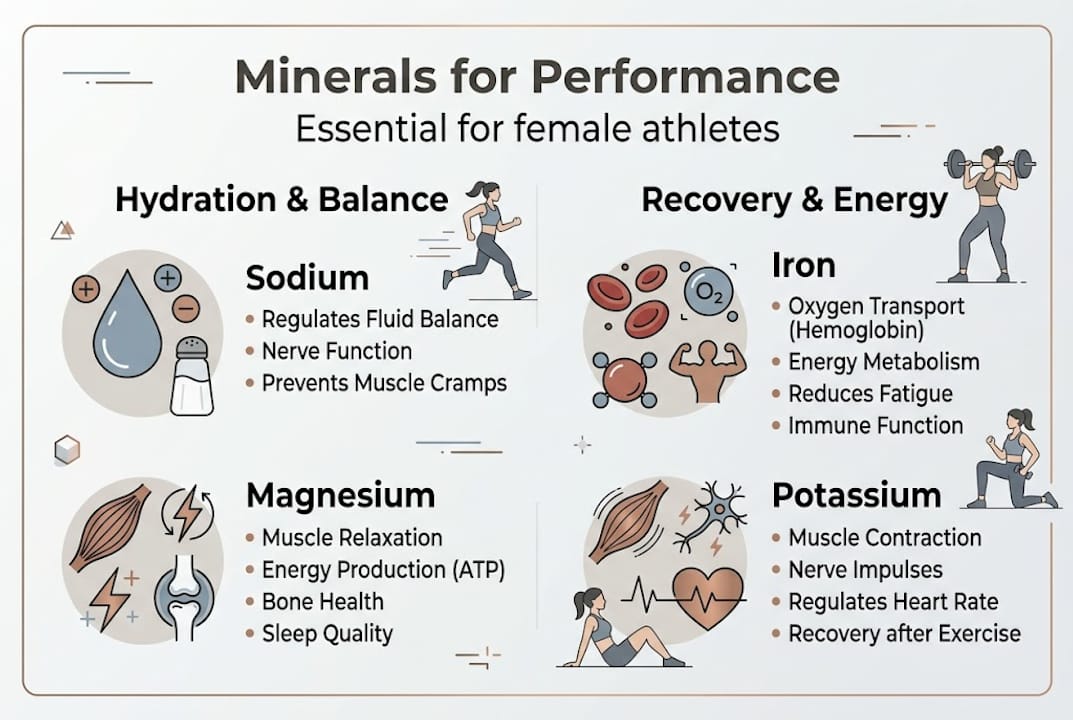
- Iron: Carries oxygen in red blood cells to working muscles. Deficiency directly impairs endurance, power output, and mental clarity.
- Magnesium: >300 metabolic reactions involve magnesium, including muscle function, energy production, nerve signalling, and muscle relaxation via its role as a calcium antagonist.
- Sodium: The primary electrolyte in sweat. Controls fluid volume inside and outside cells. Essential for sustained hydration during long sessions.
- Potassium: Works alongside sodium to maintain electrical gradients across muscle and nerve cells. Critical for preventing cramping and maintaining cardiac rhythm.
- Calcium: Beyond bone health, calcium triggers the muscle contraction cascade. Without adequate calcium, both the quality and speed of your contractions suffer.
The menstrual cycle adds another layer of complexity that most generic sports nutrition guides ignore. Oestrogen and progesterone fluctuate significantly across four phases, and these hormonal shifts alter how much sodium and magnesium you retain, how much iron you lose through menstruation, and how responsive your body is to carbohydrate and fluid intake. For example, the luteal phase (the two weeks before your period) raises your core temperature and increases your reliance on carbohydrates, meaning mineral demand during hard training is higher. Understanding this hormonal interplay is what separates good mineral strategy from great mineral strategy.
When it comes to sourcing minerals, the debate around whole foods vs supplements is nuanced. A diet rich in leafy greens, nuts, seeds, lean red meat, legumes, and dairy forms the foundation. However, intense training, dietary restrictions, and hormonal demands can push requirements beyond what food alone can reliably deliver.
Iron: the performance linchpin for female athletes
Understanding the broad benefits of minerals, we turn to the single most common deficiency hindering female athletic performance: iron.
Iron deficiency is not a niche concern. It is the most prevalent nutritional shortfall in physically active women, and its consequences are not subtle. When iron is low, your body produces fewer or smaller red blood cells, reducing its capacity to deliver oxygen to muscles. You feel this as unusual breathlessness during sessions you used to handle easily, persistent fatigue that does not resolve with sleep, and a noticeable drop in your top-end speed and power.
Iron deficiency affects up to 60% of female athletes, making it the most widespread performance-limiting mineral deficiency in this population.
The data on both prevalence and the performance cost of iron insufficiency is stark:
| Metric | Data |
|---|---|
| Prevalence in female athletes | Up to 60% |
| Endurance performance impact | 3 to 4% reduction |
| Improvement after supplementation (endurance) | 2 to 20% |
| Improvement in maximal aerobic capacity | 6 to 15% |
| Supplementation dose studied | 100 mg elemental iron per day |
| Duration of supplementation studied | Up to 56 days |
What those numbers mean in practice: even a modest 3 to 4% reduction in endurance output is the difference between holding your race pace in the final kilometre and blowing up. And the upside from correcting iron deficiency, 2 to 20% endurance improvement, is one of the largest evidence-based performance gains available outside of structured training itself.

Iron depletion happens in stages. The earliest stage, storage depletion, sees ferritin levels falling before you feel any symptoms. By the time fatigue becomes obvious, you are likely well into stage two or three. This is why testing matters. A serum ferritin result below 30 micrograms per litre is considered suboptimal for athletic performance, even if it falls within the “normal” clinical range.
Pro Tip: Request a full iron panel including serum ferritin, haemoglobin, and transferrin saturation, not just a standard haemoglobin check. Many female athletes test “normal” on haemoglobin alone whilst sitting on critically low ferritin. Speak to your GP or sports physician and get annual screening as a baseline, with additional checks if you notice fatigue, breathlessness, or a plateau in performance.
The food-versus-supplement question is directly relevant here. Haem iron from red meat, poultry, and fish absorbs at roughly 15 to 35%. Non-haem iron from legumes, tofu, and spinach absorbs at just 2 to 20%, and absorption drops further when consumed alongside coffee, tea, or calcium-rich foods. For athletes losing significant iron through menstruation, sweat, and foot-strike haemolysis (common in runners), food alone often cannot keep pace with losses. Supplementation, guided by lab results, is a legitimate and evidence-backed tool. Explore how to boost performance and recovery with a clear nutritional picture behind you.
Sodium, magnesium, and fluid balance: navigating unique female needs
With iron’s significance clear, it’s essential to understand how sodium and magnesium underpin hydration and adaptation, especially in women’s unique physiology.
Hydration is not simply about drinking enough water. Without adequate sodium and magnesium, water consumed during exercise is poorly retained and poorly distributed. For female athletes, this is compounded by the fact that female sex hormones affect fluid dynamics and electrolyte handling significantly, with elevated progesterone in the luteal phase increasing the risk of hyponatraemia (dangerously low blood sodium) and worsening the consequences of fluid loss.
| Sodium | Magnesium | |
|---|---|---|
| Primary role | Fluid volume regulation, nerve conduction | Energy production, muscle relaxation, nerve function |
| Deficiency signs | Cramping, dizziness, headache, nausea | Cramping, insomnia, anxiety, poor recovery |
| Best food sources | Electrolyte drinks, table salt, pickles | Almonds, spinach, dark chocolate, pumpkin seeds |
| Sweat loss risk | High (especially in hot environments) | Moderate (increases with training volume) |
| Supplementation timing | During and around training | Evening or post-training works well |
Research on sodium loading is instructive. Sodium hyperhydration at 7.5 g/L enhances fluid retention by approximately 509 mL before exercise and reduces body mass loss by 0.2% during steady-state cycling in heat, with effects being most pronounced in the early follicular phase. This tells us that strategic sodium intake before long events in warm conditions is not just sensible, it is evidence-backed and particularly potent at the start of your cycle.
Adjusting your electrolyte strategy around your menstrual cycle sounds complex, but a practical process makes it manageable:
- Track your cycle phase: Use an app or a simple calendar. Knowing where you are (follicular, ovulatory, luteal, or menstrual) tells you when to increase vigilance.
- Increase sodium intake during the luteal phase: Start sessions with a sodium-rich drink. You are more likely to experience fluid imbalances in this phase.
- Prioritise magnesium in the week before menstruation: Needs rise and sleep quality often suffers. An evening magnesium supplement helps address both.
- Reduce caffeine around menstruation: Caffeine is a mild diuretic and can worsen fluid and mineral losses when they are already elevated.
- Rehydrate with electrolytes post-session, not plain water: Especially in the luteal phase, drinking plain water after a long, sweaty effort risks diluting already-stretched sodium levels further.
Pro Tip: Test your hydration strategy in training, not on race day. Women respond differently to sodium and magnesium interventions depending on cycle phase. Practise your protocol during a luteal-phase training block when conditions are most demanding, then refine it. For structured guidance on this, the electrolyte replenishment tips resource is a strong starting point, and optimising electrolyte mixing gives practical ratios for different training contexts.
Adapting mineral intake for age, intensity, and life stage
Finally, to put this guidance to use, see how requirements adapt with training intensity and where you are in your athletic and life journey.
The 30 to 50 age range is not homogenous. A 32-year-old at peak training volume has meaningfully different mineral needs from a 48-year-old navigating perimenopause. The physiology shifts, and your strategy needs to shift with it. The essential electrolyte tips guide breaks this down practically, but here is the core framework.
As you move through your forties and into perimenopause, several mineral-related priorities intensify. Research confirms that peri and post-menopausal athletes require higher protein intake (1.4 to 2.2 g per kg of bodyweight), increased calcium and vitamin D for bone maintenance, and that magnesium supplementation, whilst not always directly boosting performance, consistently supports recovery quality and corrects low status that impacts sleep and muscle function.
Three adaptation strategies specific to peri and post-menopausal athletes:
- Prioritise calcium and vitamin D as a unit: Calcium from dairy, fortified foods, or supplements needs vitamin D to absorb properly. Bone density losses accelerate after 40. This is non-negotiable, not optional extra.
- Raise protein to protect muscle: Muscle maintenance becomes harder as oestrogen declines. Higher protein intake preserves lean mass and indirectly supports the mineral-dense tissue of muscle and bone.
- Use magnesium supplementation for recovery, not just performance: Even if your magnesium level is technically sufficient, the recovery benefits (better sleep, reduced muscle soreness, lower stress hormones) are clinically meaningful for women in this life stage.
Training intensity also independently raises mineral needs. A female athlete doing five high-intensity sessions per week loses significantly more sodium, potassium, and magnesium through sweat than one doing two moderate sessions. Volume and heat exposure multiply losses further. If you have recently increased your training load without adjusting your nutrition, mineral shortfalls are likely before any other dietary inadequacy shows up.
Pro Tip: A simple signal that supplementation is warranted (rather than dietary tweaks alone): persistent muscle cramps despite adequate hydration, sleep quality declining without a clear reason, or performance plateauing despite consistent training. These are red flags pointing to mineral insufficiency, not overtraining, and bloodwork will confirm or rule it out within days.
What most guides miss: it’s not just about minerals, context is everything
Most mineral guides for athletes do a reasonable job listing which minerals matter and how much you need. What they rarely address is that the correct dose, the correct timing, and the correct sources are entirely context-dependent. For women in the 30 to 50 bracket, rigid formulas almost always fall short.
Your mineral needs on a hard luteal-phase track session in July are categorically different from those on an easy follicular-phase recovery run in November. Training stress, sweat rate, dietary composition, gut health, and hormonal environment all alter how much you absorb, how much you lose, and how much your performance actually responds to supplementation. Treating minerals like a static prescription misses this entirely.
The athletes who perform most consistently are not those following the most detailed protocols. They are the ones who pay attention, adjust continuously, and treat their body’s feedback as valid data.
Building a practice of cycle tracking alongside nutrient logging is not obsessive. It is strategic. Use an easy electrolyte workflow to anchor your habit, then layer in responsiveness based on how you actually feel and perform. The evidence provides the framework. Your lived experience provides the calibration.
Boost your performance with targeted mineral support
Ready to take action on everything covered above?
Understanding your mineral needs is one thing. Having the right products to consistently meet them is another. Interval’s Starter Bundle is built specifically for female athletes doing high-intensity work, combining natural-ingredient electrolytes and pre-workout support to address the hydration and mineral demands covered throughout this article.
Whether you are managing iron recovery, cycle-aware hydration, or the extra demands of perimenopausal training, the Interval solutions range gives you a practical, clean-ingredient toolkit designed around how women actually train. Explore the full resource library alongside the product range to build a plan that works for your intensity, your cycle, and your goals.
Frequently asked questions
What minerals should female athletes prioritise for high-intensity training?
Iron, magnesium, sodium, calcium, and potassium are the most essential for performance and recovery, with magnesium alone involved in over 300 metabolic reactions critical to athletic function.
How does the menstrual cycle impact mineral needs and performance?
Hormonal shifts alter fluid balance and electrolyte loss at each phase, with elevated progesterone raising hyponatraemia risk in the luteal phase, making cycle-aware hydration strategies essential for endurance athletes.
Is food or supplementation better for meeting mineral needs?
Whole foods are the preferred foundation, but supplements are warranted when lab-confirmed deficiencies exist or when training volume and life stage push requirements beyond what diet can reliably cover.
How often should iron levels be tested for active women?
Annual screening is a sensible baseline, with additional tests if fatigue or breathlessness appears, as high prevalence and clear performance benefits make iron the single most important deficiency to catch early in female athletes.
Does electrolyte hydration need to change around the perimenopause?
Yes. As hormones shift, so do hydration and mineral retention patterns, and peri and post-menopausal athletes should pay particular attention to calcium, vitamin D, and magnesium alongside their electrolyte strategy.