


What is muscle endurance? 25 reps for 30% better Hyrox results
Muscle endurance and strength sound similar, but they drive completely different athletic outcomes. If you’re hitting a wall halfway through Hyrox stations, you might be training the wrong system. Muscle endurance is your body’s capacity to perform repeated contractions without faltering, and for female Hyrox athletes, it’s the difference between finishing strong or fading fast. This guide unpacks exactly what muscle endurance is, how it differs from strength, and the specific training methods that deliver results.
Table of Contents
- Definition And Physiological Basis Of Muscle Endurance
- Muscle Fiber Composition And Physiological Changes During Endurance Training
- Differences Between Muscle Endurance And Muscle Strength
- Common Misconceptions About Muscle Endurance
- Training Principles For Improving Muscle Endurance
- Practical Muscle Endurance Exercises For Hyrox Athletes
- Role Of Muscle Endurance In Fatigue Resistance And Performance
- Enhance Your Muscle Endurance With Targeted Nutrition And Supplements
- Frequently Asked Questions
Key takeaways
| Point | Details | |-------|---------|| | Muscle endurance is capacity for repeated contractions | It focuses on sustaining effort over time, not maximal force production. | | Different from strength training | Endurance uses high reps with moderate loads, strength uses low reps with heavy loads. | | Training specificity matters for Hyrox | Exercises must mimic race demands to transfer effectively to competition performance. | | Physiological adaptations drive gains | Increased capillaries and mitochondria improve oxygen delivery and energy production. | | Nutrition and recovery amplify results | Proper fueling and electrolyte balance support muscle function during intense training. |
Definition and physiological basis of muscle endurance
Muscle endurance is your ability to sustain repeated muscle contractions over extended periods without succumbing to fatigue. For Hyrox athletes, this translates to powering through burpees, sled pushes, and lunges without losing form or speed. Muscle endurance allows athletes to sustain a work rate significantly longer before fatigue by developing adaptations in muscle fiber type and metabolic capacity.
Think of a marathon runner’s legs completing thousands of contractions per race. That’s muscle endurance in action. Unlike strength, which focuses on a single maximal effort, endurance is about maintaining output across repetitions. Your muscles rely on aerobic metabolism to produce energy continuously, and when that system is well trained, you delay the point where lactate accumulates and performance drops.
For female Hyrox athletes aged 30 to 50, this capacity becomes critical during the final stations when glycogen stores deplete and fatigue threatens technique. Training muscle endurance builds the metabolic machinery that keeps you moving efficiently even as effort accumulates. The adaptations happen at the cellular level, enhancing your muscles’ ability to clear waste products and deliver oxygen where it’s needed most.
Key physiological factors include:
- Muscle fiber recruitment patterns that favour sustained contractions
- Metabolic pathways producing ATP without rapid fatigue
- Capillary networks delivering oxygen to working muscles
- Mitochondrial density supporting aerobic energy production
Muscle fiber composition and physiological changes during endurance training
Your muscles contain two primary fiber types: slow twitch (type I) and fast twitch (type II). Slow twitch fibers are endurance specialists. They contract steadily, resist fatigue, and rely on aerobic metabolism to generate energy. Fast twitch fibers generate explosive power but tire quickly. For Hyrox, where stations demand repeated moderate intensity efforts, slow twitch dominance becomes a performance asset.

Endurance training triggers specific adaptations that amplify your slow twitch capacity. Endurance training induces capillary growth and mitochondrial biogenesis, increasing oxygen delivery and energy production in muscles. More capillaries mean better blood flow to active tissue. More mitochondria mean greater ability to convert fuel into usable energy without producing excessive lactate.
These changes don’t happen overnight. Consistent training over weeks and months stimulates your body to adapt. Your muscles become more efficient at extracting oxygen from blood, and they develop greater stores of glycogen for sustained efforts. The result is a delay in fatigue onset and improved ability to recover between high intensity intervals.
| Fiber Type | Primary Function | Energy System | Fatigue Resistance |
|---|---|---|---|
| Type I (slow twitch) | Endurance, sustained contractions | Aerobic metabolism | High |
| Type II (fast twitch) | Power, explosive force | Anaerobic metabolism | Low |
For female athletes, these adaptations support not just physical performance but also resilience during demanding training blocks. Enhanced oxygen delivery reduces the sensation of breathlessness during high rep sets. Improved mitochondrial function means you can maintain intensity longer without hitting the wall.
Key training induced changes:
- Increased capillary density around muscle fibers
- Higher mitochondrial volume per muscle cell
- Enhanced aerobic enzyme activity
- Greater glycogen storage capacity
Pro Tip: Track your rest periods between sets. As endurance improves, you’ll need less recovery time to maintain the same work output, a clear sign of adaptation.
Differences between muscle endurance and muscle strength
Confusing endurance with strength is one of the biggest training mistakes female Hyrox athletes make. Muscular endurance is distinct from muscular strength because endurance focuses on sustaining repeated contractions, while strength is about maximal force production per contraction. The training protocols for each look completely different.
Strength training uses heavy loads with low repetitions, typically fewer than 10 reps per set. The goal is to recruit maximum motor units and generate peak force. Endurance training flips this: moderate loads with 10 to 25 or more reps per set. The objective is to train your muscles to resist fatigue across high volume work.
For Hyrox performance, both matter but in different contexts. Strength helps you move a heavy sled or complete a single burpee powerfully. Endurance ensures you can repeat that effort 20, 30, or 50 times without form breakdown. Most female athletes need more endurance focus than they think, especially if they come from strength backgrounds.
| Training Focus | Rep Range | Load Intensity | Primary Adaptation |
|---|---|---|---|
| Muscle Endurance | 10 to 25+ | Moderate (50 to 70% 1RM) | Fatigue resistance, sustained output |
| Muscle Strength | 1 to 10 | Heavy (75 to 90%+ 1RM) | Maximal force production |
Understanding this distinction shapes your programming. If you’re constantly training heavy with low reps, you’re building strength but potentially neglecting the endurance systems that keep you competitive late in a race. Conversely, only doing high rep work without any strength foundation can leave you underpowered for the heavier Hyrox stations.
Key differences:
- Endurance prioritises volume and time under tension
- Strength prioritises load and neural efficiency
- Endurance adaptations are metabolic and vascular
- Strength adaptations are neural and structural
Common misconceptions about muscle endurance
Many athletes assume muscular endurance is just about strength and lifting heavy weights, when it actually pertains to muscle’s stamina to sustain repeated actions over time without fatigue. This confusion leads to training plans heavy on max effort lifts but light on the high rep, moderate load work that builds true endurance.
Another myth is that any high rep training automatically improves endurance. Not true. The SAID principle, Specific Adaptation to Imposed Demands, means your body adapts to the exact stress you apply. If you’re doing 20 rep bicep curls but your sport requires repeated squats and lunges, the transfer is limited. Specificity matters.
Some female athletes worry that endurance training will make them bulky or slow. In reality, endurance work tends to create lean, fatigue resistant muscle that enhances performance without unnecessary mass. The moderate loads and higher reps stimulate metabolic adaptations, not the hypertrophy typical of bodybuilding protocols.
Finally, there’s a belief that cardio alone builds muscle endurance. Cardiovascular fitness supports overall stamina, but it doesn’t specifically train your muscles to handle repeated contractions under load. You need resistance based endurance training to develop the local muscular capacity Hyrox demands.
Common myths debunked:
- Myth: Endurance training equals lifting heavy weights. Reality: Endurance uses moderate loads with high reps.
- Myth: Any high rep work improves sport endurance. Reality: Training must match sport specific movement patterns.
- Myth: Endurance training causes bulk. Reality: It typically creates lean, fatigue resistant muscle.
- Myth: Cardio alone builds muscle endurance. Reality: Resistance training is essential for local muscular stamina.
Pro Tip: Test your endurance with a simple protocol. Pick a bodyweight exercise like push ups or squats. Perform as many reps as possible with strict form. If you can’t reach 20 reps, your endurance needs targeted work.
Training principles for improving muscle endurance
Effective endurance training starts with the SAID principle. Muscle endurance improvement requires specificity in training and follows the SAID principle, meaning training must overload the particular muscles and action patterns targeted for endurance. For Hyrox, this means incorporating movements that mimic race stations: squats, lunges, burpees, and pushing or pulling under load.
Use moderate weight with 10 to 25 reps per set to target endurance adaptations. Training with lighter weights and higher repetitions specifically targets muscular endurance by enhancing capillary density and mitochondrial function in muscles. This rep range stresses your aerobic energy systems without the neural fatigue of maximal lifts.
Circuit training with minimal rest is another powerful tool. By moving quickly between exercises, you simulate the continuous effort of Hyrox while accumulating metabolic stress that drives endurance gains. Keep rest periods to 30 seconds or less between movements, and aim for 3 to 5 rounds per circuit.
Progressive overload remains essential. Gradually increase load, volume, or density over weeks to force adaptation. However, avoid ramping too aggressively. Overtraining compromises recovery and increases injury risk, especially for athletes juggling training with work and family commitments.
Key training principles:
- Apply the SAID principle by training movements specific to Hyrox demands
- Use moderate loads (50 to 70% of your 1RM) for 10 to 25 reps per set
- Incorporate circuit training with minimal rest to build fatigue resistance
- Increase volume or intensity progressively to stimulate ongoing adaptation
- Include compound, multi joint exercises that engage multiple muscle groups
Pro Tip: Schedule endurance focused sessions on separate days from heavy strength work. Mixing high volume endurance with maximal strength in the same session compromises both adaptations.
Practical muscle endurance exercises for Hyrox athletes
Circuit training provides an efficient, sport specific way to build endurance. Exercises such as high repetition resistance training, planks, burpees, squats, and lunges are effective at building muscular endurance by continuously engaging multiple muscle groups under moderate resistance. These movements directly transfer to Hyrox stations.
Start with bodyweight circuits: 20 squats, 15 push ups, 20 lunges (10 per leg), 15 burpees, and a 60 second plank. Rest 30 seconds between exercises, then repeat for 4 rounds. As you adapt, add light dumbbells or a weighted vest to increase load without sacrificing rep quality.
For lower body endurance, goblet squats with 15 to 20 reps per set build the leg stamina needed for sled pushes and farmer’s carries. Pair them with walking lunges holding moderate dumbbells. Upper body endurance comes from exercises like dumbbell rows, overhead presses, and push up variations performed for high reps with controlled tempo.
Minimal rest periods during circuits simulate the continuous effort of competition. This trains your body to buffer lactate and maintain output even as fatigue accumulates. Gradually reduce rest intervals as your conditioning improves, pushing your endurance training to boost Hyrox VO2 max and overall aerobic capacity.
Hydration and electrolyte balance play critical roles during intense endurance sessions. Sweating depletes sodium, potassium, and magnesium, which are essential for muscle contraction and nerve signalling. Electrolytes for Hyrox athletes support performance by maintaining fluid balance and preventing cramps during long training blocks.
Effective endurance exercises:
- High rep squats and lunges for lower body stamina
- Burpees and mountain climbers for full body conditioning
- Plank variations for core endurance
- Push ups and dumbbell rows for upper body fatigue resistance
- Farmer’s carries and sled work for grip and leg endurance
Pro Tip: Use a step by step workout prep routine before endurance sessions to prime your muscles and nervous system. Proper warm up reduces injury risk and improves training quality. Incorporate natural performance enhancement strategies like adequate sleep and stress management to maximise adaptation.
Role of muscle endurance in fatigue resistance and performance
Muscle endurance directly influences how long you can sustain effort before fatigue forces a slowdown. During Hyrox competitions, the ability to delay fatigue onset separates top finishers from those who struggle in the final stations. Improved endurance means you maintain force output and technique even as metabolic byproducts accumulate.
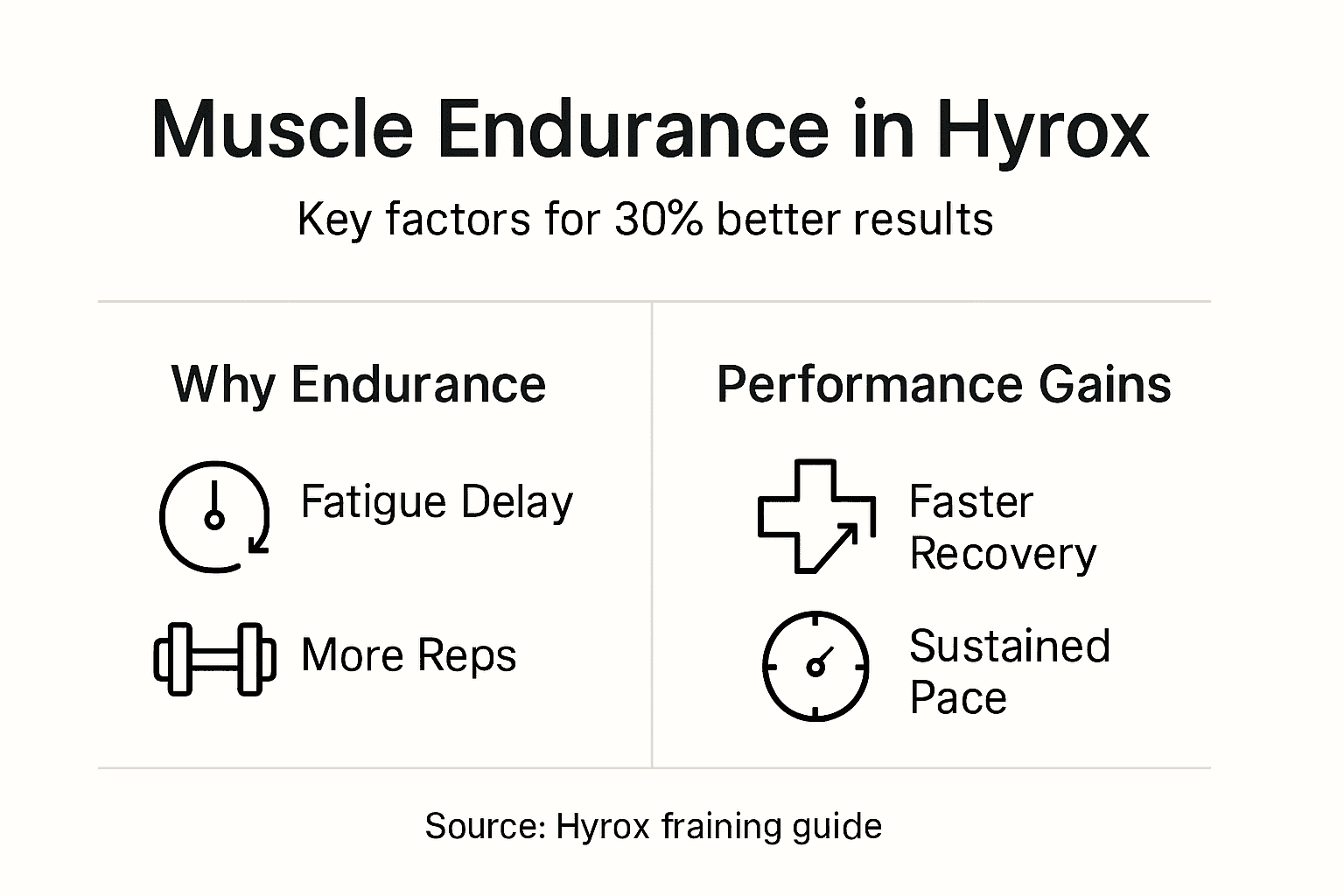
Fatigue resistance also speeds recovery between efforts. If your endurance is well developed, you clear lactate faster and replenish energy stores more efficiently. This translates to shorter rest periods between stations and better overall race times. Your body becomes more resilient to the repeated stress of high intensity intervals.
Sustaining force output over time leads to better Hyrox results. When your muscles can contract powerfully for the 20th rep as they did for the first, your performance stays consistent. This consistency prevents the form breakdown and compensatory movement patterns that increase injury risk and slow you down.
Mental resilience follows physical endurance. When you know your body can handle prolonged effort without collapsing, you approach races with confidence. Reduced physical burnout means you can push harder mentally, staying focused and aggressive even when discomfort sets in.
Combining endurance training with proper nutrition optimises outcomes. Carbohydrate availability fuels repeated contractions. Protein supports muscle repair and adaptation. Micronutrients like iron and B vitamins enable oxygen transport and energy metabolism. Neglecting nutrition undermines even the best training program.
Key performance benefits:
- Delayed fatigue onset during prolonged high intensity efforts
- Faster recovery between training sessions and competition stations
- Sustained force output across multiple repetitions and rounds
- Enhanced mental resilience and confidence under fatigue
- Improved overall race times and competitive results
Enhance your muscle endurance with targeted nutrition and supplements
Building muscle endurance through training is only half the equation. Proper nutrition and supplementation amplify your gains and accelerate recovery. Female Hyrox athletes need strategic fueling to support the high training volumes that endurance work demands.
Pre workout supplements can optimise energy availability and focus before intense endurance sessions. Natural ingredients like caffeine, beta alanine, and citrulline enhance blood flow, buffer fatigue, and improve exercise capacity. Explore our best pre-workout supplements 2025 comparison to find options tailored for women in high intensity sports.

Before every training session, use a structured pre-workout checklist for women to ensure you’re properly hydrated, fueled, and mentally prepared. Small details like timing your last meal or choosing the right supplement can significantly impact your training quality and adaptation.
Balanced nutrition supports both endurance development and recovery. Carbohydrates replenish glycogen stores depleted during high rep training. Protein provides amino acids for muscle repair. Healthy fats support hormone production and reduce inflammation. Learn how to balance nutrition naturally for Hyrox women to optimise your performance outcomes without restrictive diets.
Frequently asked questions
What is the main difference between muscle endurance and muscle strength?
Muscle endurance is the ability to sustain repeated contractions over time without fatigue, using moderate loads for high reps. Muscle strength focuses on generating maximal force in a single or few repetitions, using heavy loads. Endurance builds stamina for prolonged efforts, while strength develops peak power output.
How can I measure my muscle endurance effectively?
Perform a bodyweight exercise like push ups or squats to failure with strict form. Count total reps completed. Alternatively, use a submaximal load (50 to 60% of your 1RM) and measure how many reps you can complete before form breaks down. Track these numbers over time to gauge improvement.
What types of exercises are best for building muscle endurance?
High repetition resistance training with moderate loads works best. Circuit training combining squats, lunges, push ups, burpees, and planks builds endurance efficiently. Use 10 to 25 reps per set with minimal rest. Compound movements that engage multiple muscle groups transfer best to Hyrox performance demands.
How does nutrition impact muscle endurance training?
Carbohydrates fuel repeated contractions by maintaining glycogen stores. Protein supports muscle repair and adaptation after high volume training. Electrolytes prevent cramping and maintain muscle function during prolonged efforts. Adequate hydration and micronutrient intake optimise energy metabolism and oxygen delivery. Poor nutrition undermines training adaptations and slows recovery.
How does improved muscle endurance enhance Hyrox performance?
Better endurance delays fatigue onset during competition, allowing you to sustain effort across all eight stations. It speeds recovery between intervals, reduces form breakdown under fatigue, and improves overall race times. Enhanced endurance also builds mental resilience, giving you confidence to push harder when discomfort increases late in the race.