


Muscle Glycogen: Powering Female Hyrox Performance
Reaching the halfway point in a Hyrox race and feeling your legs suddenly heavy is a struggle many British women athletes know all too well. For female Hyrox competitors aged 30 to 50, understanding how your muscles fuel high-intensity performance can determine how strong you finish. By learning how muscle glycogen supports every explosive movement, you can harness the power of natural pre-workout supplements for sustained energy and sharper focus.
Table of Contents
- Muscle Glycogen And Its Essential Role
- Why Glycogen Matters For High-Intensity Performance
- How Glycogen Storage Works
- Practical Application For Your Hyrox Training
- How Muscles Store And Use Glycogen
- Where Glycogen Lives In Your Muscles
- How Your Body Mobilises Glycogen During Exercise
- Practical Storage Implications For Female Athletes
- Influences On Glycogen Levels In Athletes
- Training Load And Exercise Type
- Dietary Carbohydrate Timing And Quantity
- Recovery And Training Periodisation
- Hormonal Influences On Female Athletes
- Practical Application For Competition Preparation
- Optimising Glycogen Through Natural Nutrition
- Post-Workout Nutrition Timing
- Choosing The Right Carbohydrate Sources
- Balancing Nutrition For Long-Term Performance
- Natural Supplementation For Glycogen Support
- Common Pitfalls And Recovery Mistakes
- Inadequate Carbohydrate Intake
- Improper Timing Of Nutrition
- Neglecting Hydration Status
- Recovery Practices Beyond Nutrition
Key Takeaways
| Point | Details |
|---|---|
| Muscle Glycogen is Crucial for Performance | Glycogen stored in muscles provides immediate energy during high-intensity activities like Hyrox, impacting overall performance significantly. |
| Strategic Carbohydrate Intake is Essential | Consistently consuming carbohydrates pre- and post-workout maximises glycogen availability, aiding recovery and preparation for competition. |
| Adequate Recovery and Nutrition Timing Matter | Properly timed carbohydrate intake, especially within the first hour post-exercise, is critical for optimal glycogen restoration and performance enhancement. |
| Female Athletes Should Address Unique Needs | Women aged 30-50 should focus on increased carbohydrate intake and understanding hormonal impacts to optimise glycogen storage and utilisation. |
Muscle Glycogen And Its Essential Role
Muscle glycogen is your body’s primary fuel source during intense Hyrox competition. It’s stored directly in your muscle cells and provides rapid energy when you need it most.
Unlike liver glycogen, which can be distributed throughout your body, muscle glycogen fuels muscle contractions directly. This is a critical distinction for athletes like you.
During a Hyrox race, your muscles demand energy constantly. From the SkiErg to the rope climb to the final sprint, you’re depleting these glycogen stores with every movement. When glycogen runs low, your performance drops noticeably.
Women aged 30-50 often carry less total muscle mass than younger athletes, making efficient glycogen utilisation even more important. Your muscles become selective about energy sources, prioritising what they store and how they use it.
Why Glycogen Matters for High-Intensity Performance
Hyrox demands repeated high-intensity efforts over roughly 60 minutes. This isn’t steady-state cardio. You’re sprinting, lifting, climbing, and pushing hard.
Glycogen breakdown happens rapidly during these bursts:
- Immediate energy – Powers the first 10-15 seconds of intense effort
- Sustained power – Enables repeated efforts throughout the race
- Mental clarity – Adequate glycogen supports decision-making and focus
- Recovery between obstacles – Replenishes during lower-intensity transitions
Your muscles can store roughly 300-600 grams of glycogen, but Hyrox demands consistent access to this fuel throughout the entire race.
Carbohydrate availability directly influences your ability to maintain speed and strength. Research shows that skeletal muscle glycogen serves as the main energy substrate during high-intensity exercise, enabling rapid energy supply through glycogen breakdown.
This is why your pre-workout nutrition strategy matters. Filling your glycogen stores before race day isn’t optional—it’s fundamental to competitive performance.
How Glycogen Storage Works
Your body stores glycogen through a process called glycogenesis. When you consume carbohydrates, they’re broken down into glucose and stored in muscle and liver cells.
But storage capacity has limits:
- Muscles store about 1-2% of their weight as glycogen
- This capacity depends on training status and muscle fibre type
- Better-trained athletes store more glycogen in the same muscle volume
- Glycogen storage peaks when combined with proper carbohydrate intake
Female athletes often underestimate carbohydrate needs. Research indicates that women benefit from strategic carbohydrate timing—especially pre-workout—to optimise glycogen availability.
Practical Application for Your Hyrox Training
Understanding glycogen helps you make better pre-race choices. You’re not just eating for immediate energy; you’re fuelling a specific metabolic process.
Consider how carbohydrate intake supports high-intensity performance in your training sessions. The same principles apply to competition day.
Your pre-workout supplement should support glycogen availability. Look for natural carbohydrate sources combined with electrolytes to enhance absorption and maintain energy delivery.
Pro tip: Time your carbohydrate intake 60-90 minutes before Hyrox competition to allow complete digestion whilst maximising glycogen storage—this timing gives your body enough time to process fuel without causing gastric discomfort during the race.
How Muscles Store And Use Glycogen
Your muscles don’t just use glycogen—they’re specifically designed to store and mobilise it with remarkable precision. Understanding this process reveals why your pre-race nutrition timing matters so much.

Glucose enters your muscle cells through GLUT4 transporters, specialised doorways that open when insulin is present or when your muscles contract. This is why eating carbohydrates and training both increase your glycogen storage capacity.
Once inside, glucose is converted into glycogen molecules and stored in specific compartments within your muscle fibres. Muscle glycogen is stored in distinct subcellular compartments, allowing rapid mobilisation when you need energy most.
This compartmentalisation is critical. Your body doesn’t dump all glycogen into one location. Instead, it distributes stores strategically for quick access during intense effort.
Where Glycogen Lives In Your Muscles
Not all muscle fibres are created equal when it comes to glycogen storage. Your body contains fast-twitch and slow-twitch fibres, and they handle glycogen differently.
Fast-twitch fibres power your sprints, climbs, and explosive movements during Hyrox. Slow-twitch fibres sustain you during longer efforts. Glycogen is heterogeneously stored in fast- and slow-twitch fibres, meaning each fibre type prioritises its own fuel reserves.
This matters because:
Here’s how muscle glycogen storage differs by muscle fibre type:
| Feature | Fast-Twitch Fibres | Slow-Twitch Fibres |
|---|---|---|
| Main function | Explosive power and sprints | Endurance and sustained activity |
| Glycogen depletion speed | Rapid during high intensity | Gradual during prolonged exercise |
| Restoration requirement | Refuel quickly post-effort | Maintain replenishment daily |
| Hyrox impact | Fuels sprints and obstacles | Supports pacing between intervals |
- Fast-twitch dominates Hyrox efforts – Uses glycogen quickly but intensely
- Slow-twitch provides endurance – Burns glycogen steadily throughout the race
- Fibre-specific utilisation – Each type draws from its local stores first
- Performance depends on both – You need both systems firing properly
Your fast-twitch fibres can deplete their glycogen rapidly—sometimes within minutes of hard effort—which is why strategic fuelling before race day is non-negotiable.
How Your Body Mobilises Glycogen During Exercise
When you start the Hyrox race, your muscles demand ATP—the chemical energy currency that powers contractions. Glycogen breakdown provides glucose molecules to fuel this process both aerobically and anaerobically.
During the first obstacle, your muscles use anaerobic pathways—no oxygen required. Glycogen breakdown is immediate and abundant. This is raw power.
As you progress through the race and intensity varies, your body shifts between anaerobic and aerobic pathways. Both systems pull from your glycogen stores, but at different rates.
Your pre-workout supplementation strategy should consider how muscle pump enhances HIIT performance naturally by improving blood flow and nutrient delivery to working muscles. Better blood flow means better glycogen delivery when your muscles need it.
Practical Storage Implications for Female Athletes
Women aged 30-50 often have lower baseline glycogen stores than younger counterparts, but this is entirely addressable through proper nutrition.
Key factors affecting your glycogen storage:
- Training status – Regular, intense training increases storage capacity
- Carbohydrate intake – Higher intake before and after training boosts stores
- Muscle mass – More muscle means more storage space
- Hormonal status – Oestrogen influences glycogen regulation and storage
Female athletes benefit from understanding that your menstrual cycle can influence glycogen metabolism. Timing your high-carbohydrate intake strategically around training cycles optimises storage.
Pro tip: Load carbohydrates 3-5 days before Hyrox competition, not just the night before, to maximise glycogen saturation across all muscle fibres and ensure both fast-twitch and slow-twitch stores are completely full.
Influences On Glycogen Levels In Athletes
Your glycogen levels aren’t fixed. They fluctuate constantly based on what you eat, how hard you train, and how well you recover. For female Hyrox athletes, understanding these influences is the difference between showing up depleted and showing up ready.
Multiple factors work together to determine your muscle glycogen status on race day. Some you control completely. Others require strategic planning.
Training Load And Exercise Type
How hard you train directly impacts glycogen depletion. A brutal VO2 max session burns glycogen faster than steady-state work. Glycogen levels are influenced by exercise modality, intensity, and duration combined with dietary carbohydrate availability.
Hyrox-specific training demands repeated high-intensity efforts. Your SkiErg intervals, rope climbs, and burpee box jump-overs all torch glycogen rapidly. Longer training sessions compound this depletion.
The type of exercise matters too. Your body uses glycogen differently during sprinting versus distance running. Understanding your training style helps you fuel appropriately.
Dietary Carbohydrate Timing And Quantity
What you eat—and when—directly shapes your glycogen stores. This isn’t about eating more generally. It’s about strategic carbohydrate timing.
Glycogen supercompensation occurs following exhaustive exercise followed by high-carbohydrate intake, with magnitude influenced by baseline glycogen, exercise type, and diet composition. This is your supercompensation window.
Inadequate carbohydrate intake creates a glycogen deficit that carries forward. You can’t train hard tomorrow if you didn’t refuel today. The compounding effect weakens your performance week after week.
Key timing windows:
- During training – Carbs provide ongoing fuel for long sessions
- Immediately post-workout – Maximises glycogen restoration rate
- Throughout the day – Baseline carbohydrate intake supports daily glycogen maintenance
- Pre-competition – Strategic loading fills stores completely
Waiting until race week to focus on carbohydrates is too late. Your glycogen status reflects weeks of dietary choices, not one day of eating.
Recovery And Training Periodisation
Glycogen restoration requires more than food. It requires time and proper recovery strategies. Glycogen content fluctuates with training load, dietary carbohydrate intake, and recovery strategies.
Insufficient recovery time between hard sessions means incomplete glycogen restoration. Your next workout begins with depleted stores. This is how overtraining develops and performance stalls.
Female athletes often underestimate recovery needs. Your hormonal cycle influences recovery capacity, meaning some weeks you genuinely need more rest days than others.
Hormonal Influences On Female Athletes
Oestrogen affects how your body stores and uses glycogen. During certain phases of your menstrual cycle, your glycogen utilisation efficiency changes.
Folicular phase training (days 1-14 approximately) often allows better carbohydrate utilisation and glycogen storage. Luteal phase training (days 15-28 approximately) sometimes demands higher carbohydrate intake to maintain the same glycogen availability.
This isn’t about excuses. It’s about timing your peak training intensity around your natural physiology.
Practical Application For Competition Preparation
Understanding how carb loading enhances endurance for female athletes helps you strategically prepare for Hyrox. Carb loading isn’t random overeating—it’s systematic glycogen maximisation.
Start monitoring your glycogen status several weeks before competition. Track how you feel after hard sessions. Notice recovery quality. Adjust carbohydrate intake based on actual performance feedback.
Pro tip: Begin carbohydrate loading 5-7 days before Hyrox by gradually increasing carbohydrate intake whilst reducing training intensity, allowing your body to restore glycogen fully whilst maintaining training-induced adaptations.
Optimising Glycogen Through Natural Nutrition
Natural nutrition beats synthetic alternatives for glycogen restoration. Your body recognises whole foods and absorbs their carbohydrates more efficiently than processed supplements. This matters because better absorption means better glycogen replenishment.
The key is timing carbohydrates strategically around your training. You’re not just eating carbs—you’re orchestrating glycogen synthesis at the precise moment your muscles are primed to accept them.
Post-Workout Nutrition Timing
The 30-60 minutes immediately after Hyrox training is your critical window. Your muscles are hungry for glucose and ready to store it as glycogen.
Optimal glycogen restoration requires consuming sufficient dietary carbohydrates timed appropriately post-exercise. This isn’t about quantity alone—timing amplifies the effect.
Delaying carbohydrate intake by just two hours reduces glycogen synthesis rates significantly. Your muscles shift from restoration mode back to maintenance mode. You’ve lost your advantage.
Post-workout nutrition strategy:
- Consume within 30-60 minutes – Maximises glycogen synthesis rate
- Include 1-1.2 grams per kilogramme of body weight – Optimal carbohydrate dose
- Pair with protein – Enhances amino acid uptake and muscle repair
- Use whole food sources – Natural sugars and complex carbohydrates together
The post-workout window is non-negotiable. Missing it costs you days of recovery time.
Choosing The Right Carbohydrate Sources
Not all carbohydrates work equally for glycogen restoration. Simple carbohydrates like rice, potatoes, and fruit restore glycogen faster than whole grains in the immediate post-workout period.
Glucose ingestion post-exercise most effectively increases muscle glycogen synthesis. This doesn’t mean table sugar—it means foods naturally high in glucose and simple carbohydrates.
Best post-workout carbohydrate choices:
- White rice with banana
- Toast with honey and berries
- Rice cakes with dates
- Potato with fruit
- Sports drink made from fruit juice and water
Complex carbohydrates (oats, wholemeal bread, brown rice) are excellent throughout the day but slower to absorb immediately post-workout. Save them for meals 2-3 hours after training.
Balancing Nutrition For Long-Term Performance
Don’t mistake post-workout timing for your entire nutritional strategy. Balancing nutrition naturally for Hyrox and intense sports requires consistent carbohydrate intake throughout the day.
Your baseline glycogen status reflects weeks of dietary choices. If you eat inadequate carbohydrates on non-training days, you start hard training sessions partially depleted. This compounds over time.
Female athletes aged 30-50 benefit from 5-7 grams of carbohydrate per kilogramme of body weight daily for moderate training, increasing to 7-10 grams during intense training blocks. This isn’t excessive—it’s appropriate fuelling for your activity level.
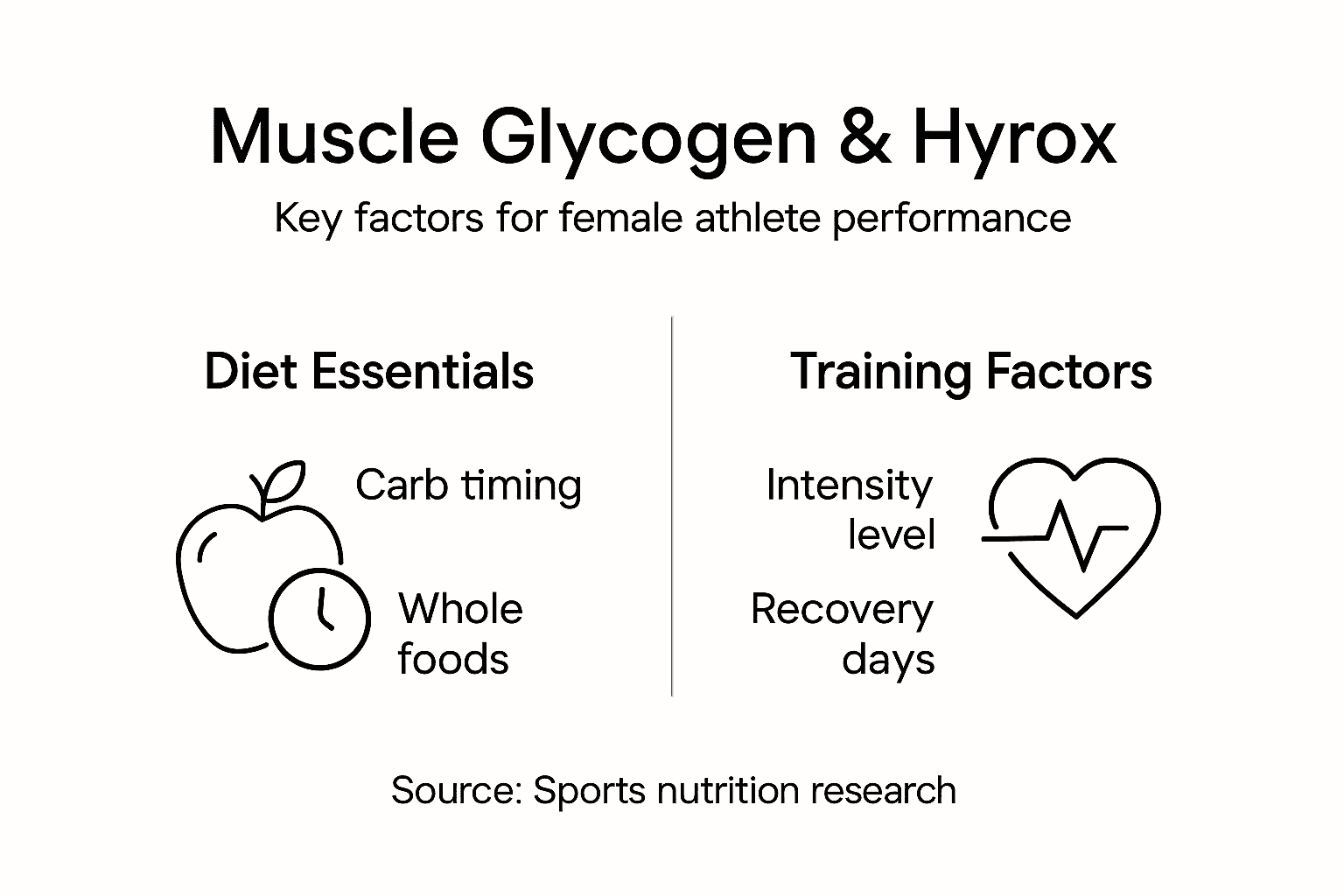
Here’s a summary of optimal glycogen management for female Hyrox athletes:
| Aspect | Best Practice | Mistake to Avoid |
|---|---|---|
| Carbohydrate Intake | 5-7g/kg daily for moderate, 7-10g for high | Skipping carbs on rest days |
| Timing | Within 30-60 mins post-workout | Delayed intake slows recovery |
| Hydration | Combine fluids with electrolytes | Only drinking water post-exercise |
| Supplementation | Use whole foods and natural products | Over-reliance on processed powders |
Natural Supplementation For Glycogen Support
While whole foods form your foundation, natural pre-workout supplements containing carbohydrates, electrolytes, and amino acids amplify glycogen availability during prolonged efforts.
Look for supplements combining natural carbohydrate sources (dates, coconut sugar, brown rice) with electrolytes for absorption and amino acids for muscle support. This combination sustains energy delivery throughout your 60-minute Hyrox effort.
Pro tip: Eat a mixed meal containing carbohydrates and protein 2-3 hours before Hyrox training, then consume simple carbohydrates with your natural pre-workout supplement 30-45 minutes before the race to maintain glycogen availability from training into competition.
Common Pitfalls And Recovery Mistakes
Most female Hyrox athletes make the same recovery mistakes repeatedly. These aren’t character flaws—they’re knowledge gaps. Understanding what goes wrong helps you avoid the performance drop that comes from poor glycogen management.
Recovery mistakes compound. One bad recovery day becomes two weak training sessions. Two weak sessions become a stalled performance plateau. Stop the cycle before it starts.
Inadequate Carbohydrate Intake
The number one mistake is undereating carbohydrates consistently. Women often fear carbohydrates, treating them as something to minimise rather than a performance fuel.
Common pitfalls in muscle glycogen management include inadequate carbohydrate intake. This single mistake cascades through your entire training block, leaving you perpetually underfuelled.
You can’t out-train poor nutrition. If you’re eating 4 grams of carbohydrate per kilogramme of body weight but training like someone eating 7 grams, your glycogen stores deplete faster than they replenish.
Female athletes aged 30-50 commonly restrict calories aggressively. This backfires. Less food means less carbohydrate, which means lower baseline glycogen, which means weaker training sessions, which means slower adaptation.
Carbohydrate intake mistakes:
- Too low on rest days – Depletes baseline stores gradually
- Inadequate around training – Misses the fuel when muscles need it
- Inconsistent day-to-day – Prevents full glycogen restoration
- Skipping post-workout meals – Wastes the critical restoration window
Improper Timing Of Nutrition
Timing matters more than most athletes realise. Eating the right carbohydrates at the wrong time is barely better than not eating them.
Improper timing of nutrient intake post-exercise delays glycogen restoration significantly. Waiting two hours after training to eat carbohydrates reduces synthesis rates by 50 percent or more.
Your muscles have a 30-60 minute window when they’re maximally receptive to glucose. This window closes gradually. After two hours, you’re no longer in peak restoration mode.
Timing errors:
- Eating carbohydrates too late post-workout
- Consuming only fats and protein immediately after training
- Spacing meals too far apart throughout the day
- Front-loading carbohydrates without protein support
The difference between eating carbohydrates at the right time versus two hours late is roughly 24-48 additional hours of recovery time.
Neglecting Hydration Status
Glycogen restoration depends on adequate hydration. Your body needs water to synthesise and store glycogen effectively. Dehydrated muscles can’t replenish glycogen optimally.
This is why electrolyte-containing drinks matter more than plain water post-workout. Your natural pre-workout supplement should include electrolytes that enhance fluid absorption and glycogen uptake simultaneously.
Hydration mistakes:
- Insufficient overall fluid intake – Impairs glycogen synthesis
- No electrolytes with water – Reduces carbohydrate absorption
- Drinking too much water too quickly – Causes stomach discomfort without benefit
- Ignoring individual sweat rate – Underprepares for race-day fuelling
Recovery Practices Beyond Nutrition
Nutrition is only part of recovery. Sleep quality, stress management, and training load balance matter equally. You can eat perfectly but still fail to restore glycogen if you’re sleeping four hours nightly.
Female athletes often prioritise training volume over recovery quality. This is backwards. Training creates the stimulus. Recovery builds the adaptation. Without adequate sleep and stress management, glycogen restoration stalls regardless of nutrition.
Pro tip: Track your post-workout meal timing and carbohydrate intake for one week, noting how you feel during the next training session—you’ll identify exactly where your timing gaps are and can adjust before race day arrives.
Fuel Your Muscle Glycogen For Peak Hyrox Performance
The article highlights how muscle glycogen availability is critical for sustaining power during Hyrox races. As a female athlete aged 30-50, you face unique challenges including efficient glycogen utilisation and the need for carefully timed carbohydrate intake. Struggling with inadequate energy or slow recovery? You are not alone. Fast-twitch muscle fibres demand rapid fuel that only well-managed glycogen stores can provide. Our solutions at Useinterval focus on natural pre-workout supplements and electrolyte blends designed to enhance glycogen storage and delivery, giving your muscles the fuel they call for.

Don’t let glycogen depletion undermine your race day. Take control by supporting your nutrition with scientifically crafted supplements that use natural ingredients to boost glycogen availability and muscle pump. Discover how a well-timed dose before training or competition can elevate your Hyrox performance. Visit Useinterval now to explore how to optimise your race preparation and make every rep count.
Frequently Asked Questions
How does muscle glycogen affect athletic performance in Hyrox?
Muscle glycogen serves as the primary energy source during high-intensity exercises, providing rapid fuel for muscle contractions and enabling sustained power throughout the Hyrox competition.
What role does carbohydrate timing play in glycogen storage for female athletes?
Strategic carbohydrate timing, especially pre-workout, can optimise glycogen availability and improve performance. Consuming carbohydrates 60-90 minutes before competition maximises glycogen storage without causing gastric discomfort during the race.
How can female athletes increase their muscle glycogen stores?
Regular intense training, consuming adequate carbohydrates, and considering hormonal influences can enhance glycogen storage capacity. It’s important for athletes to monitor their intake to ensure they are fuelling their training demands adequately.
What are the consequences of inadequate carbohydrate intake on glycogen levels?
Inadequate carbohydrate intake can lead to reduced glycogen stores, resulting in decreased performance, slower recovery, and an inability to sustain intensity during workouts, potentially leading to a plateau in training adaptation.