


Home workout routine guide for real results
TL;DR:
- A consistent, well-structured home workout routine requires minimal equipment and focuses on progressive overload and autoregulation. Building habits through simple sessions, tracking progress, and listening to your body ensure long-term results without complexity. Prioritizing consistency over perfection, along with proper warm-up and recovery, maximizes fitness gains in a sustainable way.
You don’t need a gym membership, expensive kit, or hours of free time to get genuinely fit. A well-structured home workout routine guide gives you everything you need to build strength, improve endurance, and feel better in your own body. Whether you’ve never followed a training plan before or you’ve just lost access to a gym, the truth is that bodyweight training done consistently outperforms sporadic gym sessions every time. This article gives you a practical, no-fluff at-home fitness guide built on real exercise science and designed to produce results.
Table of Contents
- Key takeaways
- Before you start your home workout routine
- How to create your beginner home workout plan
- Autoregulating your effort day to day
- Common mistakes and how to fix them
- What to expect and when
- My honest take on home workout routines
- Take your home training further with Useinterval
- FAQ
Key takeaways
| Point | Details |
|---|---|
| Consistency beats perfection | Training major muscle groups twice weekly matters more than having an elaborate plan. |
| You need almost no equipment | Household items and bodyweight exercises cover the full range of strength and aerobic work. |
| Structure your sessions properly | Every session needs a warm-up, main circuit, and cool-down to reduce injury risk and improve adherence. |
| Autoregulate your effort | Use the RPE scale daily to adjust intensity based on how your body actually feels. |
| Track simple metrics | Rep counts, perceived difficulty, and energy levels tell you everything you need about progress. |
Before you start your home workout routine
Getting started is less about what equipment you own and more about setting up the right conditions for consistency. Here’s what you actually need before your first session.
Space and environment
You need a floor area roughly 2 metres by 2 metres. A bedroom, living room, or garden all work fine. The goal is enough room to lie flat, do a lunge, and jump without hitting anything. That’s it.
Equipment (or lack of it)
A no equipment workout routine is entirely legitimate for beginners. Your bodyweight provides more than enough resistance to build real strength in the first 8 to 12 weeks. When you want to add load later, a backpack filled with books, a water bottle, or a resistance band costing a few pounds will do the job.
Mindset and consistency
The single biggest determinant of whether your home routine works is whether you show up. Training consistency matters far more than having a sophisticated plan, particularly in the early months. Decide on your days in advance and treat them like appointments.
Health considerations
If you have a known injury, joint issue, or chronic condition, speak to your GP before starting. Most people in the 20 to 40 age range can begin bodyweight training without any medical clearance, but it’s worth being honest with yourself about any limitations.
- Clear your workout space of trip hazards before every session
- Wear trainers with some grip, especially on hard floors
- Keep water nearby; hydration matters even in 20-minute sessions
- Avoid training immediately after large meals
Warm-up and cool-down
A 2 to 3 minute warm-up of dynamic movements like leg swings, arm circles, and hip rotations prepares your joints and raises your core temperature. A cool-down of static stretches for the same duration reduces next-day soreness and improves long-term flexibility. Skipping either is the most common beginner mistake. You can find solid warm-up examples that work for any fitness level.
Pro Tip: Set your workout clothes out the night before. It sounds trivial, but reducing the friction of getting started is one of the most reliable ways to build a training habit.
| Approach | Outcome |
|---|---|
| Skipping warm-up | Higher injury risk, stiff joints, reduced performance |
| Including warm-up | Better movement quality, lower injury risk, improved focus |
| Skipping cool-down | Increased soreness, slower recovery between sessions |
| Including cool-down | Faster recovery, improved flexibility over time |
How to create your beginner home workout plan
A good beginner home workout plan follows a simple three-part structure for every session: warm-up, main circuit, cool-down. The main circuit is where most of your time goes, and it should balance pushing, pulling, hinging, and squatting movements to hit your full body.
Here is a practical example of a 20-minute beginner session built around proven bodyweight movements:
- Warm-up (3 minutes): Leg swings, arm circles, hip rotations, slow bodyweight squats
- Circuit round 1 (7 minutes): 10 bodyweight squats, 8 push-ups, 10 reverse lunges per leg, 20-second plank hold, 15 jumping jacks
- Circuit round 2 (5 minutes): Repeat the circuit above with a 30-second rest between exercises
- Cool-down (5 minutes): Seated hamstring stretch, child’s pose, chest opener, standing quad stretch
A 20-minute bodyweight session done 2 to 4 times weekly builds real fitness. It covers squats, push-ups, lunges, planks, and light aerobic work. That combination addresses both strength and cardiovascular health in a single session.
For frequency, aim for 3 sessions per week with a rest or active recovery day between each. Starting at 20 to 30 minutes per session is enough. As you get fitter, you can add a fourth session or extend the circuit by one or two rounds.

Balancing strength and aerobic work
The ACSM recommends combining aerobic and resistance training for the best health outcomes, targeting at least 150 minutes of moderate aerobic activity per week alongside two or more resistance sessions. Your home circuit satisfies both requirements when you keep rest periods short and include cardio movements like jumping jacks or mountain climbers.
Progressive overload without equipment
The triple progression model gives you a clear path forward. First, increase your reps until you reach the top of your target range. Then increase difficulty by changing body position or using a unilateral variation. Finally, adjust tempo by slowing the eccentric phase to add intensity without adding weight. This keeps your body adapting week after week.
Pro Tip: Write down your reps and rounds after every session. When you can consistently complete the top of your rep range with good form, it’s time to progress. Without records, you’re guessing.
Autoregulating your effort day to day
Not every training day will feel the same. Work stress, poor sleep, and life in general affect how your body responds to training. Autoregulation is the practice of adjusting your session based on how you actually feel that day rather than blindly following a fixed plan.
The RPE scale runs from 1 to 10. An RPE of 8 means you have roughly 2 reps left before failure. For most training sessions, working at RPE 7 to 8 is the target. On days when you feel sharp, push to the top of your rep ranges. On low-energy days, reduce volume by one round or swap hard exercises for easier variations.
Practical signals to pay attention to:
- Grip strength on waking: If opening a jar feels harder than usual, your recovery is incomplete
- Resting heart rate: A rise of 5 or more beats per minute above your normal can signal under-recovery
- Joint stiffness: Persistent stiffness in knees or shoulders before warming up suggests reducing lower body or pressing volume that day
- Mood and motivation: Consistently low motivation for training is often a sign of accumulated fatigue, not laziness
Combining RPE with biofeedback signals like heart rate and joint mobility lets you tailor your daily load with precision, even at home without any monitoring technology.
Active recovery days are as important as training days. A 20-minute walk, light stretching, or yoga keeps blood moving and accelerates recovery without adding training stress. Plan one or two of these per week from the start, not as an afterthought.
Pro Tip: Before each session, rate how you feel out of 10. If you score below 5, scale the session back rather than skipping it entirely. A scaled session keeps the habit alive without digging a recovery hole.
Common mistakes and how to fix them
Even with a solid daily exercise schedule for home, most beginners hit the same predictable walls. Knowing what they are ahead of time makes them much easier to manage.
- Skipping progression: Doing the same workout week after week stops producing results within 4 to 6 weeks. Add reps, slow your tempo, or increase exercise difficulty on a structured progression plan to keep adapting
- Ignoring form in favour of reps: A sloppy push-up is less useful and more risky than a controlled one. Record yourself on your phone occasionally to check your technique
- Treating motivation as the engine: Motivation comes and goes. Schedule your sessions and rely on habit, not inspiration
- No tracking: Without records, you can’t see progress, and invisible progress is demotivating. Use a notebook or a simple app
- All training, no recovery: More sessions do not always mean faster progress. Recovery is when adaptation actually happens
“The goal is not to find the perfect workout. The goal is to keep showing up.”
Progress tracking without equipment is straightforward. Count your reps, note how hard the session felt on the RPE scale, and track your energy levels after training. Over 6 to 8 weeks, those numbers will tell a clear story.
What to expect and when
Setting realistic expectations stops people from quitting too early. Here is a realistic timeline for what a structured home workout routine produces.
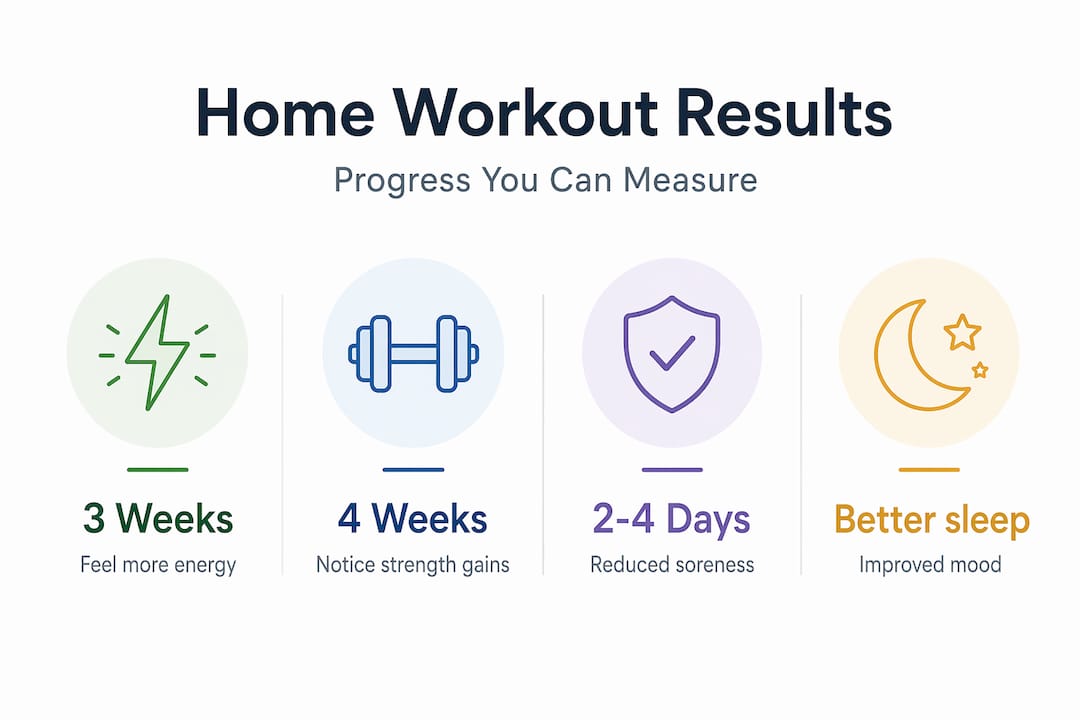
| Week range | What typically happens |
|---|---|
| Weeks 1 to 2 | Muscle soreness, learning movement patterns, fatigue after sessions |
| Weeks 3 to 4 | Soreness reduces, reps increase, sessions feel more manageable |
| Weeks 5 to 8 | Noticeable strength gains, improved endurance, better sleep quality |
| Weeks 9 to 12 | Clear physical changes, higher baseline energy, habit firmly established |
Beyond the physical changes, consistent training produces measurable improvements in mood, sleep quality, and daily energy. These benefits often appear before visible body composition changes, which is worth remembering during the early weeks when progress feels slow.
If your numbers have not improved after 4 consecutive weeks, the fix is almost always one of three things: increase session frequency, add progression, or improve sleep and nutrition. A structured beginner programme that maps out week-by-week progression removes the guesswork from this process.
My honest take on home workout routines
I’ve watched a lot of people start home training programmes with enormous enthusiasm and a downloaded 12-week plan they’ll never finish. In my experience, the plan itself is rarely the problem. The problem is that it’s too complicated to follow consistently when life gets in the way.
What I’ve found actually works is simpler than most people expect. Three sessions a week. The same basic movement patterns. A notebook. That’s the foundation. Once you’ve built the habit over six to eight weeks, adding complexity is easy because you’re already showing up.
The thing I’d push back on is the idea that home workouts are a compromise compared to the gym. For most people in their twenties and thirties, a well-run bodyweight routine produces better results than inconsistent gym attendance, because the barrier to entry is so much lower. You don’t need to commute, pay, or wait for equipment. You just need to start.
Autoregulation changed how I think about training load. Listening to biofeedback rather than grinding through a fixed plan regardless of how you feel is not a sign of weakness. It’s the reason experienced athletes stay injury-free for years while beginners burn out in months.
Start simple. Stay consistent. Progress deliberately. That’s the whole thing.
— Tom
Take your home training further with Useinterval
Building a solid routine is the foundation. Fuelling it properly is what separates people who plateau from people who keep progressing. At Useinterval, we’ve built products specifically for people training at high intensity, whether that’s in a gym or in their living room. Our Starter Bundle pairs a natural-ingredient pre-workout with electrolytes designed to support performance and recovery in the sessions that matter. No unnecessary additives, no proprietary blends that hide what you’re actually taking. Just clean, effective fuel that works as hard as your training does. If you’re serious about getting results from your home programme, the right nutrition makes every session count more.
FAQ
How many days a week should beginners train at home?
Three sessions per week with rest or active recovery days in between is the standard starting point. Most beginners see consistent progress on this frequency before adding a fourth session.
Do I need any equipment for a home workout routine?
No. A bodyweight-only routine covers squats, push-ups, lunges, planks, and aerobic movements that build real strength and fitness. Equipment becomes useful for progression after several months.
How long before I see results from a home workout plan?
Most people notice improved energy and reduced soreness within 2 to 3 weeks. Measurable strength gains and physical changes typically appear between weeks 5 and 8 of consistent training.
What is RPE and why does it matter for home training?
RPE stands for Rate of Perceived Exertion and runs from 1 to 10. Using it lets you adjust your session intensity based on daily readiness, which prevents overtraining and keeps progress sustainable over months.
How do I stop plateauing in a no equipment workout routine?
Apply the triple progression model: increase reps first, then increase exercise difficulty through position or unilateral variations, and finally slow your tempo. Changing one variable at a time is enough to keep your body adapting.