


Optimise your Hyrox race: pre-race fueling explained
TL;DR:
- Proper pre-race fueling involves strategic carbohydrate, protein, and hydration plans 24 to 48 hours before Hyrox.
- Women aged 30 to 50 should focus on higher protein intake and cycle-specific nutritional adjustments.
- Avoid introducing new foods, high fiber, fat, and alcohol close to race day to prevent gastrointestinal distress.
You train hard, sleep well, and show up ready — yet you still feel sluggish, heavy, or foggy within the first 20 minutes of your Hyrox race. More often than not, the culprit is not your fitness. It is what you ate (or did not eat) in the 48 hours beforehand. Pre-race fueling is one of the most overlooked performance levers for female Hyrox athletes, yet it can be the difference between a personal best and hitting the wall during the sled pulls. This guide breaks down exactly what to eat, when to eat it, and how to adapt it to your body as a woman aged 30 to 50 competing at high intensity.
Table of Contents
- What is pre-race fueling and why does it matter?
- How to fuel: the 48-hour strategy
- Women-specific needs: performance fueling for ages 30-50
- Common mistakes and what to avoid
- What most Hyrox guides miss: gut training and real-world adjustments
- Take your Hyrox fueling to the next level
- Frequently asked questions
Key Takeaways
| Point | Details |
|---|---|
| Strategic fueling wins | What and when you eat is as vital as fitness for Hyrox race performance. |
| Carbs are key | Focus on low-fibre, high-carbohydrate meals before your race to power muscles efficiently. |
| Test before race day | Always trial your fueling routine in training to prevent race-day surprises. |
| Women’s unique needs | Females 30-50 should watch protein and iron intake for best results, but main fueling steps remain similar. |
| Avoid GI distress | Skip high fat/fibre foods and stick to what you’ve practised to avoid digestive issues. |
What is pre-race fueling and why does it matter?
Pre-race fueling is not simply eating more the night before a race. It is a deliberate, structured approach to nutrition in the 24 to 48 hours before competition. Specifically, pre-race fueling is the strategic intake of carbohydrates, moderate protein, low fat and low fibre foods, and targeted hydration, all designed to maximise muscle glycogen stores, maintain steady energy, minimise gastrointestinal (GI) distress, and optimise performance in high-intensity hybrid events like Hyrox.
Why does glycogen matter so much? Glycogen is the stored form of carbohydrate in your muscles and liver. It is your primary fuel source during intense efforts, and Hyrox demands both sustained aerobic output across 8km of running and repeated bursts of strength through eight workout stations. If your glycogen is not fully topped up before the gun goes off, your pace will drop, your station technique will deteriorate, and your recovery between efforts will suffer.
Here is a summary of the key nutrient targets in the 48-hour pre-race window:
| Nutrient | Target | Why it matters |
|---|---|---|
| Carbohydrates | 6-10g per kg body weight | Tops up muscle and liver glycogen |
| Protein | 1.6-2.2g per kg body weight | Supports muscle repair and satiety |
| Fat | Low (under 20g per meal) | Reduces GI transit time and bloat risk |
| Fibre | Minimal (under 10g per meal) | Lowers GI distress risk during the race |
| Fluids | 500-750ml per hour of activity, plus baseline | Maintains plasma volume and performance |
For practical Hyrox race nutrition, the goals of strategic pre-race eating are clear:
- Better stamina across all eight stations and the running kilometres
- Reduced muscle cramps from early dehydration or low electrolytes
- Sharper mental focus during complex movement patterns under fatigue
- Faster recovery between training blocks and competition heats
- Lower GI stress so you can train and race without digestive distractions
“For hybrid events like Hyrox, glycogen timing is everything. Athletes who start the race under-fueled will hit a metabolic wall that no amount of race-day gels can fix.” Hyrox nutrition science
The core principle is simple: get your fuel in early and consistently, rather than scrambling the morning before. Solid pre-event hydration starts at least 24 hours out, not just race morning.
How to fuel: the 48-hour strategy
Knowing what to eat is one thing. Knowing when and how much is where most athletes fall short. Here is a practical, stepwise approach to the final 48 hours before your Hyrox event.
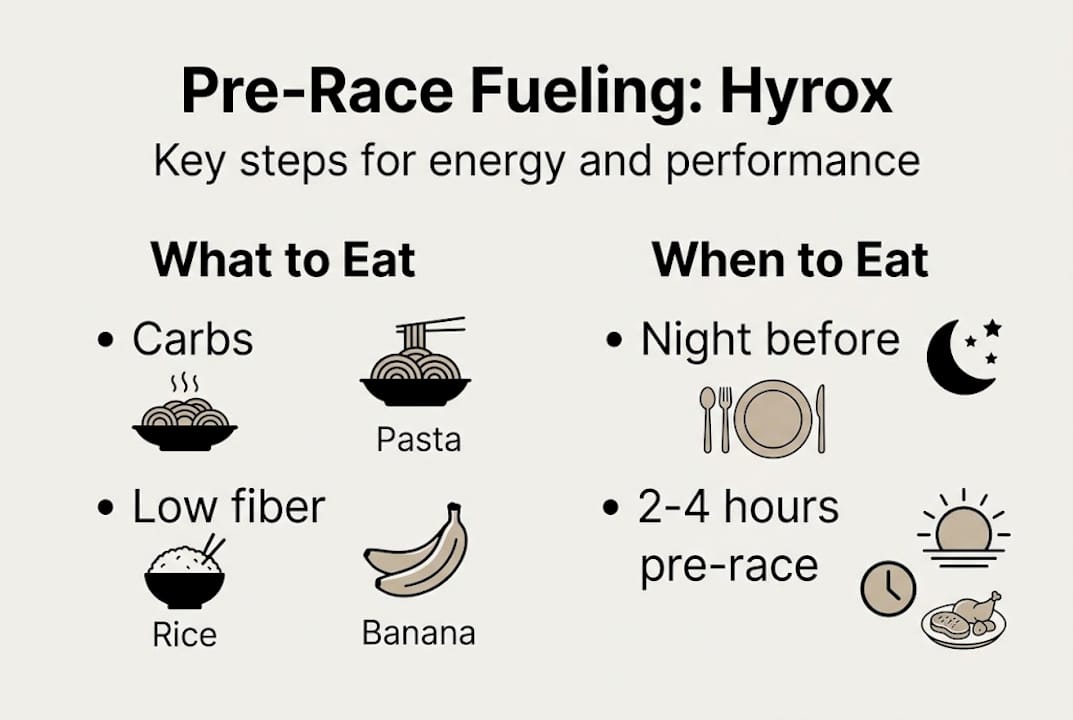
48 hours out: Increase carbohydrate intake gradually. There is no need to eat extraordinary amounts. Aim for around 6-8g of carbohydrate per kilogram of body weight across the day. Keep meals simple, low in fat, and low in fibre. Think white rice with grilled chicken, baked potatoes with a modest portion of fish, or pasta with a light tomato sauce.
Night before: The night before your race, target 120-150g of carbohydrates such as rice, pasta, or potatoes alongside 25-30g of protein from chicken or fish. Keep fat and fibre low, and hydrate with an electrolyte drink to begin replenishing sodium and potassium stores.

Race morning (2-4 hours before start): Aim for 1-3g of carbohydrate per kilogram of body weight. Porridge with a banana, a bagel with a little nut butter, or toast with jam are reliable options. Add around 20g of protein and 500-750ml of fluid. For the pre-workout meal to work, it must be food your gut already knows.
Here is a comparison of race fuel versus a typical training day:
| Element | Race day fueling | Typical training day |
|---|---|---|
| Carbohydrate focus | High, low fibre sources | Moderate, varied sources |
| Protein | Moderate, easily digestible | Higher, includes dairy/legumes |
| Fat | Minimal | Normal, including oily fish and nuts |
| Fibre | Minimal (under 10g) | Higher (20-30g) |
| Hydration | Electrolyte-focused | Water-focused |
For pre-workout snacks closer to race time, a banana, a small rice cake with jam, or a simple energy gel 30 to 60 minutes before the start works well for most athletes.
Pro Tip: If your race has an early morning start (before 8am), practise eating at that time during training weeks. Your gut needs to learn to process carbohydrates at 5am just as it does at 10am. This is called gut training for women and it is a genuine performance strategy, not an optional extra.
Carbohydrate periodisation matters here too. More carbohydrate is not always better. Overdoing it in the 48-hour window, particularly with high-fibre or unfamiliar foods, can cause bloating, cramping, and sluggishness. Aim for enough to fill glycogen stores, not so much that digestion becomes its own event.
Women-specific needs: performance fueling for ages 30-50
Here is the honest truth: the broad strokes of pre-race fueling apply to women and men alike. But the details, particularly for women aged 30 to 50, carry important nuances that most generic Hyrox guides skip.
Hormonal fluctuations across the menstrual cycle can influence how your body uses carbohydrate and fat as fuel. During the luteal phase (the two weeks after ovulation), your body relies more heavily on fat and protein for energy, which can make high-intensity efforts feel harder. If you are racing during this phase, nutrition for Hyrox women may benefit from slightly higher carbohydrate intake than usual in the pre-race window, not less.
For women aged 30-50 approaching perimenopause, protein needs are notably higher at 1.6-2.2g per kilogram of body weight daily overall. Monitoring iron and energy availability (EA) is also critical to avoid under-fueling, which is far more common in women than in men. While no major differences in the pre-race protocol itself are required, paying attention to cycle-syncing can reduce perceived effort and improve recovery.
Common pitfalls for female athletes in this age group include:
- Under-eating carbohydrates out of habit or fear of weight gain before race day
- Skipping the pre-race carb focus in favour of higher protein or fat-based meals
- Neglecting sodium and fluid during the days leading up to competition
- Ignoring iron status, particularly if training volume is high and periods are heavy
- Restricting total calories close to race day, which can blunt performance significantly
Pro Tip: If you are experiencing perimenopausal symptoms such as disrupted sleep or hot flushes in the week before your race, prioritise anti-inflammatory, easy-to-digest foods and increase your electrolyte intake. Your body is working harder at baseline, and your fuel needs to reflect that. Check performance nutrition for Hyrox athletes for more detail on adapting your approach.
Common mistakes and what to avoid
Even athletes who understand the principles of pre-race fueling often trip up in the execution. Here are the five most common errors to sidestep:
- Trying new foods on race day: Testing an unfamiliar brand of pasta or a new protein bar the night before your event is a gamble no training block can prepare you for.
- Overdoing fibre: Salads, legumes, and whole grains are excellent training foods but are a risk before Hyrox. Avoid high fibre and fat in the 24-48 hours pre-race to reduce GI distress.
- Neglecting hydration until race morning: Arriving at the venue dehydrated is nearly impossible to correct in a short warm-up window.
- Carb-loading beyond what the event requires: Full carb-loading protocols are designed for events lasting over 90 minutes at sustained effort. For most Hyrox competitors, a well-structured high-carb meal the night before is sufficient.
- Drinking alcohol the night before: Even one glass of wine impairs glycogen synthesis, disrupts sleep quality, and increases dehydration risk.
“GI distress during stations like the sled push or wall balls is almost always traced back to poor pre-race food choices, not race-day nerves. The gut does not lie.” Hyrox nutrition guide
If you have a morning heat, your race day meal workflow will look different to an afternoon slot. Morning athletes need to eat earlier, which means practising that timing in training. Athletes considering fasted workouts as part of their training cycle should understand clearly that race day is not the time to experiment with fasting. You need fuel in the tank.
What most Hyrox guides miss: gut training and real-world adjustments
Textbook pre-race nutrition plans assume ideal conditions: a relaxed evening at home, a familiar kitchen, and eight hours of unbroken sleep. Real life, particularly for women juggling work, family, and a Hyrox training block, rarely looks like that.
The most underrated performance skill is gut training for race pace. Topping up glycogen without causing bloat requires practising timed, low-residue carbohydrates during hard training sessions, not just on race week. The run-to-station alternation in Hyrox places specific mechanical pressure on the gut. If your digestive system has never processed a carbohydrate meal while running at threshold pace, race day will teach you a brutal lesson.
The gap between an ideal plan and a pragmatic one is where most athletes actually live. Staying at a hotel the night before? Pack rice cakes and a pre-portioned protein source. Family commitments making your evening chaotic? Prepare your night-before meal in advance. Early start anxiety killing your appetite? A liquid carbohydrate source like a smoothie or sports drink can bridge the gap. Check nutrition timing for Hyrox to refine your personal timing approach around real-life constraints.
Take your Hyrox fueling to the next level
Getting your pre-race nutrition right is one part of the puzzle, but having the right supplements to support your training and recovery makes the whole process far more manageable. Interval’s natural ingredient-based pre-workout and electrolytes are built specifically for athletes doing high-intensity events like Hyrox, so you are not guessing what goes into your body before a big race.
If you are new to structured sports nutrition, the Hyrox Starter Bundle is the most straightforward place to begin. It pairs your fueling strategy with products designed around your training demands. Explore Interval’s full range for personalised support, more race-specific guides, and nutrition plans that fit around the realities of competing as a woman in your 30s and 40s.
Frequently asked questions
What are the best pre-race carbs for Hyrox?
Carbohydrate choices pre-race should focus on low-residue sources such as white rice, pasta, potatoes, porridge, and bagels. These top up muscle glycogen effectively without the bloating risk that comes with high-fibre alternatives.
How soon before a Hyrox race should I eat?
Have your main meal 2-4 hours before your start time, aiming for 1-3g carbs per kg of body weight alongside around 20g of protein and 500-750ml of fluid. A light snack or energy gel 30-60 minutes before helps maintain blood sugar without causing heaviness.
Is carb loading necessary for Hyrox races?
No full carb-load is needed for most Hyrox events that take under 90 minutes to complete. A single well-structured high-carb meal the night before is sufficient for the majority of competitors, unlike ultramarathon-style loading protocols.
Do women need a different fueling strategy for Hyrox?
Women aged 30-50 largely follow the same pre-race fueling steps as men but typically benefit from higher protein intake at 1.6-2.2g per kilogram of body weight daily, and should pay closer attention to iron levels and overall energy availability.
What foods should I avoid before a Hyrox race?
Avoid high fibre and fat foods, anything new or untested, and alcohol in the 24-48 hours before competition. These choices increase the risk of GI distress and unpredictable energy levels during the event.