


What are osmolytes: their role in cells and health
TL;DR:
- Osmolytes are small organic molecules that cells produce or absorb to maintain osmotic balance and stabilize proteins during stress. They work by modulating water dynamics around proteins, promoting proper folding and function, especially under conditions like dehydration or heat. These molecules are crucial in biopharmaceutical stabilization, cellular osmoregulation, and athletic hydration strategies.
Osmolytes are defined as small, polar organic molecules that cells synthesise or absorb to maintain structural integrity during osmotic stress. Their primary function is twofold: balancing internal osmotic pressure and stabilising proteins without disrupting normal cellular chemistry. They include polyols, sugars, methylamines, and amino acids such as glycerol, trehalose, trimethylamine N-oxide (TMAO), and glycine. For researchers studying cellular resilience, and for athletes pushing their physiology to its limits, understanding osmolytes means understanding one of the most fundamental protective systems in biology.
What are osmolytes and how do they protect proteins?
Osmolytes protect proteins by modulating the water environment around them, not by binding directly to the protein itself. This indirect mechanism is what makes them so biochemically elegant. Unfavourable osmolyte–protein interactions increase protein hydration, which in turn stabilises the folded, compact conformation of the protein. The protein essentially “prefers” to fold tightly rather than expose its surface to the osmolyte.
This principle has a name in biochemistry: preferential exclusion. The osmolyte is excluded from the protein surface, raising the chemical potential of the unfolded state and shifting the equilibrium towards the native, folded form. Under conditions of heat, dehydration, or osmotic pressure, this shift is what keeps enzymes functional and structural proteins intact.
Recent 2026 experimental work has added a sharper mechanistic picture. Osmolytes alter enzyme activity through changes in water dynamics at the picosecond timescale. Osmolytes that increase water mobility around an enzyme accelerate catalysis. Those that restrict water mobility slow it down. The implication is significant: osmolyte effects on biology are mediated through water, not through the protein directly.
Osmolytes that enhance water mobility around an enzyme speed up catalysis. Those that restrict it slow the enzyme down. Water dynamics, not direct binding, are the primary control mechanism.
Pro Tip: When designing experiments involving osmolytes, separate osmolarity effects from hydration dynamics effects. Conflating the two leads to misattributed results and missed mechanistic insights.
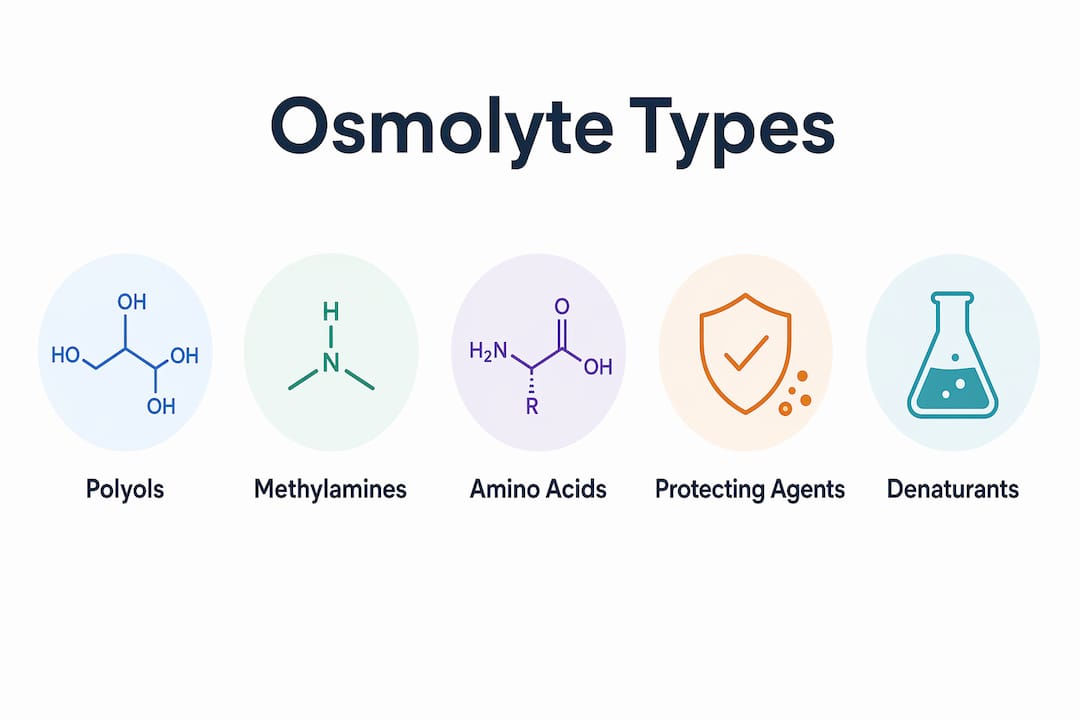
Protecting osmolytes are distinct from denaturants. Protecting agents stabilise protein folding equilibria, favouring native states under stress. Denaturants such as urea do the opposite, disrupting hydration shells and unfolding proteins. Understanding this distinction is foundational for anyone working in protein biochemistry or formulation science.
What are the main types of osmolytes?
Osmolytes divide into several chemical classes, each with distinct structural properties and biological roles.
Polyols and sugars are the most widely studied class. Glycerol is a three-carbon polyol used extensively by microorganisms and in laboratory protein stabilisation. Sorbitol accumulates in mammalian kidney cells under high-salt conditions. Trehalose and sucrose are disaccharide sugars that protect proteins and membranes during desiccation and freezing. Trehalose is particularly notable for its ability to form a protective glassy matrix around biological molecules.
Methylamines include trimethylamine N-oxide (TMAO) and betaine. TMAO is found at high concentrations in deep-sea fish, where it counteracts the protein-denaturing effects of hydrostatic pressure and urea. Betaine accumulates in plants and bacteria under salt stress. Both compounds are highly soluble and chemically inert towards cellular machinery.
Amino acid derivatives include ectoine, hydroxyectoine, and proline. Ectoine is produced by halophilic bacteria and is widely used in cosmetic and pharmaceutical formulations for its cell-protective properties. Proline accumulates in plants during drought stress and contributes to membrane stability.
The table below compares the major osmolyte classes:
| Class | Examples | Primary stress context |
|---|---|---|
| Polyols | Glycerol, sorbitol | Osmotic, thermal |
| Sugars | Trehalose, sucrose | Desiccation, freeze-thaw |
| Methylamines | TMAO, betaine | Pressure, salt, urea |
| Amino acid derivatives | Ectoine, proline | Salt, drought |
| Free amino acids | Glycine, glutamate | General osmotic stress |
A defining characteristic across all these classes is biochemical compatibility. Compatible solutes accumulate at high intracellular concentrations without disrupting enzymes, membranes, or nucleic acids. This distinguishes them from inorganic salts, which are toxic at equivalent concentrations.
How do osmolytes function within cells under osmotic stress?
Cells face osmotic stress whenever the solute concentration outside the cell changes sharply, as happens during dehydration, salt exposure, or intense physical exertion. The cell’s response is to adjust its internal osmolarity rapidly. Compatible solutes allow cells to adjust internal osmolarity without disrupting enzymes or proteins. This is osmoregulation in its most direct form.
The cellular response to osmotic stress follows a clear sequence:
- Osmosensors in the cell membrane detect changes in turgor pressure or membrane tension.
- Signal transduction cascades activate biosynthetic genes or membrane transporters.
- The cell either synthesises osmolytes internally or imports them from the surrounding environment.
- Osmolyte concentrations rise until internal and external osmotic pressures are balanced.
- Once stress resolves, osmolytes are degraded or exported to restore baseline conditions.
Bacteria show particularly well-studied osmoadaptation strategies. Bacterial osmotic regulation involves complex signalling and transport systems that differ between Gram-positive and Gram-negative species. Gram-negative bacteria such as Escherichia coli rely heavily on potassium uptake as an immediate response, followed by accumulation of glutamate and then trehalose or betaine. Gram-positive bacteria such as Bacillus subtilis preferentially import betaine and proline via dedicated ABC transporters. The diversity in these strategies reflects the tailored nature of osmolyte use across different cell wall architectures.
Pro Tip: If you are studying bacterial osmoadaptation, check whether your strain is Gram-positive or Gram-negative before selecting an osmolyte model. The regulatory machinery and preferred solutes differ substantially between the two groups.
Enzyme function is maintained throughout this process because osmolytes are genuinely compatible with cellular biochemistry. They do not bind active sites, alter cofactor availability, or change membrane fluidity in harmful ways. This is what makes them natural chemical chaperones, a term that captures their role in guiding proteins towards stable, functional conformations under stress.
What practical applications do osmolytes have in biopharmaceuticals?
The biopharmaceutical industry relies on osmolytes to keep therapeutic proteins stable through manufacturing, storage, and delivery. Protein-based drugs, including monoclonal antibodies, enzymes, and hormones, are fragile. They aggregate, unfold, or lose activity when exposed to heat, freezing, or mechanical stress. Osmolytes address each of these failure modes.
Trehalose and glycerol stabilise proteins against aggregation and thermal stress, extending shelf life and maintaining biological activity through the full manufacturing and storage cycle. Sucrose is used in liquid formulations to prevent aggregation during freeze-thaw cycles. These are not theoretical benefits. They are standard practice in the formulation of approved biologics.
Lyophilisation, or freeze-drying, is where osmolytes prove most critical. Trehalose forms a glassy matrix around proteins during freeze-drying, physically immobilising them and preventing structural collapse. This glassy state is thermodynamically stable and protects the protein during long-term storage at ambient temperatures. Vaccines, enzyme replacement therapies, and diagnostic reagents all benefit from this property.
Beyond formulation, osmolytes have emerging therapeutic potential. Ectoine has been investigated for its ability to protect human cells from UV radiation and inflammatory damage. TMAO research has revealed complex interactions with gut microbiota and cardiovascular health. Betaine supplementation has been studied in the context of liver function and athletic performance. The role of osmolytes in health sciences extends well beyond the laboratory bench.
For athletes specifically, the cellular hydration principles underpinned by osmolyte biology connect directly to electrolyte use for endurance and recovery. Maintaining intracellular osmotic balance during prolonged high-intensity exercise is not just a biochemical abstraction. It is the difference between sustained performance and premature fatigue.
Key takeaways
Osmolytes are the cell’s primary chemical defence against osmotic stress, acting through water dynamics rather than direct protein binding.
| Point | Details |
|---|---|
| Definition and scope | Osmolytes are small polar organic molecules that balance osmotic pressure and stabilise proteins. |
| Mechanism of action | They work via preferential exclusion and water dynamics modulation, not direct protein binding. |
| Chemical diversity | Major classes include polyols, sugars, methylamines, and amino acid derivatives such as ectoine. |
| Cellular function | Cells accumulate osmolytes through biosynthesis or uptake in response to osmotic stress signals. |
| Biopharmaceutical use | Trehalose and glycerol stabilise therapeutic proteins against aggregation, heat, and freeze-thaw stress. |
Why osmolyte research is harder than it looks
The science of osmolytes looks deceptively tidy on paper. You have a molecule, it stabilises a protein, the cell survives stress. The reality is considerably messier, and I think the field has not been fully honest about that.
The biggest methodological trap is conflating osmolarity effects with hydration dynamics effects. When you add trehalose to a system, you change both the osmotic pressure and the water structure simultaneously. Most published studies do not separate these variables cleanly. The 2026 work on picosecond water dynamics is a genuine step forward precisely because it isolates the water-mediated mechanism. That kind of rigour should be the standard, not the exception.
The compatibility principle is also frequently overstated. Yes, osmolytes accumulate without disrupting native biology at physiological concentrations. But concentration matters enormously. TMAO at the levels found in deep-sea fish would be problematic in a mammalian cell. Context is everything, and translating osmolyte biology from one organism to another requires caution.
For those working in biotech applications, the translation from bench to formulation is where most projects stall. Knowing that trehalose forms a glassy matrix is one thing. Knowing the exact concentration, the drying rate, and the residual moisture content that produces a stable product is another matter entirely. The biochemistry is the easy part.
— Tom
Hydration and recovery with Useinterval

The biology of osmolytes makes one thing clear: cellular hydration is not passive. It is an active, regulated process that determines whether your cells function or falter under stress. For athletes training at high intensity, that stress is real and repeated. Useinterval’s Starter Bundle is built around this principle, combining electrolytes and pre-workout formulas that support the osmotic balance your cells depend on during and after hard sessions. The ingredients are natural, the formulations are informed by the science, and the goal is straightforward: keep your cells working when it counts most.
FAQ
What are osmolytes in simple terms?
Osmolytes are small organic molecules that cells use to manage water balance and protect proteins under stress. Common examples include glycerol, trehalose, and TMAO.
How do osmolytes protect proteins?
They work through preferential exclusion, staying away from the protein surface and increasing protein hydration, which stabilises the folded conformation without direct binding.
What is the difference between osmolytes and electrolytes?
Electrolytes are charged ions such as sodium and potassium that conduct electrical signals and regulate fluid movement. Osmolytes are uncharged organic molecules that stabilise proteins and adjust osmotic pressure at the molecular level.
Which osmolytes are used in biopharmaceuticals?
Trehalose, glycerol, and sucrose are the most widely used. Trehalose is particularly valued for forming a protective glassy matrix around proteins during freeze-drying and long-term storage.
Do osmolytes have any role in athletic performance?
Osmolyte biology underpins cellular hydration during exercise. Maintaining intracellular osmotic balance supports enzyme function and delays fatigue, which is why electrolyte formulations designed for endurance athletes draw on these same principles.