


Isotonic supplements: what they are and why they matter
TL;DR:
- Many sports drinks labeled as isotonic may not meet proper osmolality standards. Using verified isotonic supplements enhances hydration, fuel delivery, and performance during intense exercise. Female athletes should tailor electrolyte intake to their cycle phase and session demands for optimal results.
Not all sports drinks are created equal, and believing otherwise could be costing you performance on your hardest training days. The market is flooded with products labelled as “sports drinks,” “electrolyte solutions,” and “hydration formulas,” yet most female athletes in their thirties and forties cannot tell you the fundamental difference between them. An isotonic supplement is defined as a beverage or drink mix with an osmolality matching human blood plasma, typically 270 to 310 mOsm/kg, containing 6 to 8% carbohydrates and electrolytes designed for rapid absorption. Getting this right matters more than most people realise.
Table of Contents
- What is an isotonic supplement?
- Essential ingredients and their role in performance
- Who should use isotonic supplements and when?
- Choosing a quality isotonic supplement safely
- The overlooked keys: it’s not about the label, but the science
- Move from confusion to confidence: choosing your isotonic solution
- Frequently asked questions
Key Takeaways
| Point | Details |
|---|---|
| True isotonic formula | A supplement is isotonic when it matches blood osmolality and provides 6-8% carbohydrates plus essential electrolytes. |
| Best for longer sessions | Isotonic supplements are ideal for high-intensity exercise sessions lasting more than 60 minutes. |
| Safety always matters | Look for third-party certifications such as NSF or Informed Sport to ensure supplement safety and effectiveness. |
| Female-specific adjustments | Adjust electrolyte intake around the menstrual cycle to optimise hydration and athletic performance. |
What is an isotonic supplement?
The word “isotonic” comes from Greek, meaning equal tension. In practice, it describes a fluid that has the same concentration of dissolved particles as your blood plasma. This is the critical factor that determines how quickly your body can absorb fluids and carbohydrates during exercise.
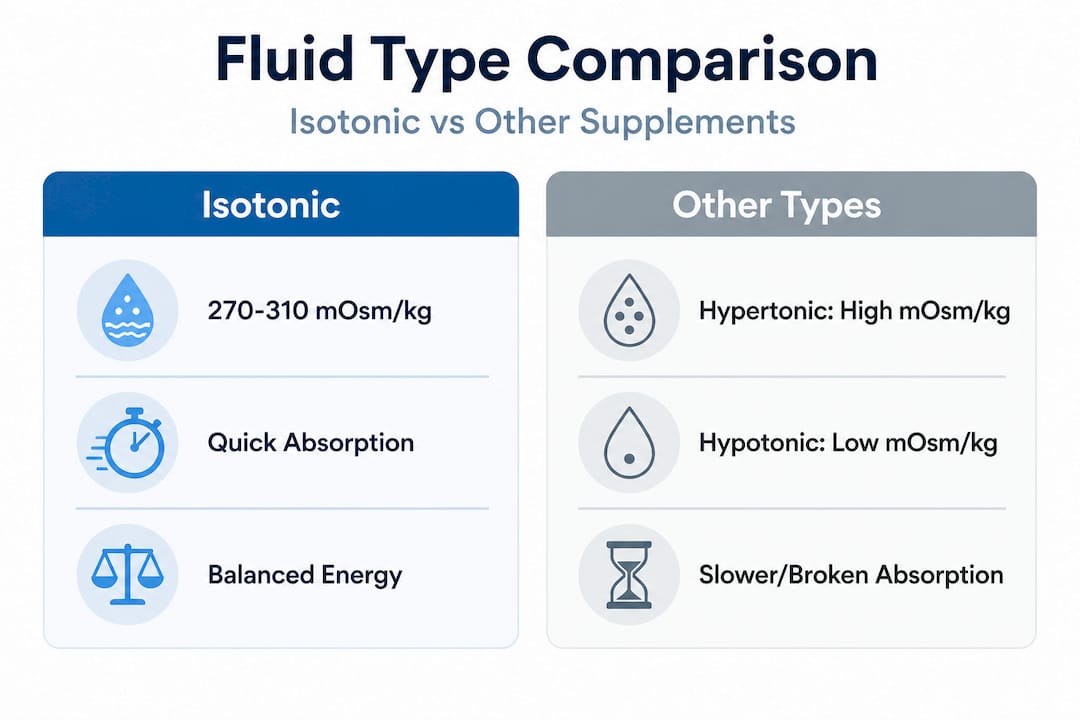
An isotonic supplement is defined by an osmolality of 270 to 310 mOsm/kg, a carbohydrate content of 6 to 8%, and a carefully selected electrolyte profile. These parameters are not arbitrary. They mirror the concentration of your own blood, which means your gut can absorb the fluid rapidly without needing to dilute or concentrate it first. Understanding what makes a drink isotonic goes far beyond reading a label.
Here is a quick breakdown of the core characteristics:
- Osmolality: 270 to 310 mOsm/kg, matching blood plasma concentration
- Carbohydrate content: 6 to 8% (roughly 6 to 8 grams per 100 ml)
- Electrolytes: Sodium, potassium, and magnesium at physiologically relevant doses
- Absorption speed: Faster than plain water during moderate to high-intensity exercise
- Purpose: Simultaneous fluid, fuel, and electrolyte delivery during sustained effort
“Osmolality is the key variable that separates a true isotonic supplement from a generic sports drink. If the osmolality is off, so is the absorption rate, and that directly impacts your endurance and hydration status.”
One of the most common misconceptions is that any brightly coloured drink with electrolytes qualifies as isotonic. Many popular sports drinks are actually hypertonic, meaning they have a higher concentration than blood, which slows absorption and can cause gastric distress mid-session. Some brands never even publish osmolality data on their packaging, which alone should raise questions.
If you are training at high intensity and relying on a product that is technically hypertonic, you are asking your body to work harder to absorb fluid at the exact moment it needs resources most. Exploring natural electrolyte options that meet the isotonic standard is a practical starting point.
| Property | Isotonic | Hypertonic | Hypotonic |
|---|---|---|---|
| Osmolality (mOsm/kg) | 270 to 310 | Above 310 | Below 270 |
| Carbohydrate % | 6 to 8% | Above 8% | Below 6% |
| Absorption speed | Rapid | Slower | Very fast |
| Best use | During exercise | Recovery or post-training | Short sessions or pre-hydration |
Essential ingredients and their role in performance
Knowing the definition is one thing. Understanding why each ingredient exists in an isotonic supplement, and what happens when the balance is off, is what separates informed athletes from those guessing at their nutrition.

The 6 to 8% carbohydrate content in a true isotonic is not a random figure. At this concentration, carbohydrates contribute to energy delivery without tipping the osmolality above the isotonic threshold. Go above 8% and you create a hypertonic environment in your gut. Your body then draws water from surrounding tissues to dilute the solution before it can be absorbed. The result is bloating, cramping, and a noticeable dip in performance.
Electrolytes each play a distinct and irreplaceable role:
- Sodium stimulates thirst, helps retain fluid in the bloodstream, and drives the sodium-glucose co-transport mechanism that pulls carbohydrates into the gut wall. Without adequate sodium, absorption slows considerably.
- Potassium supports muscle contraction and nerve signal transmission. Potassium losses during heavy sweating are directly linked to cramping and premature fatigue.
- Magnesium is involved in over 300 enzymatic reactions, including those governing muscle relaxation and energy metabolism. Female athletes in their thirties and forties are particularly prone to suboptimal magnesium status, which can exacerbate hormonal-related fatigue.
Comparing your options is essential before committing to a product. An electrolyte tablets comparison can reveal significant differences in ingredient quality, dosage, and osmolality claims between products marketed similarly.
| Feature | Isotonic | Hypertonic | Hypotonic |
|---|---|---|---|
| Energy delivery | Moderate and sustained | High but delayed | Low and fast |
| Hydration speed | Optimal during exercise | Suitable post-exercise | Pre-session hydration |
| GI comfort | High when balanced | Risk of distress | Generally well tolerated |
| Carb content | 6 to 8% | Above 8% | Below 6% |
Pro Tip: If you are checking labels and cannot find an osmolality figure, look at the total carbohydrate per 100 ml. More than 8 grams per 100 ml means the drink is likely hypertonic. For sessions focused on fat oxidation or shorter bouts, sugar-free electrolyte options can preserve the isotonic balance without the additional carbohydrate load.
One commonly overlooked point is that the ratio of carbohydrate types matters too. Supplements that use a blend of glucose and fructose can deliver carbohydrates through multiple gut transporters simultaneously, effectively increasing absorption capacity during very high-intensity efforts without altering osmolality. This is the kind of ingredient-level detail that separates a quality isotonic from a cheap imitation.
Who should use isotonic supplements and when?
Understanding the science is only useful if you know how to apply it to your actual training sessions. Isotonic supplements are not an everyday drink for low-key activity. They are a precision tool for specific training and competition scenarios.
The research is clear on timing: sessions exceeding 60 minutes at high intensity, or any bout involving repeated sprint efforts or sustained threshold work, are where isotonic supplements genuinely earn their place. Below that threshold, plain water or a low-dose hypotonic drink is typically sufficient.
Key considerations for female athletes aged 30 to 50:
- Session length: Prioritise isotonic use for efforts lasting more than 60 minutes
- Intensity level: High-intensity intervals, HYROX training, CrossFit, or endurance sport at threshold all justify isotonic use
- Hormonal phase: Electrolyte needs shift across the menstrual cycle, particularly in the luteal phase when progesterone increases sodium and fluid losses; replenishment tips for female athletes are a valuable resource here
- Certification: Look for NSF Certified for Sport or Informed Sport logos to ensure the product has been third-party tested for banned substances and accurate labelling
- Heat and humidity: Sweat rate increases significantly in warm conditions, raising the need for both fluid and sodium replacement
The timing of electrolyte intake relative to your session can also determine how effective the supplement is. Beginning hydration before you feel thirsty, particularly in the final 30 minutes before a long effort, helps you start the session in an optimal fluid state rather than playing catch-up.
Pro Tip: If you experience GI distress during training after taking a sports drink, it is often a sign the product is hypertonic rather than a sign that you have a sensitive gut. Switching to a verified isotonic formula typically resolves the issue within a few sessions.
Research into the best electrolyte drink choices consistently highlights that certified products with transparent labelling outperform generic alternatives. The fast-acting benefits of a properly formulated isotonic can be felt within 15 minutes of consumption during exercise, which is a practical measure you can track yourself.
Choosing a quality isotonic supplement safely
The supplement market is poorly regulated in many respects, and isotonic products are no exception. Knowing what to look for, and what to avoid, protects both your health and your performance.
Certification is the clearest signal of product integrity. NSF and Informed Sport certification means the product has been independently tested to confirm it contains what it claims and nothing that is banned in sport. For competitive athletes or those simply wanting assurance about ingredient safety, this is non-negotiable.
Red flags to watch for when reading labels:
- Proprietary blends: These list ingredients without disclosing individual doses, making it impossible to verify osmolality or electrolyte levels
- Vague claims: Phrases like “advanced hydration complex” or “performance matrix” without supporting data
- Missing osmolality data: A genuine isotonic product should either publish this or provide carbohydrate percentage per 100 ml so you can calculate it yourself
- Excessive sugar: Some products disguise high carbohydrate content using multiple sugar names across the ingredient list
- Artificial additives: Colours, flavours, and preservatives add osmotic load without nutritional benefit
“Ingredient transparency is not a bonus feature. It is the baseline standard for any supplement you are putting into your body during high-intensity training.”
Understanding why buffered electrolytes matter can also help you make better label comparisons. Buffered forms of minerals like magnesium are absorbed more efficiently and are gentler on the gastrointestinal tract than cheap oxide forms, yet many labels simply say “magnesium” without specifying the form.
Pro Tip: Take a photograph of every supplement label you are currently using and check the carbohydrate per 100 ml figure. If it is above 8 grams, you are consuming a hypertonic drink, regardless of what the front of the packet claims. Learning to optimise your electrolyte intake using this simple check is one of the most practical upgrades you can make to your training nutrition immediately.
Recovery strategies like infrared sauna use or natural muscle recovery approaches can complement good supplement choices, but they cannot compensate for consistently poor hydration and fuelling during sessions.
The overlooked keys: it’s not about the label, but the science
Here is something we rarely see discussed openly in sports nutrition: the term “isotonic” has become almost meaningless on product packaging because it is being used as a marketing claim rather than a scientific descriptor.
We have worked with female athletes across a wide range of disciplines, from endurance runners to HYROX competitors, and one pattern is consistent. The athletes who struggle most with mid-session fatigue, cramping, and slow recovery are often using supplements they believe are isotonic based on branding alone. When they actually check the carbohydrate percentage or find out that no osmolality data exists for the product, the disconnect becomes obvious immediately.
The real problem is that “isotonic” sounds scientific enough to be persuasive without being specific enough to be verifiable. This puts the burden on you as the athlete to do the basic maths yourself. That is not ideal, but it is the reality of the current market.
What we have observed is that female athletes aged 30 to 50 often have more nuanced physiological needs than the “standard athlete” that most supplement formulations are built around. Hormonal fluctuations across the menstrual cycle measurably affect sodium retention, thirst sensitivity, and carbohydrate utilisation. A product that works reasonably well in the follicular phase may leave you feeling flat and depleted in the luteal phase if it does not account for these shifts.
The electrolyte workflow approach that we have seen work consistently involves matching supplement choice to both session type and cycle phase, rather than treating supplementation as a static daily habit. This is a more demanding approach, but the performance returns are real and measurable.
One-size-fits-all advice in sports nutrition is not just unhelpful. It can actively undermine your training adaptations if it keeps you in a chronic state of suboptimal hydration or inadequate fuelling.
Move from confusion to confidence: choosing your isotonic solution
Cutting through the noise is exactly what we built Interval around. Every product in our range is formulated to meet the precise osmolality, carbohydrate, and electrolyte standards that genuine isotonic supplementation demands, using natural ingredients that you can actually read on a label.
If you are ready to move from confusion to a supplement strategy grounded in real science, the Interval Starter Bundle is the most practical place to begin. It is designed specifically for high-intensity athletes who want verified formulations without proprietary blend guesswork. Explore the full range of products and resources available at Interval UK and take the next step with a supplement partner that puts the science first.
Frequently asked questions
How do isotonic supplements differ from regular sports drinks?
Isotonic supplements are formulated to match blood plasma osmolality at 270 to 310 mOsm/kg with a specific carb-electrolyte balance, whereas many regular sports drinks are hypertonic and absorb more slowly, which can impair hydration during intense exercise.
Is it safe to use isotonic supplements every day?
Daily use is generally safe when aligned with genuine training demands, but the International Society of Sports Nutrition recommends prioritising certified products and calibrating intake to actual exercise needs rather than using isotonic supplements as a default hydration strategy.
What signs show a supplement is not truly isotonic?
A product that lacks published osmolality data, does not specify carbohydrate percentage per 100 ml, or uses vague proprietary blends is almost certainly not a verified isotonic formulation regardless of what the front of the packaging states.
Should I adjust my supplement intake based on my menstrual cycle?
Yes. Cycle-adjusted electrolyte intake is supported by research showing that sodium retention, thirst response, and carbohydrate utilisation all shift across the cycle, meaning a static supplement dose may under-serve you during the luteal phase in particular.
Recommended
- Complete Guide to Buffered Electrolytes for Athletes – Interval
- Electrolytes Explained: Essential Role in Fitness – Interval
- Fast-acting electrolytes: boost performance and recovery naturally – Interval
- What Is Isotonic Drink and Why Athletes Rely On It – Interval
- Why Choose Plant-Based Supplements: Wellness Impact
- Best Electrolyte Drinks for Weight Loss - Fueled Framework