


What is holistic athletic fueling: a complete guide
TL;DR:
- Holistic athletic fueling integrates nutrition, hydration, recovery, and mental health, treating athletes as complete systems.
- This approach emphasizes individual factors like gut health and stress, leading to improved performance and sustainability.
Holistic athletic fueling is the practice of tailoring nutrition, hydration, recovery, and lifestyle factors together to support optimal athletic performance rather than treating each element in isolation. The industry term for this approach is integrative sports nutrition, and it treats the athlete as a complete system where gut health, mental state, and biochemistry are as relevant as macronutrient ratios. If you have ever followed a textbook meal plan and still felt flat on race day, this is why. The 4Ps framework, which stands for Personalise, Periodise, Prefuel, and Prepare, is the most evidence-grounded model currently available for putting this into practice.
What is holistic athletic fueling and why does it matter?
Integrative sports nutrition moves away from numeric calorie counting and towards treating athletes as integrated ecosystems where mental health, stress, and gut health are inseparable from food choices. Ignoring these factors undermines performance regardless of how precise your macros are. That is a significant shift from the traditional model, and it has real consequences for how you structure your week.
The core principle is that no single variable operates alone. Your carbohydrate intake affects your gut microbiome. Your sleep quality affects your glycogen resynthesis rate. Your stress levels affect your appetite and your absorption of nutrients. Treating these as separate problems to solve separately is where most athletes go wrong.
For fitness enthusiasts aged 25 to 45 doing high-intensity training, this matters more than it does for recreational exercisers. The physiological demands are higher, the recovery windows are shorter, and the margin for error is smaller. Getting the approach right is not a luxury. It is the difference between consistent progress and chronic fatigue.
What are the key components of holistic athletic fueling?
The four pillars of a whole body athlete diet are nutrition, hydration, recovery, and mental well-being. Each one feeds directly into the others, and neglecting any single pillar creates a ceiling on your performance.

Nutrition centres on carbohydrate, protein, and micronutrient strategies built around your individual needs rather than population averages. The 4Ps framework recommends consuming 6 to 10 g/kg of carbohydrates in the 24 to 36 hours before competition to optimise glycogen stores, and 30 to 90 g per hour during activity to delay fatigue. These are not arbitrary numbers. They reflect the upper and lower bounds of what the gut can absorb and what working muscles can use.
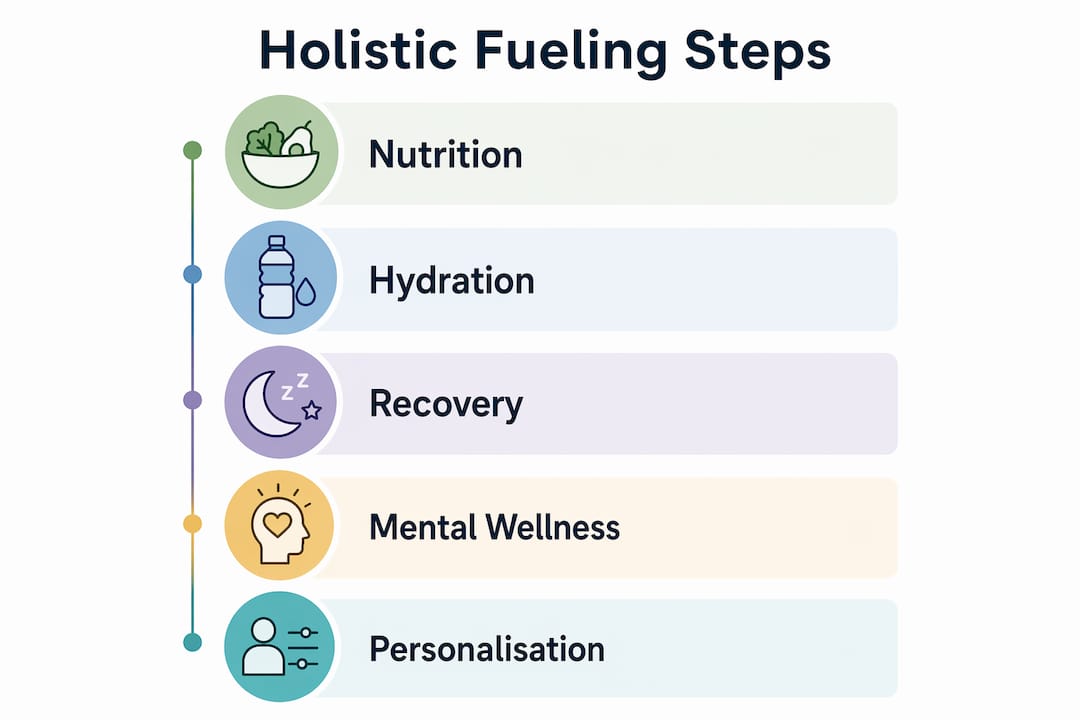
Hydration is equally individual. Sweat rate testing by measuring body mass loss during exercise outperforms generic hydration charts because every 500-gram loss represents roughly a 500 ml fluid deficit. Knowing your own rate means you can drink to replace rather than drink to a schedule.
Recovery and mental well-being are the two components most commonly dropped when athletes are short on time. Both are mistakes. Stress and gut health are physiologically linked to nutrient absorption, and rejecting restrictive diet culture in favour of intuitive eating principles supports both performance goals and long-term mental health.
Key components to build your fuelling plan around:
- Personalised carbohydrate targets based on training load, not a fixed daily number
- Electrolyte intake of 500 to 700 mg sodium per hour during endurance efforts, adjusted by sweat composition
- Post-exercise protein and carbohydrate within 60 minutes to support muscle repair
- Gut training during low-intensity sessions to build tolerance for race-day fuel volumes
- Stress management and sleep protocols as non-negotiable parts of the nutrition plan
Pro Tip: Weigh yourself before and after a hard session without drinking during it. That mass difference in grams equals your fluid deficit in millilitres. Do this three times across different conditions and you have a reliable personal hydration baseline.
How does holistic athletic fueling differ from traditional sports nutrition?
Traditional sports nutrition is largely reductionist. It assigns calorie targets, splits macros, and applies population-level guidelines. Integrative sports nutrition starts from the individual and builds outward. The distinction is not philosophical. It produces measurably different outcomes.
Personalisation is the defining variable, because responses to nutrition vary by genotype, phenotype, sex, age, and sweat composition. A 35-year-old female athlete training twice daily has fundamentally different needs from a 28-year-old male doing one session per day, even if their body mass and training volume are identical.
| Feature | Traditional sports nutrition | Integrative sports nutrition |
|---|---|---|
| Approach | Population averages and fixed macros | Individual biochemistry and lifestyle factors |
| Hydration | Generic fluid targets (e.g. 2 litres per day) | Sweat rate testing and personalised electrolyte targets |
| Mental health | Separate from nutrition planning | Integrated as a direct performance variable |
| Gut health | Rarely addressed | Central to absorption and race-day readiness |
| Diet culture | Often reinforces restriction | Actively rejects restriction in favour of intuitive eating |
| Data used | Body weight and calorie tracking | Genetic, phenotypic, and biometric data |
The gut health distinction is particularly important for high-intensity athletes. Macronutrient ratios alone are insufficient because baseline gut integrity and systemic inflammation must be optimised through whole foods before layering complex fuel strategies on top. If your gut is inflamed, you will not absorb the carbohydrates you are consuming, regardless of how well-timed they are.
How to implement athletic fueling strategies across training, competition, and recovery
Practical implementation follows the 4Ps framework across three distinct phases. Each phase has different priorities, and confusing them is one of the most common errors in comprehensive athletic diet planning.
Phase 1: Pre-competition (24 to 36 hours out)
- Begin carbohydrate loading at 6 to 10 g/kg body mass across the 24 to 36 hours before your event, prioritising low-fibre sources to reduce gut bulk.
- Confirm your hydration status by checking urine colour. Pale straw is the target. Dark yellow means you are already behind.
- Eat your final pre-event meal 2 to 3 hours before the start. Include 1 to 4 g/kg carbohydrates and moderate protein. Avoid high-fat and high-fibre foods that slow gastric emptying.
- Practise this exact protocol in training first. Never trial new foods or timing strategies on race day.
Phase 2: In-event nutrition
Carbohydrate-electrolyte supplementation during moderate to high-intensity exercise significantly increases time to exhaustion and maintains blood glucose and sodium levels. Target 30 to 90 g of carbohydrates per hour depending on intensity and duration, alongside 400 to 800 ml of fluid per hour adjusted by sweat rate. Sodium targets of 500 to 700 mg per hour prevent the dilutional hyponatraemia that causes cramping and cognitive decline in longer efforts.
| Duration | Carbohydrate target | Fluid target | Sodium target |
|---|---|---|---|
| Under 60 minutes | Not required | 400 ml/hr | Not required |
| 60 to 90 minutes | 30 to 45 g/hr | 400 to 600 ml/hr | 300 to 500 mg/hr |
| Over 90 minutes | 60 to 90 g/hr | 500 to 800 ml/hr | 500 to 700 mg/hr |
Phase 3: Recovery
Post-exercise recovery requires 1.2 g/kg carbohydrates combined with 0.3 to 0.4 g/kg protein within 30 to 60 minutes to maximise glycogen resynthesis and muscle repair. This window matters most when you have another session within 24 hours. Miss it and you start the next session already depleted. Useinterval’s guide to post-workout protein recovery covers the practical application of these targets in detail.
Pro Tip: Gut training is not optional for high-intensity athletes. Practise consuming your target carbohydrate volume during low-intensity sessions first. The gut adapts to absorb more fuel when trained progressively, just like a muscle.
Gut training during low-intensity exercise is necessary to avoid gastrointestinal distress during high-intensity efforts. Neglecting this is the single most common cause of race-day digestive failure in otherwise well-prepared athletes.
What are the benefits of holistic fueling for fitness enthusiasts?
The benefits of integrative sports nutrition are measurable across performance, recovery, and long-term wellbeing. They are not abstract.
- Delayed fatigue. Optimised carbohydrate and electrolyte management directly extends time to exhaustion. Dehydration exceeding 2% of body mass reduces cardiac output and thermoregulation, which means even modest fluid deficits cut performance before you feel thirsty.
- Faster recovery. Protein combined with carbohydrates during recovery periods under 24 hours reduces muscle damage markers and enhances rehydration. The effect is small but consistent, and it compounds across a training block.
- Better mental performance. Treating stress and mental health as nutrition variables rather than separate concerns reduces the cognitive load that undermines pacing, decision-making, and motivation during hard efforts.
- Sustainability. Intuitive eating principles encourage athletes to honour hunger cues while still applying evidence-based strategies like carbohydrate loading. This removes the psychological burden of rigid restriction and makes the approach maintainable across years, not just weeks.
“The most durable fuelling strategy is one you can follow consistently, not one that is theoretically perfect but practically unsustainable.”
For a deeper look at how electrolytes fit into this picture, Useinterval’s guide to electrolyte use for endurance covers the specifics of sodium, potassium, and magnesium management across different training demands.
Key takeaways
Holistic athletic fueling works because it treats nutrition, hydration, gut health, and mental well-being as a single integrated system rather than separate variables to manage independently.
| Point | Details |
|---|---|
| Personalisation is non-negotiable | Fuelling plans must account for sex, age, sweat rate, and genotype to be effective. |
| Carbohydrate timing drives performance | Consume 6 to 10 g/kg in the 24 to 36 hours pre-competition and 30 to 90 g per hour during effort. |
| Recovery nutrition has a hard deadline | Carbohydrates and protein must arrive within 30 to 60 minutes post-exercise to maximise repair. |
| Gut training prevents race-day failure | Practise your in-event fuel volume during low-intensity sessions before applying it at race pace. |
| Mental health is a fuelling variable | Stress and gut health directly affect nutrient absorption and must be managed as part of the plan. |
Why most athletes are still leaving performance on the table
I have spoken with a lot of athletes who eat well by any conventional measure. They hit their protein targets, they carb-load before events, they take electrolytes. And yet they still bonk at kilometre 30, or feel sluggish in the second half of a hard session, or find their recovery slower than it should be. The missing piece is almost always one of three things: gut health, stress load, or hydration precision.
The conventional sports nutrition model gives you a framework and tells you to apply it. The integrative model asks you to test it against your own physiology first. That distinction sounds minor. In practice it changes everything. I have seen athletes reduce their in-event gastrointestinal distress dramatically simply by spending six weeks gut training at low intensity before attempting their target carbohydrate intake at race pace. No new products. No new protocols. Just sequencing.
The other thing I would push back on is the idea that mental health is a soft variable. It is not. Chronic stress elevates cortisol, which impairs glycogen storage and increases protein catabolism. If you are under significant life stress and wondering why your nutrition plan is not working, that is likely your answer. The food is fine. The context it is being consumed in is not.
My honest recommendation is to start with sweat rate testing and a gut training block before you touch anything else. These two interventions are free, evidence-based, and produce results within four to six weeks. Everything else, including supplements, genetic testing, and continuous glucose monitoring, builds on top of that foundation. Without it, you are optimising the wrong variables.
— Tom
Support your fuelling plan with Useinterval’s Starter Bundle
Useinterval’s Starter Bundle is built for athletes who take their fuelling seriously. It pairs a natural-ingredient pre-workout with a precisely formulated electrolyte product, giving you the carbohydrate and sodium support your training demands without artificial fillers. The electrolyte formula is designed to meet the 500 to 700 mg sodium per hour target that endurance research consistently points to, and the pre-workout uses ingredients that support sustained output rather than a short spike. If you are ready to move beyond generic supplements and start fuelling with the specificity your training deserves, the Starter Bundle is the practical starting point.
FAQ
What is holistic athletic fueling in simple terms?
Holistic athletic fueling is the practice of combining nutrition, hydration, recovery, and mental well-being into a single personalised strategy rather than managing each element separately. It is also called integrative sports nutrition.
How many carbohydrates do athletes need during competition?
The evidence-based target is 30 to 90 grams of carbohydrates per hour during moderate to high-intensity exercise, with the upper end applying to efforts lasting longer than 90 minutes.
Why is gut training important for athletes?
Gut training involves gradually increasing your carbohydrate intake during low-intensity sessions to build tolerance. Without it, attempting high fuel volumes at race pace commonly causes gastrointestinal distress that derails performance.
How do I personalise my hydration strategy?
Weigh yourself before and after a training session without drinking during it. Every 500-gram difference equals a 500 ml fluid deficit. Repeat across different conditions to establish your personal sweat rate and adjust fluid and sodium intake accordingly.
What is the post-exercise nutrition window?
The most effective recovery window is 30 to 60 minutes after exercise. Consuming 1.2 g/kg carbohydrates with 0.3 to 0.4 g/kg protein in this period maximises glycogen resynthesis and muscle repair, particularly when you have another session within 24 hours.