


What is peak performance fueling for athletes?
TL;DR:
- Peak performance fueling involves precisely timing macronutrients and electrolytes to match training demands. Proper fueling enhances performance, accelerates recovery, and prevents underdelivery caused by under-fuelling or poor hydration. Building consistent habits around pre-, during-, and post-workout nutrition optimizes training adaptations and overall athletic output.
Peak performance fueling is the practice of aligning what you eat and drink with the specific demands of your training. It is not general healthy eating, and it is not just adding a protein shake after a session. Done properly, it means timing your carbohydrates, protein, hydration, and electrolytes so your body has exactly what it needs, precisely when it needs it. Get this right and you perform at a higher level, recover faster, and adapt more effectively to hard training. Get it wrong and even the most disciplined training block will underdeliver.
Table of Contents
- Key takeaways
- The fundamentals of peak performance fueling
- Pre-workout fueling: what to eat before training
- Fueling during exercise: keeping performance high
- Post-workout recovery fueling
- Recognising and fixing under-fuelling
- My take on where most athletes go wrong
- Fuel your training with Useinterval
- FAQ
Key takeaways
| Point | Details |
|---|---|
| Fueling is not general nutrition | Peak performance nutrition matches macronutrients and hydration to your specific training demands and timing. |
| Carbohydrate timing drives performance | Consuming carbohydrates before, during, and after sessions directly supports glycogen levels and delays fatigue. |
| Electrolytes are non-negotiable | Sodium and other electrolytes become critical during sessions lasting over an hour or in hot conditions. |
| Recovery window is wider than you think | Protein intake within two to three hours post-training still supports muscle repair effectively. |
| Under-fuelling is a hidden performance killer | Fatigue, mood shifts, and declining output are signs your daily intake does not match your training load. |
The fundamentals of peak performance fueling
Understanding what fuels peak performance starts with knowing how each macronutrient contributes to your output. Carbohydrates are the primary fuel source for any high-intensity effort. When you sprint, lift heavy, or push through a Hyrox circuit, your body draws from glycogen stored in your muscles and liver. Glycogen depletion impairs performance and triggers that well-known sensation of hitting the wall. Keeping those stores stocked is not optional if you train seriously.
Protein does a different job. It does not power your session in real time. Instead it repairs the tissue damage that training causes, supports adaptation, and keeps your body building rather than breaking down. Fat contributes meaningfully during lower-intensity aerobic work, but it cannot be mobilised fast enough to cover the demands of high-intensity sport. Treating fat as your primary training fuel is a mistake that many endurance athletes still make.
Hydration underpins everything. Even mild dehydration affects both physical output and cognitive sharpness. Sodium losses per litre of sweat range from 230 mg to over 1,600 mg depending on the individual, which is why plain water is often insufficient during extended sessions. Electrolytes, particularly sodium, support fluid retention, nerve function, and temperature regulation.
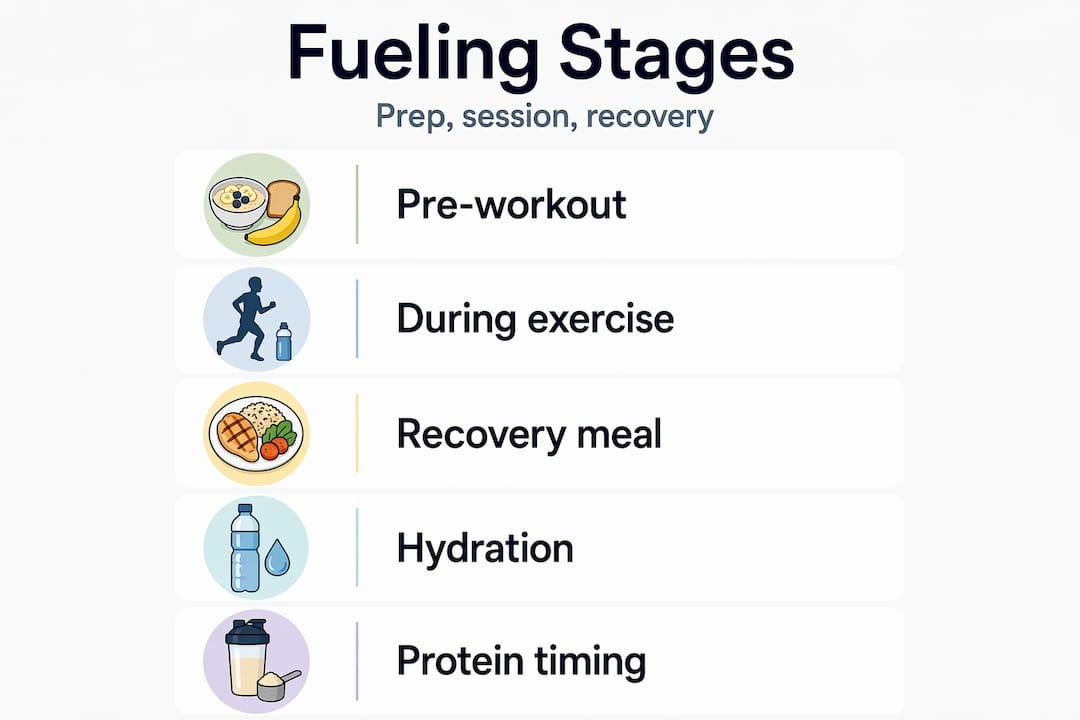
Timing ties it all together. Here is how the framework looks in practice:
- Pre-workout (2 to 4 hours before): carbohydrate-rich meal with moderate protein and low fat
- Pre-workout (30 to 60 minutes before): light carbohydrate snack if needed, minimal fat or fibre
- During exercise (sessions over 60 minutes): consistent carbohydrate intake and fluid with electrolytes
- Post-workout (within 2 hours): carbohydrates plus protein to start glycogen replenishment and muscle repair
Pro Tip: Do not leave your post-workout nutrition to chance. Prepare your recovery meal or snack in advance so it is ready the moment you finish. Convenience is a genuine performance tool.
Pre-workout fueling: what to eat before training
The two to four hour pre-workout window is where you set yourself up for a strong session. A meal in this window should be built around familiar, easily digestible carbohydrates, a moderate portion of protein, and as little fat and fibre as possible. Fat and fibre slow gastric emptying, which means the carbohydrates you need available during your session will still be sitting in your gut. Low-fibre starches like white rice, white bread, or pasta with a simple protein source are reliable choices precisely because they have been tested and proven in training.
The 30 to 60 minute window is for top-ups only. A banana, a small portion of oats, or a sports drink can raise blood glucose and provide a last burst of available energy without causing digestive problems. This window is not the time to experiment with new foods.
Common mistakes in this window include:
- Skipping the pre-workout meal entirely in an attempt to train fasted
- Eating a fibre-heavy salad or high-fat meal too close to the session
- Relying on coffee as a meal replacement
- Applying generic clean-eating rules that were never tested during actual training
Hydration before exercise matters just as much as food. Aim to arrive at your session well-hydrated by drinking steadily through the morning or afternoon before you train. Including some sodium with your pre-workout meal helps your body retain that fluid rather than losing it through urine before you even start.
Pro Tip: Whatever you plan to eat before a race or competition, rehearse your pre-race meal in training first. The worst time to discover a food disagrees with you is on race day.
Fueling during exercise: keeping performance high
For sessions under 60 minutes, your pre-workout glycogen stores are usually sufficient. Once you push past an hour, particularly at moderate to high intensity, carbohydrate intake during the session becomes a significant performance lever. Endurance athletes consume 30 to 60 grams of carbohydrate per hour as a standard practice, with some trained athletes tolerating up to 100 grams per hour using glucose-fructose blends.
That upper figure matters for a specific reason. The gut has separate transport mechanisms for glucose and fructose. When you combine them, you can absorb and oxidise carbohydrates faster than with glucose alone, which raises the practical ceiling for high-rate fueling.
Here is a simple framework for carbohydrate intake during exercise:
- Sessions of 60 to 90 minutes: aim for 30 to 45 grams per hour using a single carbohydrate source
- Sessions of 90 minutes to 2.5 hours: target 45 to 60 grams per hour, consider a glucose-fructose product
- Sessions beyond 2.5 hours: consider up to 90 grams per hour if your gut is trained for it
| Session duration | Carbohydrate target | Recommended source |
|---|---|---|
| Under 60 minutes | 0 to 30 g/h | Water or light sports drink |
| 60 to 90 minutes | 30 to 45 g/h | Single-source carbohydrate |
| 90 min to 2.5 hours | 45 to 60 g/h | Glucose-fructose blend |
| Over 2.5 hours | Up to 90 to 100 g/h | Trained gut required |
Pushing above 100 grams per hour shows limited additional performance benefit and significantly increases the risk of gastrointestinal distress. Your gut is a trainable organ, but you must work up to high intake rates gradually over weeks, not sessions.
Electrolytes during longer efforts are not optional. Drinking plain water during sessions over two hours can actually dilute blood sodium, increasing the risk of hyponatremia. A product that includes sodium in meaningful amounts is worth using for any session exceeding an hour in warm conditions or beyond 90 minutes in cooler weather. For a detailed breakdown of electrolyte ratios for athletes, it is worth understanding your individual sweat profile before you standardise an approach.
Pro Tip: Start fueling early in long sessions, well before you feel hungry or tired. By the time your body signals it, you are already behind. Pacing your intake across the session is far more effective than trying to catch up in the final third.
Post-workout recovery fueling
Recovery is where the adaptation from training actually happens, and nutrition is what drives it. The immediate priority is glycogen replenishment. Carbohydrate intake in the first two hours after exercise restores glycogen most rapidly, which becomes especially relevant if you train twice in a day or on consecutive days with limited rest time.

Combining carbohydrates with protein in the post-workout window accelerates both glycogen restoration and muscle protein synthesis. A ratio of roughly 3:1 or 4:1 carbohydrates to protein works well in practice. Think rice cakes with chicken, chocolate milk, or a purpose-built recovery drink with both macronutrients present.
Practical post-workout options that work:
- White rice with a lean protein source and a small amount of salt
- Greek yoghurt with banana and honey
- A recovery shake containing both carbohydrates and whey protein
- A toasted bagel with eggs and a sports electrolyte drink on the side
| Recovery goal | Nutrient priority | Timing |
|---|---|---|
| Glycogen replenishment | Carbohydrates (1 to 1.2 g per kg bodyweight) | Within 2 hours |
| Muscle repair | Protein (20 to 40 g) | Within 2 to 3 hours |
| Fluid and sodium replacement | Water with electrolytes | Immediately and ongoing |
Protein timing is effective within a broader two to three hour window after training, so you do not need to panic if your recovery meal is slightly delayed. What matters more is that you eat the right amounts consistently across the full day. Re-hydrating with a sodium-containing fluid after training helps retain the water your body actually needs for recovery rather than immediately losing it.
Pro Tip: Weigh yourself before and after a hard session. Every kilogram lost is approximately one litre of fluid. Replace 150% of that loss over the following two to three hours to fully re-hydrate.
Recognising and fixing under-fuelling
Under-fuelling is the most underestimated barrier to performance among recreational and competitive athletes alike. It does not always look dramatic. Fatigue, mood shifts, and a slow decline in training output are the most common presentations, and they are easy to dismiss as overtraining or poor sleep when the real cause is simply not eating enough to match your training load.
Signs you may be under-fuelling include:
- Persistent fatigue that does not improve with rest
- Mood changes, irritability, or difficulty concentrating
- Declining performance across sessions you previously handled comfortably
- Increased soreness and extended recovery time
- Increased frequency of minor illnesses or injuries
Matching carbohydrate intake to your body weight and training load is the practical starting point. A hard training day demands more than a rest day, and that adjustment needs to happen deliberately, not by accident. Individual factors including age, training volume, sweat rate, and gastrointestinal tolerance all affect your precise requirements. Individual sweat rate testing can reveal significant differences in sodium needs that a generic plan simply will not account for.
Wearable technology, food tracking apps, and periodic check-ins with a sports dietitian are all tools worth using if you are serious about getting this right. The athletes who progress fastest are usually the ones who treat their nutrition with the same rigour as their training programme.
Pro Tip: Track your food intake for one typical training week and one rest week. The difference in caloric and carbohydrate needs is usually larger than most athletes expect, and seeing the numbers makes it far easier to fuel each day appropriately.
My take on where most athletes go wrong
I have seen athletes train extraordinarily hard while treating nutrition as an afterthought. They obsess over sets, reps, and pace data while eating the same meals regardless of what the session demanded. That disconnect is one of the most consistent limiters I notice.
The other mistake is the opposite. Some athletes become so fixated on minute-by-minute fueling windows, precise gram counts, and supplement stacking that they lose sight of the foundation. Consistent total daily intake matched to your training frequency matters more than whether your protein shake was consumed at 17 minutes or 47 minutes post-workout. The science has moved on from the obsessive anabolic window narrative.
What I have found genuinely moves the needle is building repeatable habits around the big three: a solid pre-workout meal you have tested, consistent fueling during any session over an hour, and a recovery meal within a reasonable window after training. That framework, applied consistently, outperforms any over-engineered protocol in the real world.
The hydration piece also deserves more credit than it typically gets. Most athletes know they should drink more, but far fewer understand that the electrolyte composition of what they drink is just as relevant as the volume, particularly if they are a heavy or salty sweater.
— Tom
Fuel your training with Useinterval
If you are ready to put peak performance fueling into practice, the right products make consistency far easier. Useinterval is built specifically for athletes doing high-intensity work who want natural ingredients they can trust.
The Useinterval Starter Bundle brings together the pre-workout energy and electrolyte hydration you need to cover the core fueling demands covered in this article. Natural ingredients, no unnecessary fillers, and formulated for the demands of serious training. For a deeper understanding of how sports nutrition supports high-intensity results, the Useinterval blog covers the science behind every product decision. Start with the fundamentals and build from there.
FAQ
What is peak performance fueling?
Peak performance fueling is the practice of aligning your carbohydrate, protein, hydration, and electrolyte intake with the timing and demands of your training. It goes beyond general healthy eating to directly support energy, recovery, and sustained output.
How much carbohydrate should you eat before exercise?
A meal two to four hours before training should include easily digestible carbohydrates and moderate protein. A lighter carbohydrate snack 30 to 60 minutes before can top up blood glucose without causing digestive discomfort.
How many grams of carbohydrate do you need during a long session?
Most athletes benefit from 30 to 60 grams of carbohydrate per hour for sessions over 60 minutes. Trained athletes using glucose-fructose blends may tolerate up to 90 to 100 grams per hour, but this requires progressive gut training.
What are the signs of under-fuelling in training?
Persistent fatigue, declining performance, mood changes, and extended recovery time are the primary indicators. Under-fuelling reduces motivation and output in ways that are often misattributed to overtraining.
Do you need electrolytes or just water during exercise?
For sessions under 60 minutes in moderate conditions, water is generally sufficient. For longer sessions or hot environments, sodium-containing electrolytes become critical because plain water can dilute blood sodium and increase the risk of hyponatremia.