


What is nutraceutical purity? A guide for athletes
TL;DR:
- Nutraceutical purity ensures supplements contain exactly what is claimed, free from contaminants or adulteration.
- Third-party testing and certifications like NSF or USP provide independent verification of a product’s ingredient authenticity and safety.
You take supplements to perform better, recover faster, and feel stronger. But what if what’s on the label isn’t what’s in the bottle? Understanding what is nutraceutical purity isn’t just an academic exercise. It’s the difference between a supplement that works and one that wastes your money or, worse, compromises your health. Only 8% of creatine products were third-party certified as of 2026, despite nearly three-quarters of adults using at least one dietary supplement regularly. That gap should concern every serious athlete.
Table of Contents
- Key takeaways
- What nutraceutical purity actually means
- Standards and testing that verify purity
- Risks and challenges to maintaining purity
- How to assess nutraceutical purity before you buy
- Putting purity knowledge into practice
- My take on where purity standards are heading
- Train harder with supplements you can trust
- FAQ
Key takeaways
| Point | Details |
|---|---|
| Purity means more than clean labelling | Nutraceutical purity covers ingredient authenticity, absence of contaminants, and accurate label claims. |
| cGMP certification is baseline, not a luxury | Manufacturers using Current Good Manufacturing Practices provide the minimum acceptable quality controls. |
| Third-party seals are your best verification tool | Certifications from NSF, USP, or Alkemist give independent confirmation of what a product contains. |
| Supply chains create real contamination risk | Global botanical sourcing introduces adulteration and pathogen risks that poor testing fails to catch. |
| Purity directly affects your results | A diluted or contaminated supplement won’t deliver the performance benefit you’re paying for. |
What nutraceutical purity actually means
The term gets used loosely, but nutraceutical purity has a precise meaning. It refers to the degree to which an ingredient or finished product contains exactly what it claims to contain, nothing more and nothing less. No contaminants, no substituted materials, no undisclosed fillers, and no discrepancy between the label and the actual contents.
This is distinct from, but related to, several other quality concepts you’ll come across:
- Potency refers to whether the active ingredient is present at the stated dose. A product can be pure but under-dosed.
- Identity refers to whether the ingredient is genuinely what it’s labelled as. Some botanical supplements contain entirely different plants.
- Quality standards refer to the broader set of manufacturing, testing, and documentation practices that protect both purity and potency throughout the production process.
Purity sits at the centre of all of these. Label claims can be misleading, and adulteration risks safety as well as efficacy. For athletes, this has direct consequences. A pre-workout that contains heavy metal contaminants can affect kidney function over time. A protein powder spiked with cheap amino acids to inflate nitrogen readings won’t build the muscle you’re training for.
Common contaminants in the nutraceutical space include:
- Heavy metals such as lead, arsenic, and cadmium, particularly in botanical and plant-based products
- Microbial contamination including bacteria, moulds, and yeast introduced through poor sanitation
- Pesticide residues from agricultural sourcing without proper controls
- Undeclared pharmaceutical compounds, sometimes added to make products feel more effective
- Substitute or diluted botanical ingredients used to cut costs at the raw material stage
The importance of nutraceutical purity isn’t abstract. Every one of these contaminant categories has been linked to real product recalls and consumer harm.
Standards and testing that verify purity
Knowing that purity matters is one thing. Understanding how it gets verified is what lets you make smarter choices as a consumer.
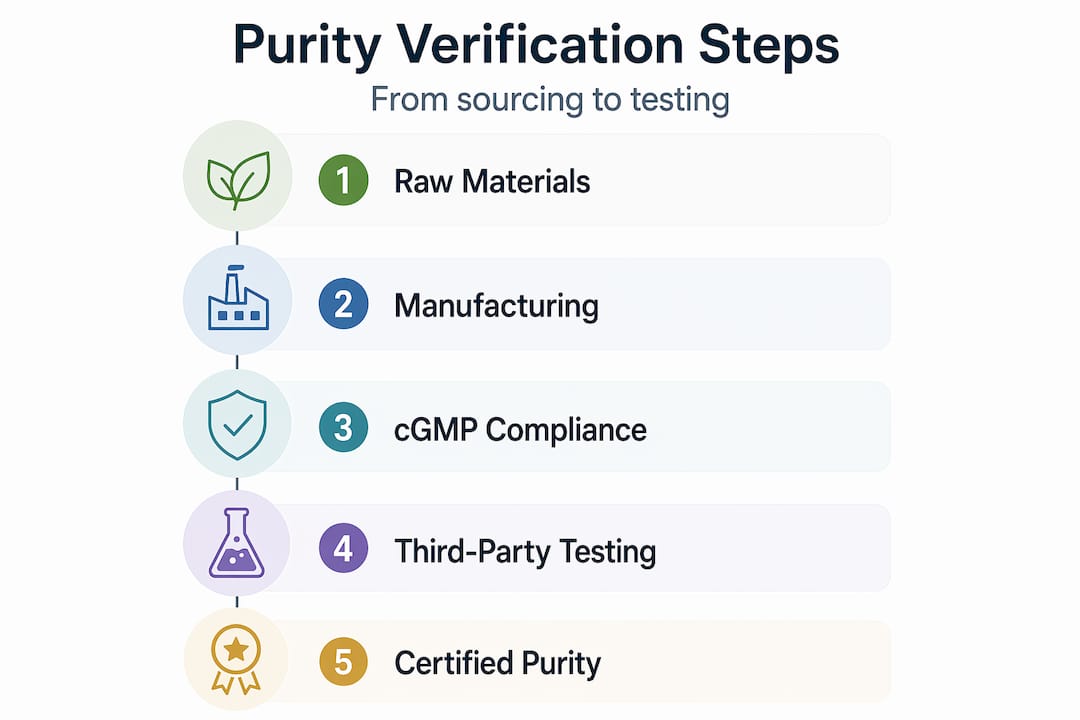
Current Good Manufacturing Practices (cGMP) are the regulatory floor for supplement manufacturing. cGMP enforces strict controls across sourcing, sanitation, labelling, and batch-to-batch consistency. A facility operating under cGMP must document everything from raw material receipt to finished product release. It’s a necessary starting point, but it doesn’t guarantee that every individual batch meets the purity claims on the label.
That’s where third-party testing becomes the differentiating factor. Independent certifying bodies test products against stated specifications without any financial interest in the result.
| Certifying body | What it verifies | Best known for |
|---|---|---|
| NSF International | Ingredient identity, potency, and absence of banned substances | Sports supplement certification |
| USP (United States Pharmacopeia) | Purity, strength, and dissolution testing | Broad supplement and pharmaceutical standards |
| ConsumerLab | Accuracy of label claims and contamination screening | Consumer-facing independent reviews |
| Alkemist Labs | Botanical ingredient identity and authenticity | Herbal and plant-based ingredient verification |
Third-party testing allows responsible suppliers to demonstrate true ingredient quality and purity in a way that self-reported testing simply cannot. The distinction matters because self-testing creates an obvious conflict of interest.
On the analytical side, the methods used to test supplements have advanced considerably. Traditional single-marker testing checks for one or two target compounds. This is straightforward but easy to defeat through sophisticated adulteration. Metabolomic fingerprinting offers a comprehensive quality check by mapping the entire chemical profile of a botanical ingredient, making it far harder for substituted or adulterated materials to pass undetected.
Purity thresholds themselves are also being pushed upward. USP sets creatine purity at 98%, but newer alliances within the industry are pushing for 99.5% verified purity per batch as a premium benchmark. That 1.5% difference may sound small, but at meaningful doses it represents a measurable reduction in potential contaminant exposure.
Pro Tip: When evaluating a supplement brand, ask whether their third-party testing is per batch or per formula. Per batch is the standard that actually matters. A formula tested once can still vary batch to batch.
Risks and challenges to maintaining purity
Even when manufacturers intend to produce a pure product, the supply chain creates significant vulnerability. Most supplement brands do not grow or extract their own raw materials. They source from brokers and suppliers across multiple countries, which introduces layers of risk that are difficult to monitor.

The global botanical supply chain is a major risk for contamination. Testing at both raw material and finished product stages is the minimum required to catch problems before they reach the consumer. When brands skip either stage, contaminated ingredients can pass straight through into finished products.
The specific risks worth knowing about as a consumer include:
- Ingredient substitution, where a cheaper or more available plant species is used in place of the stated ingredient, often undetectable without proper authentication testing
- Dilution, where a genuine ingredient is present but at a fraction of the stated concentration
- Spiking, where a product is intentionally adulterated with undeclared substances to enhance its apparent effect, a particular problem in pre-workout and weight loss categories
- Pathogen contamination, which can occur at the farm level if sanitation and harvesting protocols are poor
- Cross-contamination in shared manufacturing facilities, which is especially relevant for athletes subject to anti-doping rules
Supply chain complexities allow poor-quality botanical materials to enter final products unless farm-level documentation and sanitation are properly verified. Good Agricultural and Collection Practices (GACP) set standards for how raw botanicals are grown, harvested, and stored, but compliance varies enormously across different sourcing regions.
Strict quality systems including documentation and audit readiness are what separate credible manufacturers from those simply relying on a clean-looking label. Without traceability from farm to finished product, there is no reliable way to verify what you are consuming.
How to assess nutraceutical purity before you buy
Practical knowledge is more useful than abstract principles. Here is a concrete process for evaluating nutraceutical ingredient safety before any supplement enters your routine.
-
Check for recognised third-party seals. Look specifically for NSF Certified for Sport, USP Verified, or Informed Sport certification. Independent third-party seals from bodies like NSF, USP, or ConsumerLab provide the most reliable assurance of purity and potency. These seals mean an independent party has verified the product, not just the manufacturer.
-
Research the brand’s transparency. Reputable brands publish their Certificates of Analysis (COAs) for each batch. A COA shows the actual test results for that specific production run. If a brand won’t share this on request, that tells you something important.
-
Scrutinise the label carefully. Understanding nutraceutical labelling means looking beyond the front panel. The supplement facts panel should list every ingredient including fillers, binders, and flow agents. Proprietary blends that obscure individual ingredient doses are a red flag for anyone serious about what they’re consuming.
-
Verify the seller. Purchasing from unauthorised third-party marketplaces increases the risk of counterfeit or improperly stored products. Buy directly from the brand or from verified retailers wherever possible.
-
Look for sport-specific certification if you compete. For athletes subject to anti-doping testing, purity takes on additional urgency. The best pre-workout supplements for competitive athletes carry Informed Sport or NSF Certified for Sport status because these programmes test for prohibited substances specifically. A standard cGMP certification does not.
Pro Tip: Search your supplement’s product name plus “COA” or “third-party tested” before purchasing. Brands proud of their purity make this information easy to find. Brands that bury it or don’t have it are telling you something.
You can also find detailed guidance on supplement certifications for athletes that breaks down exactly what each seal means in practice.
Putting purity knowledge into practice
Understanding nutraceutical purity gives you a genuine advantage as a consumer. The benefits of pure nutraceuticals go beyond avoiding harm. A product that delivers exactly what the label states will produce consistent, predictable results. That consistency is what allows you to build effective nutrition protocols around your training.
Quality in this industry is no longer a differentiator. It is a prerequisite. Quality is now a mandatory baseline requiring extensive documentation and audit readiness from any credible manufacturer. Brands that treat purity as a selling point rather than a non-negotiable standard are, intentionally or not, revealing that they view it as optional.
Purity is not a premium feature. It is the minimum you should accept. Every supplement you take is either working for you or it isn’t, and impure products make that distinction impossible to know.
Prioritise certification, demand transparency, and treat an absence of third-party testing as a reason to look elsewhere. Your training deserves that standard.
My take on where purity standards are heading
I have followed the supplement industry closely for years, and the direction of travel is genuinely encouraging, even if the current state leaves a lot to be desired.
What strikes me most is how long the industry allowed self-regulation to substitute for independent verification. For a long time, brands could print impressive-sounding quality claims without any external body checking whether those claims were true. Consumers had no practical way to tell the difference between a brand that genuinely invested in purity and one that spent that money on marketing instead.
What has changed is consumer demand. Athletes and health-conscious buyers are more informed than ever, and they are asking better questions. That has pushed more brands toward legitimate third-party certification, and it has pushed certifying bodies to raise their own standards. The push toward 99.5% per-batch purity verification for creatine is a good example of the industry responding to pressure from informed buyers.
My practical advice is simple. Don’t assume that a premium price means a pure product. And don’t assume that a modest price means a poor one. The only reliable signal is independent, batch-level testing with published results. Everything else is marketing.
If you want to understand how purity concerns affect athletes specifically, the piece on supplement purity for female athletes is worth your time.
— Tom
Train harder with supplements you can trust
If reading this has made you more careful about what goes into your body before a session, that’s exactly the right response. At Useinterval, we build our pre-workout and electrolyte products around natural ingredients with full transparency about what’s in every serving.
Our Starter Bundle is designed for athletes who train at high intensity and want supplements that perform without compromise. Every ingredient is selected for efficacy, sourced responsibly, and clearly labelled so you know precisely what you’re consuming. No proprietary blends obscuring doses, no unnecessary fillers, and no guessing. If you’re ready to train with something you can actually trust, the Useinterval Starter Bundle is the place to start.
FAQ
What is nutraceutical purity in simple terms?
Nutraceutical purity means a supplement contains exactly what its label states, with no contaminants, substituted ingredients, or undisclosed additives. It is the foundation of both safety and efficacy in any supplement product.
How can I tell if a supplement is pure?
Look for third-party certification seals from organisations such as NSF International, USP, or Informed Sport, and ask the brand for a Certificate of Analysis for the specific batch you are buying.
What are the main nutraceutical contamination risks?
The most common risks include heavy metals, microbial contamination, pesticide residues, undeclared pharmaceutical compounds, and ingredient substitution or dilution at the raw material stage.
Why does nutraceutical purity matter for athletes?
Athletes face anti-doping consequences from contaminated supplements in addition to the health risks. Sport-specific certifications like NSF Certified for Sport test specifically for prohibited substances that standard manufacturing checks do not screen for.
What is the difference between cGMP and third-party certification?
cGMP sets the regulatory minimum for how supplements must be manufactured, covering processes and documentation. Third-party certification goes further by independently testing the actual finished product to verify that label claims are accurate.