


Why supplement certifications matter for female athletes
TL;DR:
- Many sports supplements contain undeclared prohibited substances, posing health and doping risks.
- Product-based certifications like NSF, Informed Sport, and BSCG provide more reliable safety assurance than GMP alone.
- Active verification of batch codes and ongoing diligence are essential for safe, certified supplement use.
A recent survey found that 35% of sports supplements tested online contained WADA-prohibited substances, with 57% of those ingredients undeclared on the label. For female athletes training at high intensity, that is not a footnote. It is a direct threat to your health, your results, and your competitive standing. Certifications exist precisely to close this gap, yet most women still treat them as a minor checkbox rather than a non-negotiable part of their supplement routine. This guide breaks down what certifications actually mean, where they fall short, and how to use them properly to protect your performance.
Table of Contents
- What supplement certifications really mean
- The risks of going uncertified: Contamination, potency, and athlete health
- Do certifications guarantee safety? Exploring the limits and loopholes
- How to confidently choose certified supplements for your performance
- The uncomfortable truth: Why most supplement buyers still get it wrong
- Level up your performance with trusted, certified supplements
- Frequently asked questions
Key Takeaways
| Point | Details |
|---|---|
| High contamination risk | Many uncertified supplements are tainted with banned or harmful substances. |
| Certification is not a guarantee | Even certified products require extra checks to ensure batch safety and up-to-date testing. |
| Smart supplement choices boost performance | Using properly certified supplements can protect your health and help you reach your athletic goals. |
| Women’s needs deserve extra scrutiny | Female athletes should prioritise ongoing verification to support performance, recovery, and wellbeing. |
What supplement certifications really mean
The word “certified” gets used loosely in the supplement industry, and that vagueness costs athletes dearly. There are two distinct types of certification worth understanding: manufacturing certifications and product-based certifications. Manufacturing certifications, chiefly Good Manufacturing Practice (GMP), confirm that a facility follows consistent quality processes. They say nothing about whether the finished product is free from banned substances. Product-based certifications, by contrast, test the actual supplement that ends up in your hands.
The major product-based schemes that matter most for competitive and performance-focused athletes are NSF Certified for Sport, Informed Sport, and BSCG Gold Standard. Each uses independent laboratories to screen for contamination. NSF screens for 290+ banned substances, while Informed Sport batch-tests products throughout their commercial life. BSCG applies a similarly rigorous protocol, particularly respected in professional sport. Understanding third-party certification standards helps you see why independent oversight matters far more than a brand’s own quality claims.
Not all schemes carry the same weight. Some logos are self-awarded or rely on paperwork audits rather than laboratory analysis. This is why supplement purity for performance starts with identifying who actually did the testing and how.
Certification logos worth recognising:
- NSF Certified for Sport (shield logo, blue)
- Informed Sport (blue tick, batch-tested mark)
- BSCG Gold Standard (gold certification seal)
- Cologne List (German-based, widely trusted in European sport)
- Labdoor (independent grading, though not a formal certifier)
| Certifier | What it tests | Batch testing | Banned substances screened |
|---|---|---|---|
| NSF Certified for Sport | Product and facility | Yes | 290+ |
| Informed Sport | Product | Yes, ongoing | 250+ |
| BSCG Gold Standard | Product | Yes | 490+ |
| GMP only | Facility processes | No | None |
As you can see, GMP alone leaves a significant gap. For certifications for safe performance, product-level testing is the baseline you need, not the bonus.
The risks of going uncertified: Contamination, potency, and athlete health
The data is harder to ignore than most brands would like you to believe. A 2025 survey of online sports supplements found that 35% contained prohibited substances, 18% failed potency testing, 12% exceeded heavy metals limits, and 8% failed microbiological safety checks. Each of those categories represents a different kind of harm.
“More than one in three online sports supplements tested contained a WADA-prohibited substance, with over half of those ingredients completely undeclared on the product label.”
For women training at high intensity, these risks compound in specific ways. Your hormonal environment, recovery cycles, and cumulative exposure to trace compounds all differ from male athletes. Heavy metals such as arsenic and lead accumulate over repeated exposure. Undeclared stimulants interact with stress hormones that are already elevated during intense training blocks. Potency failures mean you may be under-dosing on a key recovery ingredient without ever knowing it, undermining weeks of consistent effort.
Those risks associated with clean label supplement risks are not abstract. Athletes have faced competition bans, serious health incidents, and prolonged inflammation as a direct result of contaminated, uncertified products.
Many workout supplement myths revolve around the idea that natural or plant-based products are automatically safer. They are not. Without independent testing, even a product with a clean ingredient list can carry contamination from shared manufacturing equipment or poor supply chain controls.
Top risks of skipping certification:
- Ingesting WADA-prohibited substances without knowing
- Failing a drug test, ending your competitive career
- Absorbing heavy metals that accumulate over training seasons
- Receiving a product that is underdosed or mislabelled
- Experiencing adverse hormonal effects from undeclared stimulants
- Suffering gastrointestinal or immune disruption from microbial failures
The performance stakes are real. Every supplement you take should be working for you, not quietly working against your goals.
Do certifications guarantee safety? Exploring the limits and loopholes
Here is where honest advice matters most. Certifications reduce risk considerably, but they do not eliminate it entirely. GMP does not equal tested for doping agents, a point the USADA makes clearly. Batch testing is still a sample-based process, and no scheme tests every single unit produced.

This distinction matters enormously. A product can carry an NSF logo based on a batch tested six months ago while the current batch was produced under slightly different conditions. Informed Sport’s ongoing batch testing reduces this risk significantly, which is why it remains a preferred choice for elite athletes.
| Feature | GMP only | Informed Sport / NSF / BSCG |
|---|---|---|
| Facility quality audit | Yes | Yes |
| Product tested for doping agents | No | Yes |
| Ongoing batch testing | No | Yes (varies by scheme) |
| Banned substance screening | None | 250 to 490+ substances |
| Appropriate for competitive athletes | No | Yes |
Actions to take beyond checking the logo:
- Verify the specific product and batch number on the certifier’s official website.
- Check the certification expiry date, not just the presence of the logo.
- Research whether the manufacturer uses dedicated or shared production lines.
- Look for a certificate of analysis (COA) available directly from the brand.
- Cross-reference the product with whole-food supplement benefits and consider whether the ingredient profile is even necessary for your training phase.
Pro Tip: Bookmark the batch search pages for Informed Sport and NSF directly. When a new tub arrives, take 60 seconds to input the batch code before you open it. This one habit alone puts you ahead of the vast majority of athletes.
Certifications are a powerful filter, but they are the start of your due diligence, not the end of it.
How to confidently choose certified supplements for your performance
Knowing the risks and the limits of certification, here is a practical five-step process you can apply consistently.
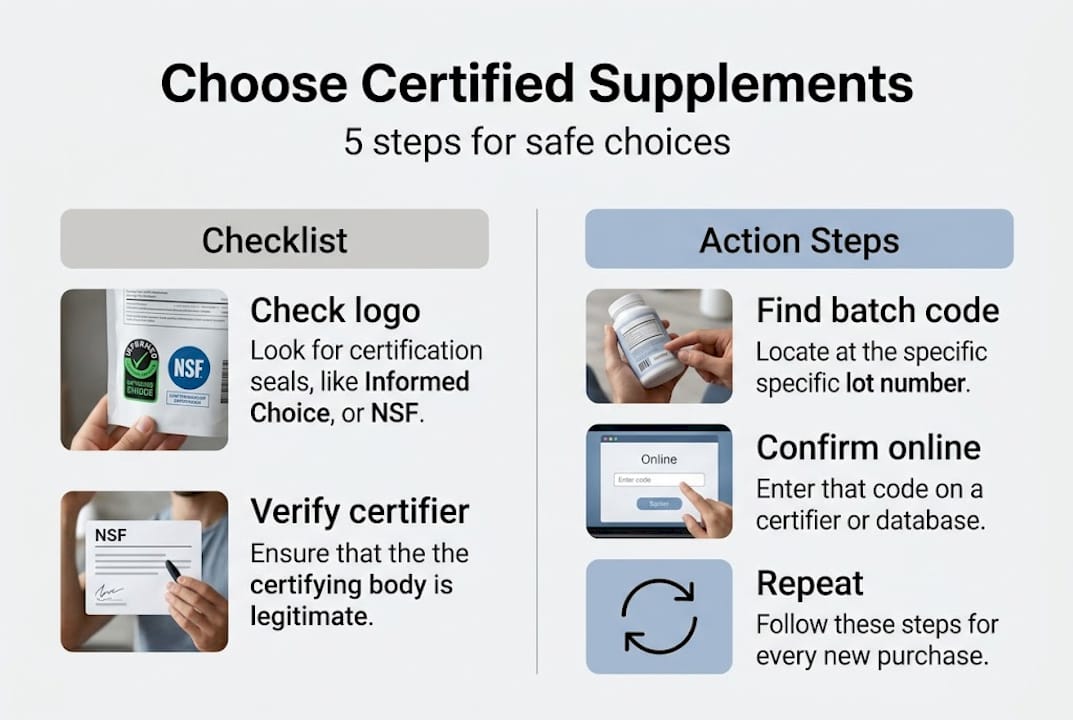
Step 1: Check the logo. Only recognise NSF Certified for Sport, Informed Sport, BSCG Gold Standard, or Cologne List as credible sports-specific certification. Do not accept GMP alone as adequate for performance supplements.
Step 2: Identify the certifier. Visit the certifier’s website and confirm the brand appears on their official list of certified products. Some brands use outdated logos from lapsed certifications.
Step 3: Find the batch code. Locate the batch or lot number printed on your product, usually on the base of the container or inside the lid.
Step 4: Verify online. Use the certifier’s batch search tool to confirm your specific product is covered. Best practice recommends using NSF or Informed Sport over basic GMP for athletic use, and always cross-checking batch numbers.
Step 5: Repeat each purchase. Reformulations happen. Certifications lapse. Manufacturing facilities change. Build verification into every new order, not just your first.
Pro Tip: Set a phone reminder for every supplement reorder to spend two minutes checking the batch code before your first serving. It takes less time than a warm-up, and it protects months of hard training.
For women in high-intensity sport, hormonal health and recovery are particularly sensitive to contamination. An athlete’s guide to safe performance will help you understand which ingredients carry the highest risk profiles. If you are currently using synthetic products and want cleaner options, learning how to transition to natural supplements can make that shift straightforward without sacrificing performance.
Avoid the pitfall of assuming a premium price tag equals certification. Many expensive supplements carry zero third-party testing. Equally, do not assume a smaller brand is automatically riskier. Some independent brands pursue Informed Sport certification precisely because their target audience demands it.
The uncomfortable truth: Why most supplement buyers still get it wrong
Here is what we have seen repeatedly. Athletes do the right thing once. They research, they find a certified product, they feel confident. Then the next purchase is rushed. The next flavour launch from the same brand gets grabbed without a second thought. The logo is there, so it must still be fine.
That “set and forget” approach is where contamination incidents happen. Certification is not a permanent state; it requires active maintenance from brands and active verification from you. Real safety in high-intensity female sport comes from treating supplement scrutiny as a habit, not a one-time effort.
We have seen what cumulative exposure to trace contaminants does over a full training season. The effects are rarely dramatic enough to trigger immediate alarm, but they quietly erode recovery quality, hormonal balance, and energy consistency. Building a habit of checking batch codes and sharing that practice with training partners creates a layer of protection that no single certification logo can replicate. Your supplement intake for female athletes should be treated with the same rigour as your training programme.
Level up your performance with trusted, certified supplements
You now have the knowledge to make genuinely informed choices. Putting it into practice starts with choosing products that were built with this standard of transparency from the ground up.
Our certified Starter Bundle brings together our natural pre-workout and electrolytes, both developed with third-party testing and full ingredient transparency at the core. No proprietary blends hiding underdosed actives. No compromises on purity. Every batch is traceable, and we make that information available because we believe you deserve nothing less. If you are ready to train harder with complete confidence in what you are taking, shop certified supplements and see exactly what sets our products apart.
Frequently asked questions
What is the difference between GMP and certified sports supplements?
GMP does not mean tested for banned substances. GMP confirms a product was manufactured to a consistent standard, whereas certifications like NSF Certified for Sport and Informed Sport test the finished product specifically for prohibited substances and contaminants.
How can I check if a supplement is truly certified?
Look for a recognised certification logo such as Informed Sport or NSF, then use the certifier’s online registry to confirm your exact product and batch code. Certifiers like Informed Sport offer a publicly available batch verification search tool.
Are certified supplements 100% safe for athletes?
Certifications reduce risk considerably but cannot guarantee complete safety, which is why checking each new batch and staying informed about product changes remains essential.
Which certification logos should I trust most for sports supplements?
NSF Certified for Sport, Informed Sport, and BSCG Gold Standard are the three most trusted and widely recognised certifications for competitive and performance-focused athletes.