


Your guide to natural ergogenics for athletes
TL;DR:
- Natural ergogenic aids derived from foods, plants, and minerals can enhance performance when used with proper timing and dosing, supported by solid evidence. Athletes should personalize protocols based on sport, training phase, and individual response, prioritizing fundamentals like nutrition and sleep. Systematic trial, quality sourcing, and patience are essential for effective, long-term benefits from natural ergogenic strategies.
Most athletes assume that meaningful performance enhancement comes from a lab. It doesn’t. A solid guide to natural ergogenics shows you that some of the most effective performance tools are derived from whole foods, plants, and minerals that have been used, studied, and refined across decades of sport science. The key is knowing which ones actually work, at what dose, and when to use them. This article cuts through the noise and gives you a practical, evidence-based breakdown of the best natural ergogenics available today.
Table of Contents
- Key takeaways
- Guide to natural ergogenics: what they are and how they work
- The best natural ergogenics and how to use them
- How to personalise your ergogenic protocol
- Integrating natural ergogenics into your training routine
- Common clarifications on natural ergogenic aids
- My take on natural ergogenics and long-term performance
- Try Useinterval’s natural performance bundle
- FAQ
Key takeaways
| Point | Details |
|---|---|
| Natural ergogenics are evidence-based | Several plant-based performance boosters have strong research support and work through clear physiological mechanisms. |
| Timing and dose matter enormously | Even the best natural ergogenic aid will underperform if taken at the wrong time or in the wrong amount. |
| Personalise your protocol | Supplement choice should match your sport, training phase, and individual response rather than a generic stack. |
| Fundamentals come first | No supplement replaces sound nutrition, quality sleep, and consistent training as the foundation of performance. |
| Quality sourcing is non-negotiable | The purity and standardisation of natural supplements varies widely; choose tested, reputable products. |
Guide to natural ergogenics: what they are and how they work
The term “ergogenic aid” comes from the Greek ergon (work) and gennan (to produce). In practice, it refers to any substance or method that improves exercise performance beyond your normal capacity. Natural ergogenic aids are those derived from plant extracts, whole foods, or naturally occurring compounds rather than synthetic chemistry.
These aids target specific physiological mechanisms. The main ones are energy metabolism (how efficiently you produce ATP), oxygen delivery and utilisation (critical for aerobic sports), neuromuscular function (power output and fatigue resistance), and recovery (reducing muscle damage and restoring capacity faster). Different ergogenics hit different targets, which is exactly why a one-size-fits-all approach fails consistently.
Efficacy also varies. Supplement effectiveness depends on athlete characteristics, sport type, dose, timing, and even genetics. Two athletes on identical protocols can see measurably different outcomes. This isn’t a reason to abandon natural supplementation. It’s a reason to treat it like training: test, observe, and adjust.
Pro Tip: Before adding any ergogenic aid, establish a two-to-four week baseline of training performance metrics. Without that reference point, you cannot tell whether a supplement is working or whether you are simply having a good week.
The concept of evidence-based selection matters here. Not every “natural” label carries real performance benefit. Some supplements are genuinely under-researched. Others are well-studied but only in sedentary populations. Understanding natural vs synthetic supplements helps you filter out the noise and focus on what actually moves the needle in trained athletes.
The best natural ergogenics and how to use them
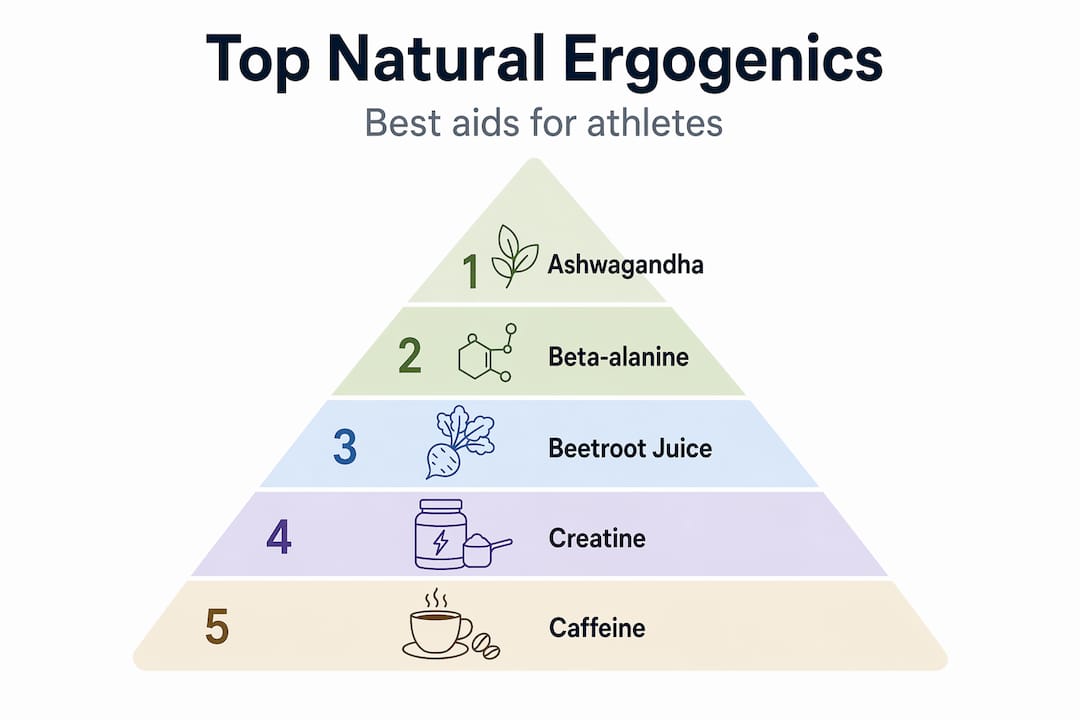
This is where the research gets specific. Not all plant-based performance boosters are created equal. Here is a breakdown of the most evidence-supported options.
Caffeine
Caffeine is the most consistently validated natural ergogenic in sport science. Caffeine at 3–6 mg/kg improves power output, endurance performance, and technical execution across a wide range of sports. It works primarily by blocking adenosine receptors, reducing perceived effort, and increasing adrenaline output.
Timing is critical. Caffeine taken 30–60 minutes before exercise produces the strongest performance effect. Miss that window and you may peak too early or too late. A dose of 200–400 mg consumed pre-exercise also slows glycogen depletion by shifting the body toward fat oxidation, which is particularly useful for endurance athletes.
Creatine monohydrate
Creatine is naturally found in red meat and fish, and your body synthesises it from amino acids. As a supplement, creatine improves jump performance, reduces sprint time, and increases muscular strength. It works by replenishing phosphocreatine stores faster, which supports repeated high-intensity efforts.

Minor side effects include water retention and occasional gastrointestinal discomfort, particularly during loading phases. For most athletes doing high-intensity work, these are manageable trade-offs for measurable gains in output.
Beetroot juice and dietary nitrates
Beetroot juice is one of the more interesting natural supplements for athletes doing endurance or mixed-intensity sports. Acute supplementation enhances anaerobic power and improves muscle oxygen saturation post-exercise without raising heart rate or blood pressure, based on a 2026 crossover study in trained football players.
Nitrates from beetroot are converted to nitric oxide in the body, which widens blood vessels and improves oxygen delivery to working muscles. For more on the mechanism, dietary nitrate’s performance role is worth understanding in detail. The benefits are more reliable for endurance and oxygen economy than for maximal strength activities.
Beta-alanine
Beta-alanine raises muscle carnosine levels, which buffers acid build-up during high-intensity exercise. Beta-alanine improves jump performance and is particularly useful for sports with repeated short bursts of effort lasting 60–240 seconds. The harmless tingling sensation (paraesthesia) during loading is the most common complaint.
Ashwagandha
Ashwagandha (Withania somnifera) is an adaptogen with growing sports science interest. A 2025 review across 12 studies found it may improve strength, VO2max, and recovery, though most of the research involves untrained or recreationally active subjects rather than elite athletes. It is worth considering for athletes dealing with high training loads, stress, and sleep disruption. Treat current evidence as promising rather than definitive.
Pro Tip: Do not layer multiple new supplements at once. Introduce one at a time over three to four weeks so you can attribute any change in performance or recovery to a specific compound.
| Ergogenic aid | Primary benefit | Best suited to | Key caution |
|---|---|---|---|
| Caffeine | Endurance, power, focus | Most sports | Avoid late-day use; build tolerance awareness |
| Creatine | Sprint, strength, jumps | Power and team sports | Water retention; GI sensitivity during loading |
| Beetroot juice | Oxygen efficiency, anaerobic power | Endurance, field sports | Less effective for pure max-strength events |
| Beta-alanine | Acid buffering | Interval and mixed work | Harmless tingling during loading phase |
| Ashwagandha | Recovery, fatigue resistance | High load training blocks | Limited trained-athlete evidence to date |
How to personalise your ergogenic protocol
Knowing the best natural ergogenics is only half the task. Applying them correctly to your specific context is where athletes consistently fall short. Tailored, sport-specific protocols consistently outperform generic stacks because supplements need to match physiological demands, not just goals.
Here is a practical framework for building your own approach:
- Identify your sport’s dominant energy system. Aerobic endurance events benefit most from beetroot juice and caffeine. Power and speed sports lean toward creatine and beta-alanine. Mixed sports often warrant a combination.
- Align supplementation with your training phase. Creatine loading during a strength block makes more sense than during a deload week. Caffeine is most valuable in the final weeks before competition when training specificity peaks.
- Account for your fitness level and training history. Highly trained athletes may see smaller absolute gains from some supplements because their baseline physiology is already efficient. Less trained athletes often see more pronounced responses.
- Be deliberate about timing and dosing. Caffeine’s window is well-defined. Nitrate benefits from beetroot juice typically appear within two to three hours of consumption. Getting these windows wrong reduces efficacy substantially.
- Do not substitute supplements for fundamentals. Nutrition, sleep, and training form the base. Supplements add specific mechanisms on top of that base. They cannot compensate for poor recovery or inadequate dietary intake.
Gender considerations are worth noting too. Female athletes may respond differently to some ergogenics, particularly those affecting hormonal pathways. For a detailed breakdown, natural supplement intake for female athletes offers updated guidance specific to 2026.
Pro Tip: If you are unsure where to start, prioritise caffeine and creatine. These two have the most consistent research support across the widest range of sports and athlete types.
Integrating natural ergogenics into your training routine
Knowing about a supplement and actually building it into your routine without creating dependence or gaps in your nutrition are different things. Here is how to do it practically:
- Source third-party tested products. The natural supplement market is poorly regulated in many areas. Look for products verified by organisations such as Informed Sport or NSF International to confirm purity and accurate labelling.
- Build supplements around your nutrition, not instead of it. Beetroot extract works better when your baseline nitrate intake from vegetables is already solid. Creatine loads more effectively with adequate carbohydrate and protein intake surrounding training.
- Hydration matters more than most athletes acknowledge. Creatine increases water retention in muscle tissue. Caffeine has a mild diuretic effect at high doses. Pairing ergogenics with consistent electrolyte and hydration management keeps both systems working.
- Track your response systematically. Use training logs, race results, or session ratings of perceived exertion to monitor whether a supplement is producing the response you expect. Subjective feel alone is unreliable.
- Avoid overreliance. Natural does not mean unlimited. Beta-alanine loading beyond recommended doses does not produce proportionally greater carnosine increases. More is not always more.
A noteworthy point on placebo effects: research consistently shows that athletes who believe a supplement is working often perform better, independent of its biochemical action. This is not a reason to dismiss natural ergogenics. It is a reason to be rigorous about how you evaluate them. Blind testing protocols, where possible, give you a cleaner picture.
Common clarifications on natural ergogenic aids
There is a lot of confusion in this space, and some of it comes from legitimate scientific nuance being lost in marketing noise. A few points worth clarifying directly:
- Are natural supplements safer than synthetic? Generally, the evidence-backed ones covered here are well-tolerated. However, “natural” is not a synonym for “risk-free.” Dose, interaction with other compounds, and individual health status all matter. Consulting a sports dietitian before significant supplementation is sensible.
- Can natural ergogenics fully replace synthetic ones? For most recreational and competitive athletes, yes. The performance gains from well-timed caffeine, creatine, and dietary nitrates are comparable to many synthetic alternatives in the real-world sport context.
- How long before you see benefits? Caffeine works acutely (within one hour). Creatine typically shows performance effects after five to seven days of consistent use. Ashwagandha may take four to eight weeks to produce noticeable adaptations.
- Do natural ergogenics trigger doping violations? The compounds covered here are generally permitted under WADA regulations, but always verify specific supplement certifications, particularly for competition athletes. Contamination in unverified products is a genuine risk.
My take on natural ergogenics and long-term performance
I have watched a lot of athletes chase performance through supplement stacks that look impressive on paper but deliver very little in practice. In my experience, the problem is almost never which supplement they are taking. It is the order in which they prioritise things.
What I have found is that athletes who see the most consistent improvement from natural ergogenics are those who already train well, eat well, and sleep consistently. The supplement becomes the marginal gain, not the solution to a fundamental gap. When the fundamentals are solid, even modest compounds like beetroot juice or beta-alanine produce results you can actually measure.
I am also genuinely sceptical of brands that lean hard on the “all-natural” badge as if that alone is a meaningful performance claim. Naturalness and efficacy are separate qualities. The reason I trust the compounds in this article is not that they come from plants. It is that they have mechanistic clarity and consistent research behind them.
My advice is to experiment with one compound at a time, keep records, and be patient. The athletes who respect evidence and track their own responses consistently outperform those chasing the next miracle product. Personalised supplementation is not a marketing concept. It is genuinely how this works.
— Tom
Try Useinterval’s natural performance bundle
If you train at high intensity and want a clean, evidence-informed starting point, Useinterval has done the formulation work for you.
The Useinterval Starter Bundle combines natural caffeine and beetroot extract in a pre-workout designed specifically for high-intensity athletes. The ingredients align directly with the evidence covered in this guide: correct dosing, transparent labelling, and third-party quality standards. There are no synthetic stimulants, no proprietary blends, and no guesswork about what you are putting in your body. If you are building a natural ergogenic protocol and want a product that reflects what the research actually supports, this is a practical place to begin. Explore the full range at Useinterval and find the stack that fits your training.
FAQ
What is a natural ergogenic aid?
A natural ergogenic aid is any substance derived from whole foods, plants, or naturally occurring compounds that improves exercise performance. Common examples include caffeine, creatine, and beetroot juice.
How much caffeine should athletes take for performance?
Caffeine at 3–6 mg per kg of bodyweight, consumed 30–60 minutes before exercise, produces the most consistent performance benefits for endurance and power sports.
Does beetroot juice work for high-intensity sport?
Yes. Acute beetroot juice supplementation has been shown to increase anaerobic power and improve muscle oxygen saturation in trained athletes, making it useful for both endurance and interval-based sports.
How long does creatine take to work?
Most athletes experience measurable performance improvements in sprint and strength tasks within five to seven days of consistent creatine supplementation, particularly when combined with adequate carbohydrate and protein intake.
Are natural ergogenic aids permitted in competition?
The main evidence-backed compounds covered here, including caffeine, creatine, beetroot nitrates, and beta-alanine, are generally permitted under WADA regulations. Always verify the specific product through a certified testing programme before competition use.