


Enhance athletic performance with real food supplements
TL;DR:
- Whole food supplements offer higher bioavailability and natural nutrient synergy compared to synthetic isolates.
- Female athletes often face specific deficiencies like iron, vitamin D, and calcium that real food sources address effectively.
- Personalizing supplement strategies based on testing, hormonal cycles, and training phase yields better performance results.
Iron deficiency affects 15 to 60% of female athletes, quietly cutting VO2 max by 3 to 4% before you even notice something is off. Yet most women reaching for a supplement grab a synthetic isolate, assuming more milligrams means more benefit. That assumption is worth questioning. Real food supplements work differently, bringing natural cofactors, enzymes, and phytonutrients that change how your body actually absorbs and uses what you take. This guide breaks down the science, the gaps most female athletes face between 30 and 50, and how to build a supplement strategy that genuinely supports your training rather than just ticking a box.
Table of Contents
- What makes real food supplements different
- Nutrient gaps in female athletes: real food solutions
- How whole food supplements enhance performance
- Debate: food first or supplementation?
- Our take: why female athletes should personalise their supplement strategy
- Take your performance to the next level naturally
- Frequently asked questions
Key Takeaways
| Point | Details |
|---|---|
| Real food offers better absorption | Whole food supplements provide nutrients with natural cofactors, improving bioavailability for female athletes. |
| Common gaps addressed naturally | Iron, calcium, and vitamin D deficiencies in active females are filled more effectively with real food supplements. |
| Performance benefits proven | Evidence shows real food sources like dates and ashwagandha boost endurance, energy plateau, and recovery. |
| Food first, personalise later | A balanced diet should be the foundation; supplement only for individual gaps or periods of high training. |
| Personalisation matters most | Testing, monitoring, and adjusting intake leads to optimal outcomes, particularly for female athletes aged 30-50. |
What makes real food supplements different
Synthetic supplements isolate a single nutrient and deliver it in a concentrated form. That sounds efficient, but your body rarely encounters nutrients in isolation. In whole foods, vitamins and minerals travel with enzymes, cofactors, and phytonutrients that help transport, activate, and absorb them. Strip those away and you often get a nutrient your body struggles to use fully.
Real food supplements preserve this complexity. A whole food iron source, for example, arrives with vitamin C and organic acids that dramatically improve uptake. Synthetic supplements versus whole foods research shows that real food supplements offer higher bioavailability precisely because of these natural enzymes and phytonutrients. That is not a minor detail. For a female athlete training five or six days a week, the difference between absorbed and unabsorbed nutrients shows up in your sessions.
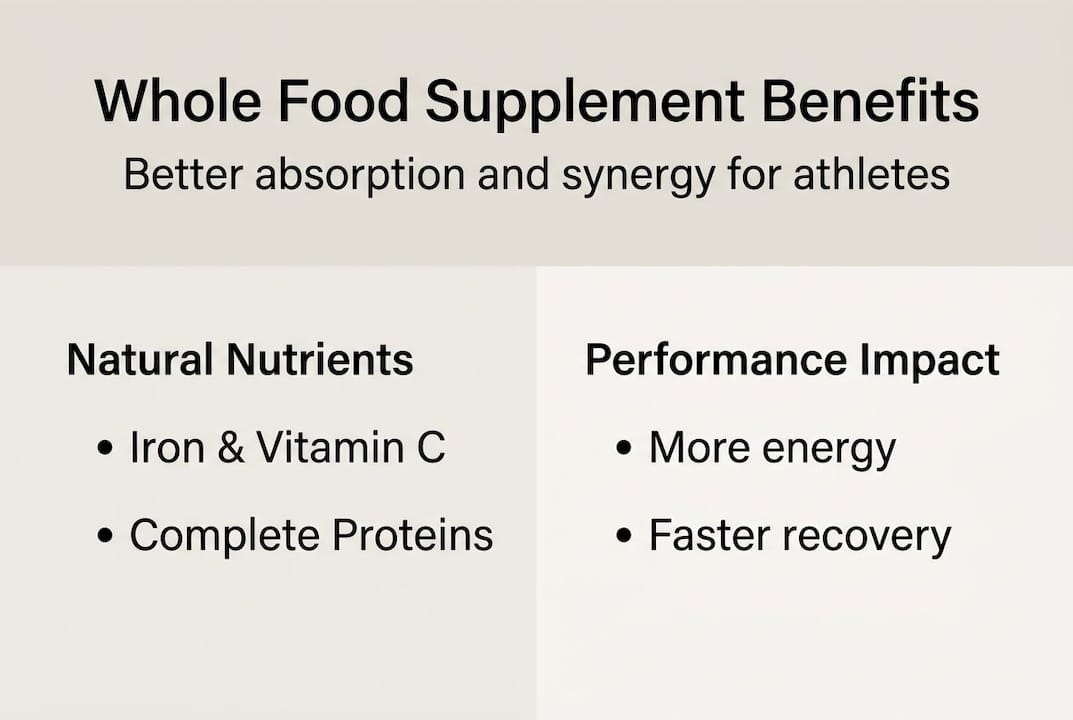
Understanding why whole-food supplements matter becomes even more relevant when you consider synergistic effects. Nutrients work in networks. Magnesium activates vitamin D. Vitamin K2 directs calcium to bone rather than arteries. Iron absorption depends on vitamin C and is blocked by calcium taken at the same time. Synthetic supplements rarely account for these relationships, which is why you can take a full spectrum multivitamin and still test deficient.
Here is a quick comparison of how the two approaches stack up:
| Feature | Synthetic supplements | Real food supplements |
|---|---|---|
| Bioavailability | Often lower | Generally higher |
| Cofactors included | Rarely | Yes, naturally present |
| Digestive tolerance | Can cause irritation | Usually well tolerated |
| Nutrient synergy | Limited | Built in |
| Processing level | High | Minimal |
The key benefits of choosing natural compounds include:
- Better absorption through naturally occurring cofactors
- Reduced digestive stress compared to synthetic isolates
- Broader micronutrient support from whole food matrices
- Lower risk of toxicity from fat-soluble vitamins in food-bound forms
- Hormonal compatibility with phytonutrients that support endocrine function
“The closer a supplement is to its original food form, the more your body recognises and uses it.”
Nutrient gaps in female athletes: real food solutions
Female athletes between 30 and 50 face a specific cluster of deficiencies that synthetic supplements often fail to address adequately. Iron, vitamin D, and calcium deficiencies are particularly common due to menstrual losses, sweat, and the hormonal shifts of perimenopause. Add high training loads and you have a recipe for fatigue, stress fractures, and declining performance that gets misread as overtraining.
The nutritional needs for female athletes are genuinely distinct from male athletes, yet most supplement research uses male subjects. That gap matters when you are trying to make informed decisions about what to take and when.
Whole food sources fill these gaps in ways that are easier for your body to process. Leafy greens provide non-haem iron alongside vitamin C for absorption. Dates offer rapid and sustained carbohydrate energy. Beetroot delivers nitrates that improve oxygen efficiency. These are not trendy ingredients. They are functional foods with measurable effects on the essential minerals for athletes that matter most during hard training blocks.

Here is a practical overview of the most critical nutrients to monitor:
| Nutrient | Performance impact | Real food source |
|---|---|---|
| Iron | VO2 max, endurance | Spinach, lentils, pumpkin seeds |
| Vitamin D | Bone health, immunity | Mushrooms, fortified oat milk |
| Calcium | Muscle contraction, bone density | Kale, tahini, fortified plant milk |
| Magnesium | Recovery, sleep, energy | Dark chocolate, nuts, seeds |
| B12 | Nerve function, red blood cells | Nutritional yeast, eggs |
Top nutrients to prioritise during high training loads:
- Iron especially if you are still menstruating or training twice daily
- Vitamin D particularly through autumn and winter in the UK
- Calcium critical during perimenopause when bone density drops faster
- Magnesium often depleted through sweat and stress
- Omega-3s for inflammation management and joint health
Exploring natural sports nutrition steps can help you map these nutrients to your actual training phase rather than guessing.
Pro Tip: Get a full blood panel before starting any supplement protocol. Testing ferritin, 25(OH)D, and serum magnesium gives you a baseline so you supplement what you actually need, not what you assume you need.
How whole food supplements enhance performance
The performance case for real food supplements goes beyond plugging deficiencies. Whole food nutrients support energy metabolism, antioxidant defence, muscle repair, and hormonal balance in ways that isolated compounds simply cannot replicate.
Take dates. They contain roughly 75g of carbohydrates per 100g, and research confirms that dates provide a 23% longer energy plateau compared to commercial gels, with better gastrointestinal tolerance. For a woman doing a two-hour Hyrox session or a long trail run, that sustained release matters enormously. Ashwagandha is another standout. Studies show 600mg per day for 28 days significantly improves recovery scores and sleep quality in female athletes, both of which are critical for adaptation.
The role of whole food antioxidants in recovery is nuanced. Antioxidants from food sources reduce oxidative stress without overwhelming the hormetic stress that drives adaptation. That is a meaningful distinction.
Practical supplement strategies to consider:
- Pre-workout: Dates or beetroot juice for natural nitrates and carbohydrate energy
- During training: Electrolytes from coconut water or mineral-rich sources rather than synthetic salts
- Post-workout: Tart cherry for inflammation, magnesium glycinate for muscle relaxation
- Daily support: Ashwagandha for cortisol management, iron-rich foods with vitamin C
For essential amino acids and muscle repair, whole food protein sources like hemp, pea, and egg provide the full spectrum your body needs without the artificial sweeteners and fillers found in many synthetic protein powders.
Exploring plant-based supplements can also open up options that align better with gut health, especially if synthetic supplements have caused digestive issues in the past.
Pro Tip: Avoid mega-dosing antioxidant supplements like isolated vitamin E or high-dose vitamin C immediately post-workout. This can blunt the cellular stress signals your body needs to trigger adaptation and strength gains.
Debate: food first or supplementation?
The food first principle is well established and worth respecting. A balanced diet usually suffices for most recreational athletes, and supplements are not a shortcut around poor nutrition habits. If your diet is genuinely varied, colourful, and adequate in calories, many supplements become redundant.
But female athletes in their 30s and 40s are not most people. High training loads, menstrual losses, perimenopause, and the sheer caloric restriction some athletes impose on themselves create real gaps that food alone cannot always close. This is where targeted supplementation earns its place.
Key considerations for the food first debate:
- A whole food diet should always be the foundation, not an afterthought
- Supplements fill specific, identified gaps rather than replacing meals
- Timing matters as much as what you take
- Quality and purity of supplements varies enormously, making supplement purity a non-negotiable concern
- More is not better. Excess fat-soluble vitamins accumulate and cause harm
Edge cases where supplementation becomes more urgent include: perimenopause with accelerating bone density loss, athletes training more than ten hours per week, those following plant-based diets without careful planning, and anyone recovering from illness or injury.
Research also highlights that female athletes are underrepresented in supplementation studies, which means precision dosing for women is still catching up. Blanket recommendations based on male physiology often underdose or overdose for female athletes.
“Individualising supplement protocols for women based on hormonal status, training phase, and dietary patterns produces better outcomes than following generic guidelines.”
Finally, supplements and performance adaptation research reminds us that timing and context determine whether a supplement helps or hinders. Taking the right thing at the wrong time can be as counterproductive as not taking it at all.
Our take: why female athletes should personalise their supplement strategy
Most supplement guides treat female athletes as a single category. They are not. A 32-year-old marathon runner in heavy training has completely different needs from a 48-year-old CrossFit athlete navigating perimenopause. One-size-fits-all advice fails both of them.
What we have seen consistently is that the athletes who get the most from supplementation are those who treat it as a dynamic process rather than a fixed protocol. They test, adjust, and respond to how their body changes across training blocks and hormonal phases. That takes more effort than buying a generic stack, but the performance returns are real.
Practical steps to personalise your approach:
- Test key biomarkers every three to six months, not just when you feel run-down
- Track symptoms alongside training load to spot patterns before they become problems
- Adjust supplement timing and dosage based on your menstrual or hormonal cycle
- Prioritise food quality first, then layer in targeted supplements for specific gaps
For a deeper starting point, the guide on top supplements for female Hyrox athletes offers a practical framework built around real training demands.
Take your performance to the next level naturally
If this guide has made one thing clear, it is that real food supplements work best when they are chosen with intention and quality in mind. At Interval, every product is built around clean, evidence-based ingredients that support the demands of high-intensity training without the synthetic fillers that compromise absorption.
The Starter Bundle is the simplest way to experience what a natural, whole food approach to pre-workout and electrolytes actually feels like in your sessions. Explore the full range at Interval supplements and find a combination that fits your training phase, your body, and your goals. No guesswork, no compromises.
Frequently asked questions
Are real food supplements safer than synthetic ones?
Real food supplements provide nutrients with natural cofactors that improve bioavailability and reduce the risk of toxicity compared to synthetic isolates, provided you choose quality-controlled sources.
Should female athletes supplement iron even if they are not anaemic?
Yes. Iron supplementation improves aerobic capacity by 6 to 15% in iron-deficient but non-anaemic female athletes, making it worth addressing even before anaemia develops.
Do real food supplements work quickly?
Some act relatively fast. Ashwagandha at 600mg daily for 28 days improved recovery and sleep quality in female footballers, while dates provide immediate energy benefits during training.
Can you combine real food and synthetic supplements?
Absolutely. Combining both allows you to use whole food sources for broad micronutrient support while using isolated forms, such as chelated iron or vitamin D3, for precision dosing where gender-specific research is still developing.
Recommended
- Natural Performance Boosters: Elevate High-Intensity Results – Interval
- Why Whole-Food Supplements Matter for Athletes – Interval
- How to Enhance Athletic Focus Naturally for Intense Training – Interval
- Natural supplement intake guide for female athletes 2026 – Interval
- Why use conditioning drills? Boost basketball performance – Hoop Mentality