


Clean label supplements: the athlete's guide to safe performance
Nearly half of all protein powders on the market contain heavy metal levels that exceed California’s Prop 65 safety limits. That’s not a fringe finding from a small lab. The Clean Label Project tested 160+ protein powders and found 47% failed on contamination. The uncomfortable truth is that ‘organic’, ‘natural’, and even ‘clean label’ branding doesn’t automatically mean safe. For Hyrox women training hard and pushing their bodies to the limit, understanding what these terms actually mean is not optional. It’s essential.
Table of Contents
- What does clean label mean?
- Clean label for supplements: What sets it apart
- How does clean label differ from ‘natural’ and ‘organic’?
- Risks: Common pitfalls and heavy metal contamination
- Selecting clean label supplements for Hyrox training
- Find your clean label supplement solution
- Frequently asked questions
Key Takeaways
| Point | Details |
|---|---|
| Clean label means transparency | Supplements labelled clean emphasise simple, real ingredients and full disclosure, but lack legal regulation. |
| Certifications matter for safety | Look for NSF or Informed Sport certifications to ensure your supplements are free of banned substances and contaminants. |
| Organic and plant-based protein risks | Data shows plant-based and organic proteins frequently have higher levels of heavy metals, making whey/collagen safer choices. |
| Practical checklists aid selection | Use a clear selection checklist to choose genuinely clean, safe supplements for peak Hyrox performance. |
What does clean label mean?
The term ‘clean label’ didn’t come from a regulatory body. It came from consumers who were tired of ingredient lists that read like chemistry homework. The movement pushed brands to simplify formulations, remove artificial additives, and be transparent about what’s actually inside the product.
Here’s the critical part: clean label is not a regulated term. There is no government body that certifies a product as clean label. No legal threshold. No standardised definition. What it means in practice is shaped entirely by consumer expectation and third-party certifiers.
For a supplement to genuinely qualify as clean label, it should tick these boxes:
- Recognisable ingredients with plain-language names
- Minimal processing from source to final product
- No artificial colours, flavours, or preservatives
- Full transparency on what’s in the formula and at what dose
- No unnecessary fillers or proprietary blends
“Clean label means simple, recognisable ingredients, minimal processing, and no artificial additives — but it is not a regulated term.” This distinction matters enormously when you’re choosing what to put in your body before a Hyrox race.
It’s also worth separating clean label from clean label in foods, where the movement started. In food, clean label often refers to removing E-numbers and artificial preservatives. In supplements, the stakes are higher because you’re dealing with concentrated compounds, not just a packet of crisps. If you want to understand how this applies specifically to your supplement choices, our guide on clean label supplements UK breaks it down further.
Clean label for supplements: What sets it apart
Supplements occupy a uniquely unregulated space. Unlike pharmaceuticals, they don’t require pre-market approval in the UK. That means a brand can put almost anything on a label and sell it legally, provided it doesn’t make specific medical claims. This is exactly why clean label standards matter more in supplements than in almost any other product category.
For athletes, the risks go beyond health. A contaminated supplement can trigger a positive doping test, end a competition season, and damage a reputation. Third-party supplement testing exists precisely because the industry cannot self-regulate effectively.

Here’s how clean label standards compare across supplement types:
| Feature | Standard supplement | Clean label supplement |
|---|---|---|
| Ingredient transparency | Often uses proprietary blends | Full disclosure of all ingredients and doses |
| Artificial additives | Common | Absent or minimal |
| Third-party testing | Rare | Standard practice |
| Banned substance screening | Not guaranteed | NSF/Informed Sport certified |
| Heavy metal testing | Not required | Included in certification |
The two certifications that matter most for Hyrox athletes are NSF Certified for Sport and Informed Sport. Both screen for over 270 banned substances and verify that what’s on the label is actually in the product. These are not marketing badges. They are rigorous, independent audits.
Pro Tip: If a supplement doesn’t display NSF Certified for Sport or Informed Sport on the packaging, treat it as unverified regardless of how clean the branding looks.
When choosing natural supplements for Hyrox training, these certifications are your first filter. Everything else comes second. For a broader look at how supplementation fits into training for women, our piece on natural support for Hyrox women is worth reading alongside this.
How does clean label differ from ‘natural’ and ‘organic’?
This is where most athletes get misled. The words ‘natural’ and ‘organic’ carry enormous weight in marketing, but they mean very different things from clean label, and in some cases they can actually indicate higher contamination risk.
Natural is almost entirely unregulated in the supplement space. A product can be labelled natural while containing heavily processed ingredients, synthetic compounds, and artificial stabilisers. The word has no enforceable definition on a supplement label.
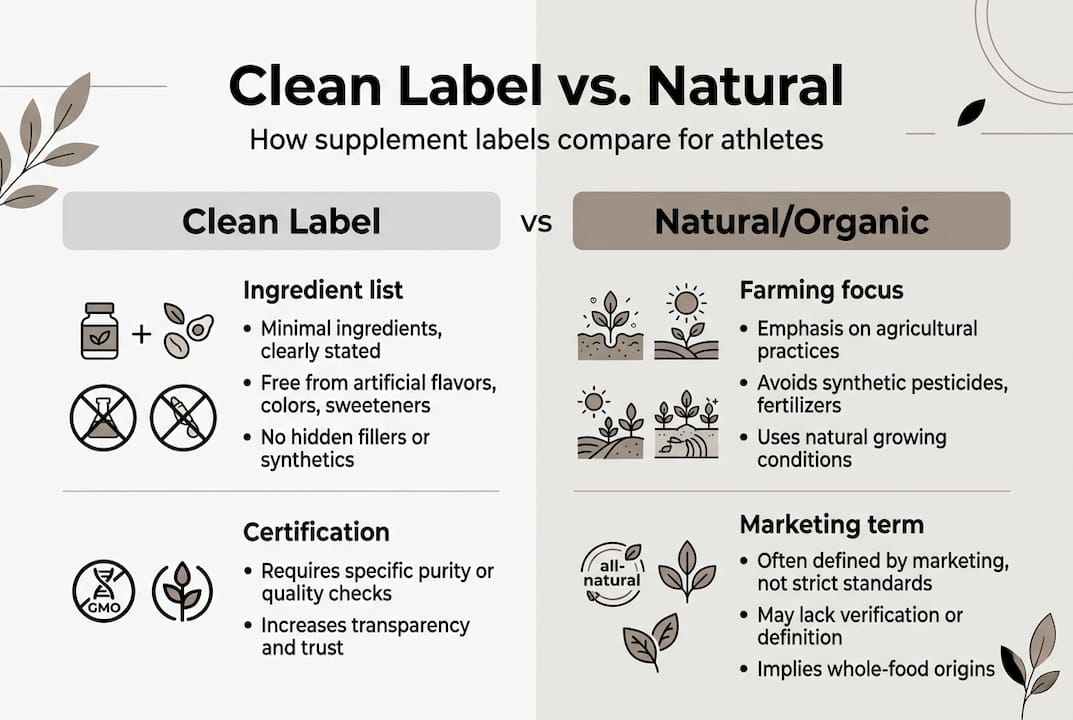
Organic is more meaningful. It refers to how ingredients are farmed: no synthetic pesticides, no GMOs, and strict soil management standards. But here’s the problem. Organic farming cannot control what’s already in the soil. Heavy metals like lead and cadmium accumulate naturally in the earth, and organic proteins showed higher contaminants than non-organic counterparts in independent testing.
| Term | Regulated? | What it covers | Heavy metal risk |
|---|---|---|---|
| Natural | No | Nothing enforceable | Unknown |
| Organic | Yes (farming) | Farming methods only | Higher (soil absorption) |
| Clean label | No (but third-party verified) | Final product transparency | Lower when certified |
Key insight: Organic certification tells you how the plant was grown. Clean label certification tells you what ended up in your supplement. For Hyrox athletes, the latter is what protects your health and your eligibility.
Plant-based proteins are particularly vulnerable here. Pea, rice, and hemp proteins absorb heavy metals from soil more readily than animal-derived proteins. This is not a reason to avoid plant-based eating. It is a reason to be more rigorous about testing when choosing plant-based supplements. If you’re working on building a supplement regimen from scratch, this distinction should shape your choices from day one.
Risks: Common pitfalls and heavy metal contamination
Let’s look at the data directly. The Clean Label Project protein study found that plant-based proteins contained three times more lead than whey protein. Forty-seven per cent of all tested powders exceeded California’s Prop 65 heavy metal limits. These aren’t obscure brands. Many were household names sold in mainstream retailers.
The contamination picture breaks down like this:
- Plant-based proteins (pea, rice, hemp): Highest heavy metal levels, particularly lead and cadmium
- Organic variants: Consistently higher contamination than non-organic equivalents
- Chocolate flavours: Cocoa is a known accumulator of cadmium, making chocolate-flavoured powders higher risk across all protein types
- Whey and collagen proteins: Generally the lowest in heavy metals, especially non-chocolate flavours
- Certified products: NSF and Informed Sport certified options show significantly lower contamination across all categories
For Hyrox women training multiple sessions per week, the cumulative exposure from a contaminated supplement adds up fast. Heavy metals don’t flush out quickly. Lead and cadmium accumulate in bone and kidney tissue over time, with effects on energy, hormonal balance, and recovery that are subtle but real.
“The protein powder you’ve been using for years might be the least clean thing in your nutrition plan, even if the label says organic.”
Pro Tip: If you use a plant-based protein, prioritise one that carries Informed Sport or NSF certification and explicitly publishes its heavy metal testing results. If that data isn’t available, it’s a red flag.
For a full breakdown of what to avoid and why, our guide on avoiding supplement mistakes covers the most common errors Hyrox athletes make when selecting products. The full protein powder contamination study is also worth bookmarking as a reference.
Selecting clean label supplements for Hyrox training
Knowing the risks is only useful if it changes what you buy. Here is a practical, step-by-step process for selecting supplements that are genuinely clean, safe, and effective for high-intensity Hyrox training.
-
Check for NSF Certified for Sport or Informed Sport on the packaging. This is non-negotiable. These certifications screen for banned substances and verify label accuracy. Transparent dosing and NSF certification are the baseline for any serious athlete’s supplement stack.
-
Look for full ingredient and dosage disclosure. Every active ingredient should be listed with its exact dose. If you see a ‘proprietary blend’ with a combined weight but no individual breakdown, walk away.
-
Avoid proprietary blends entirely. They exist to hide underdosing. A brand confident in its formula has no reason to obscure what’s in it.
-
Favour whey or collagen protein over plant-based where possible. If plant-based is important to you, apply extra scrutiny and only accept certified options with published testing data.
-
Check the flavour. Chocolate variants carry higher cadmium risk due to cocoa content. Unflavoured or non-chocolate options are a safer default.
-
Read the stabilisers and preservatives. Clean label supplements use natural stabilisers like rosemary extract or vitamin E. Synthetic preservatives like BHA or BHT are a sign the formula hasn’t been thought through.
-
Cross-reference with third-party databases. Sites like the Clean Label Project publish brand-level testing data. Use them.
For more on building an effective training nutrition stack, our articles on natural performance enhancement and synergistic supplementation for Hyrox give you the full picture.
Find your clean label supplement solution
You now know what clean label actually means, why organic and natural labels don’t guarantee safety, and exactly what to look for when choosing supplements for Hyrox training. The next step is finding products that meet those standards without the guesswork.
At Interval, we’ve built our pre-workout and electrolyte formulas specifically for athletes doing high-intensity training. Every ingredient is disclosed at full dose. No proprietary blends, no artificial additives, and no compromises on testing. Our starter bundle is the simplest way to get your Hyrox nutrition sorted with products you can actually trust. Clean ingredients, transparent labels, and formulas designed around the demands of your training.
Frequently asked questions
Does clean label guarantee a supplement is free of heavy metals?
No. Clean label is not a regulated term and does not guarantee freedom from heavy metals. Only third-party certifications like NSF Certified for Sport or Informed Sport, which include contaminant testing, can provide reliable assurance. Empirical data shows that even clean label, plant-based, and organic proteins can contain elevated lead levels.
Are organic supplements safer than clean label options?
Not necessarily. Organic certification governs farming practices, not the final product’s contaminant levels. Organic proteins showed three times the lead content of non-organic variants in independent testing, making clean label with third-party certification the more reliable safety indicator.
What certifications should I look for in clean label supplements for Hyrox athletes?
Prioritise NSF Certified for Sport or Informed Sport. Both programmes screen for over 270 banned substances and verify that label claims match actual product contents, which is critical for competitive athletes.
Is whey protein a safer clean label option for Hyrox women?
Yes. Whey and collagen proteins, particularly non-chocolate flavours, are generally lowest in heavy metals compared to plant-based and organic alternatives, making them a lower-risk choice for daily supplementation.
Recommended
- Supplement Purity: Protecting Female Athletes’ Performance – Interval
- How to Transition to Natural Supplements for Sports – Interval
- Natural supplement intake guide for female athletes 2026 – Interval
- Clean Label Supplements: Better Choices for Athletes – Interval
- Ultracyclist safety checklist: gear, prep, and expert tips – The Beam