


What is high intensity interval training for women?
Ever wondered if there’s a smarter way to train when your schedule is packed but your fitness goals are ambitious? High intensity interval training offers exactly that: a proven method to boost cardiorespiratory fitness, burn fat, and build strength in sessions lasting 30 minutes or less. For women aged 30 to 50 juggling demanding lives and intense sports, HIIT delivers measurable gains without endless gym hours. This guide breaks down what HIIT truly involves, why it works so effectively for your age group, and how to structure sessions that match your goals and experience level.
Table of Contents
- What Is High Intensity Interval Training (HIIT)?
- Benefits Of HIIT For Women Aged 30 To 50
- How To Do HIIT Effectively: Timing, Intensity And Progression
- HIIT Compared To Other Training Methods: When And Why To Choose It
- Get Started With Effective HIIT Routines Today
- Frequently Asked Questions
Key takeaways
| Point | Details |
|---|---|
| HIIT improves fitness efficiently | Cardiorespiratory fitness increases significantly whilst reducing body fat percentage in women aged 30 to 50. |
| Intensity drives results | Work intervals reach 80 to 95% of your maximum heart rate for optimal metabolic and cardiovascular benefits. |
| Sessions are time efficient | Complete workouts last up to 30 minutes including warm up and cool down phases. |
| Metabolism stays elevated | Post exercise calorie burn continues through the afterburn effect, supporting fat loss goals. |
| Progression matters | Start with manageable work to rest ratios and advance gradually to maximise safety and performance gains. |
What is high intensity interval training (HIIT)?
High intensity interval training is a workout method that alternates intense effort with recovery periods to improve cardiovascular capacity and metabolic health. Unlike steady state cardio where you maintain a consistent moderate pace, HIIT pushes you into higher heart rate zones during work intervals, then allows partial recovery before the next effort. This cyclical pattern creates physiological adaptations that enhance both aerobic and anaerobic systems.
Typical HIIT sessions involve intervals ranging from 10 seconds to 4 minutes with varied work to rest ratios depending on your fitness level and training goals. During work phases, you aim for 80 to 95% of your maximum heart rate, which feels challenging and unsustainable for long periods. Recovery intervals drop intensity to 40 to 60% of max heart rate, allowing your heart rate to decrease whilst keeping muscles active.
The structure differs fundamentally from moderate intensity continuous training where you might jog or cycle at a steady pace for 45 minutes. HIIT compresses similar or superior fitness benefits into shorter timeframes by maximising effort during work intervals. A beginner might use a 1:2 work to rest ratio, such as 30 seconds hard effort followed by 60 seconds recovery. Advanced athletes often progress to 1:1 ratios or even 2:1, where work intervals exceed rest periods.
Heart rate zones provide a practical guide for intensity. Zone 4 sits at 80 to 90% of maximum heart rate and represents vigorous effort. Zone 5 exceeds 90% and feels nearly maximal. During HIIT, you cycle between these upper zones and lower recovery zones, creating metabolic stress that triggers adaptation. This approach suits women doing high intensity sports because it mirrors the intermittent demands of many athletic activities whilst boosting workout stamina through repeated exposure to challenging efforts.
Common HIIT formats include:
- Tabata protocol: 20 seconds maximum effort, 10 seconds rest, repeated 8 times
- Classic intervals: 1 to 4 minute work periods with equal or longer rest
- Pyramid structure: Progressively longer then shorter intervals within one session
- EMOM (every minute on the minute): Fixed work duration at the start of each minute, rest for remainder
Benefits of HIIT for women aged 30 to 50
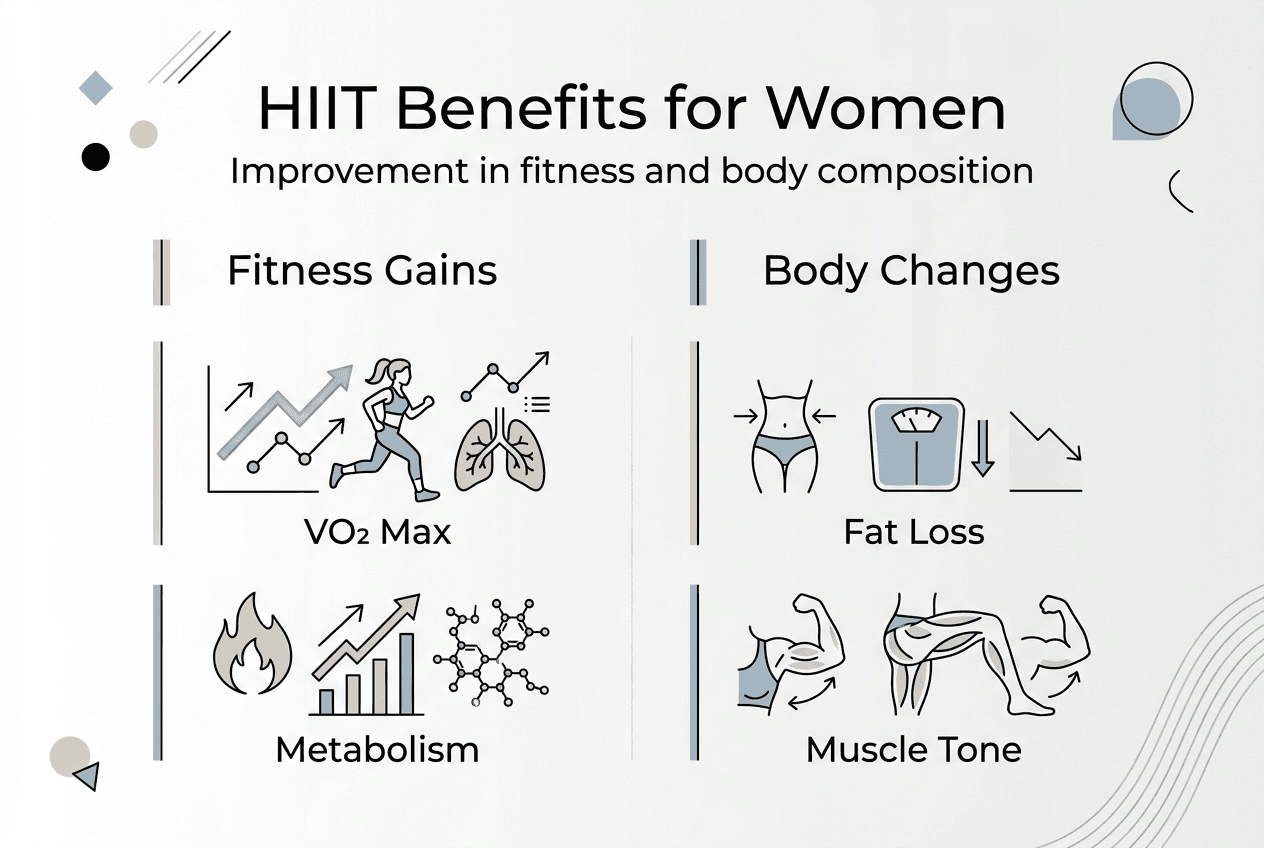
Research consistently demonstrates that HIIT enhances cardiorespiratory fitness with significant increases in VO2 max among women in this age bracket. VO2 max measures your body’s ability to utilise oxygen during intense exercise, serving as a gold standard indicator of cardiovascular health and endurance capacity. Improvements of 10 to 15% are common after 8 to 12 weeks of regular HIIT training, translating to better performance in sports and daily activities.

Body composition changes represent another compelling benefit. Studies show that HIIT reduces body fat percentage whilst preserving or even increasing lean muscle mass in female athletes. This dual effect stems from enhanced fat oxidation during and after workouts, combined with the muscle preserving stimulus of high intensity efforts. Unlike long duration steady cardio that can lead to muscle loss, HIIT maintains the metabolic tissue you need for strength and power.
The afterburn effect, scientifically termed excess post exercise oxygen consumption (EPOC), means your metabolism stays elevated for hours after finishing a HIIT session. Your body works harder to restore oxygen levels, clear metabolic byproducts, and repair muscle tissue. This process burns additional calories beyond the workout itself, supporting fat loss goals without requiring extra training time. For busy women balancing careers, families, and athletic pursuits, this efficiency proves invaluable.
Metabolic health improvements extend beyond aesthetics. HIIT improves insulin sensitivity, which becomes increasingly important for women at risk of metabolic syndrome as they age. Better insulin function helps regulate blood sugar, reduces inflammation, and supports hormonal balance. These adaptations complement the cardiovascular benefits, creating a comprehensive health improvement package.
Cardiovascular efficiency gains manifest through:
- Increased stroke volume (blood pumped per heartbeat)
- Enhanced capillary density in working muscles
- Improved mitochondrial function for energy production
- Better lactate threshold, delaying fatigue during intense efforts
The muscle pump benefits from HIIT also support nutrient delivery and waste removal, whilst improving VO2 max directly enhances your capacity for sustained high intensity work. These physiological changes make everyday activities feel easier whilst elevating your athletic ceiling.
Statistic spotlight: Women aged 30 to 50 following structured HIIT programmes for 12 weeks typically see VO2 max improvements of 12 to 18%, placing them in higher cardiovascular fitness categories.
How to do HIIT effectively: timing, intensity and progression
Effective HIIT execution begins with understanding appropriate intensity levels. Work intervals should reach 80 to 95% of your maximum heart rate, which you can estimate by subtracting your age from 220. For a 40 year old woman, maximum heart rate approximates 180 beats per minute, making the target work interval zone 144 to 171 bpm. This intensity feels hard but manageable for the prescribed duration.
Work to rest ratios determine session difficulty and should match your current fitness level. Beginners benefit from 1:2 or 1:3 ratios, allowing ample recovery between efforts. As fitness improves, progress to 1:1 ratios where work and rest durations match. Advanced athletes can handle 2:1 ratios, though these demand significant cardiovascular capacity and recovery ability. Rushing progression increases injury risk and compromises form.
Authentic HIIT sessions last up to 30 minutes including essential warm up and cool down phases. A typical structure allocates 5 minutes for warm up, 15 to 20 minutes for intervals, and 5 minutes for cool down. This timeframe provides sufficient stimulus for adaptation whilst managing fatigue and recovery demands. Longer sessions often indicate insufficient intensity during work intervals.
Progression should follow a systematic approach:
- Master proper exercise form at moderate intensity before adding speed or load
- Begin with shorter work intervals (20 to 30 seconds) and longer rest periods
- Gradually increase work interval duration whilst maintaining intensity
- Reduce rest periods once you can complete all intervals with good form
- Add complexity through exercise variation or increased resistance
- Monitor recovery quality and adjust frequency if performance declines
Sprint interval training (SIT) represents a distinct category involving near maximal or maximal efforts for very short durations, typically 10 to 30 seconds. These all out bursts demand complete recovery between intervals and create different physiological stress compared to standard HIIT. SIT suits experienced athletes seeking peak power development but requires exceptional fitness foundations.
Pro tip: Track your heart rate recovery by measuring how many beats your heart rate drops in the first minute after stopping intense work. Improvements in this metric indicate advancing cardiovascular fitness and better autonomic nervous system function.
Session frequency matters for results and recovery. Most women thrive on 2 to 3 HIIT sessions weekly, allowing 48 hours between intense workouts for adaptation. Combining HIIT with strength training and lower intensity steady work creates balanced programming that prevents overtraining whilst maximising diverse fitness qualities. Consider pre workout timing to optimise energy availability for your hardest intervals.
| Experience level | Work duration | Rest duration | Ratio | Session frequency |
|---|---|---|---|---|
| Beginner | 20 to 30 seconds | 60 to 90 seconds | 1:2 to 1:3 | 2 per week |
| Intermediate | 30 to 60 seconds | 30 to 60 seconds | 1:1 | 2 to 3 per week |
| Advanced | 45 to 90 seconds | 30 to 45 seconds | 2:1 to 1:1 | 3 per week |
HIIT compared to other training methods: when and why to choose it
Research demonstrates that HIIT proves as effective or superior to moderate intensity continuous training for improving body composition and cardiorespiratory fitness. MICT involves sustained effort at 50 to 70% of maximum heart rate for 30 to 60 minutes, building aerobic base and endurance. Whilst MICT offers value for recovery days and aerobic development, HIIT delivers comparable cardiovascular adaptations in roughly half the time.
The efficiency advantage stems from intensity. Higher effort levels trigger greater metabolic disruption, forcing your body to adapt more aggressively. MICT burns calories during the session but generates minimal afterburn effect. HIIT creates substantial EPOC, extending calorie expenditure for 12 to 24 hours post workout. For women managing tight schedules alongside high intensity sports, this time efficiency proves decisive.
Both HIIT and sprint interval training improve cardiovascular health but differ fundamentally in intensity and rest requirements. SIT demands true maximal efforts that leave you breathless and unable to continue beyond 20 to 30 seconds. Rest periods between SIT intervals extend to 2 to 4 minutes, allowing near complete recovery. HIIT maintains challenging but sustainable intensity that permits repeated intervals with shorter rest.
Best use cases guide your training choices:
- Choose HIIT when time is limited but you want maximal fitness gains
- Select MICT for active recovery, aerobic base building, or lower stress training days
- Use SIT sparingly for peak power development and advanced conditioning
- Combine methods across your weekly programme for comprehensive fitness
Practical considerations include injury history, current fitness level, and recovery capacity. HIIT places greater stress on joints and connective tissue compared to MICT, making proper warm up and progression essential. Women returning from injury or new to structured training benefit from establishing a MICT foundation before introducing HIIT intensity. The comparison between HIIT and sprint training highlights that both methods require adequate recovery to prevent breakdown.
| Training method | Intensity level | Session duration | Recovery demand | Primary benefits |
|---|---|---|---|---|
| HIIT | 80 to 95% max HR | 20 to 30 minutes | Moderate to high | VO2 max, fat loss, time efficiency |
| MICT | 50 to 70% max HR | 30 to 60 minutes | Low to moderate | Aerobic base, active recovery |
| SIT | 95 to 100% max HR | 10 to 20 minutes | High | Peak power, anaerobic capacity |
Goal alignment determines optimal method selection. Fat loss responds well to HIIT due to elevated metabolism and muscle preservation. Endurance events benefit from MICT volume combined with strategic HIIT sessions. Power sports favour SIT alongside strength work. Most active women achieve best results by cycling through all three approaches based on training phase and recovery status.
Get started with effective HIIT routines today
Ready to experience the fitness transformations HIIT delivers? The starter bundle from Interval provides natural pre workout and electrolytes formulated specifically for women doing high intensity training. These supplements support energy production, hydration, and recovery without artificial ingredients or unnecessary stimulants. Combining quality nutrition with smart programming accelerates your progress whilst protecting long term health.
Explore practical guidance on boosting workout stamina and understanding muscle pump benefits to refine your approach. Consistency matters more than perfection. Start with manageable intervals, focus on proper form, and progress gradually as your body adapts. The combination of structured HIIT sessions and targeted supplementation creates a powerful foundation for achieving your athletic and fitness goals in 2026 and beyond.
Frequently asked questions
What intensity should HIIT intervals be performed at?
Work intervals should reach 80 to 95% of your maximum heart rate, which feels challenging and slightly breathless. You should be able to speak only a few words at a time during peak effort. This intensity zone triggers the cardiovascular and metabolic adaptations that make HIIT effective.
How long should each HIIT session last including warm up?
Complete HIIT workouts last up to 30 minutes total, with 5 minutes for warm up, 15 to 20 minutes of intervals, and 5 minutes for cool down. Longer sessions typically indicate work intervals lack sufficient intensity. Quality trumps quantity in effective HIIT programming.
Is HIIT suitable for women over 40 and those new to intense workouts?
Yes, when properly progressed and scaled to individual fitness levels. Begin with longer rest periods, shorter work intervals, and lower intensity exercises. Build gradually over 6 to 8 weeks before advancing to more demanding protocols. Proper warm up and recovery practices become increasingly important with age.
What makes HIIT effective for fat loss and fitness gains?
HIIT creates significant metabolic disruption that elevates calorie burn for hours after training through the afterburn effect. The intensity preserves lean muscle mass whilst preferentially burning fat. Cardiovascular adaptations improve oxygen utilisation and work capacity, enhancing overall fitness efficiently.
Can HIIT improve muscle strength and flexibility?
HIIT primarily develops cardiovascular fitness and muscular endurance rather than maximal strength. However, bodyweight or resistance based HIIT exercises maintain muscle mass and improve functional strength. Combine HIIT with dedicated strength training and mobility work for comprehensive physical development and injury prevention.