


Workout schedule tips for working women: 2026 guide
TL;DR:
- A sustainable workout routine for working women relies on flexibility, short sessions, and everyday movement instead of perfection. Incorporating 3–4 sessions weekly, primarily strength training and HIIT, supports health goals efficiently within busy schedules. Building systems and habits ensures consistency and reduces guilt, making fitness sustainable over time.
A sustainable workout schedule for working women is built on flexibility, short sessions, and consistent movement rather than perfect plans executed under ideal conditions. The biggest mistake busy professionals make is designing a routine for a predictable week that never actually arrives. The most effective approach combines 3–4 sessions per week of 30–45 minutes, at least two dedicated strength days, and daily ambient movement that requires no gym time at all. Fitness experts including Dr Lucy Demaine and Donna McDermott, alongside guidance from WMN Magazine, all point to the same conclusion: adaptability beats ambition every time.
1. Build a flexible schedule instead of a rigid plan
Rigid workout plans fail working women because real weeks are never predictable. A better approach is what Dr Lucy Demaine describes as a flexible workout bank: a set of pre-planned sessions at different lengths and intensities that you can swap based on the day you actually have.
The key principle is swapping intensity, not skipping the habit entirely. On a low-energy Tuesday, a 10-minute walk replaces a 45-minute strength session. The neurological cue stays intact, and long-term adherence improves because you never enter the all-or-nothing spiral that leads to burnout.
- Prepare three session lengths in advance: 10 minutes, 20 minutes, and 40 minutes
- Assign each a default intensity: low, moderate, and high
- On any given day, pick the version that fits your available time and energy
- Never cancel a session entirely. Downgrade it instead.
Pro Tip: Write your three session options into your phone calendar on Sunday evening. Reducing the decision on the day removes the most common reason women skip workouts.
2. Prioritise strength training twice weekly
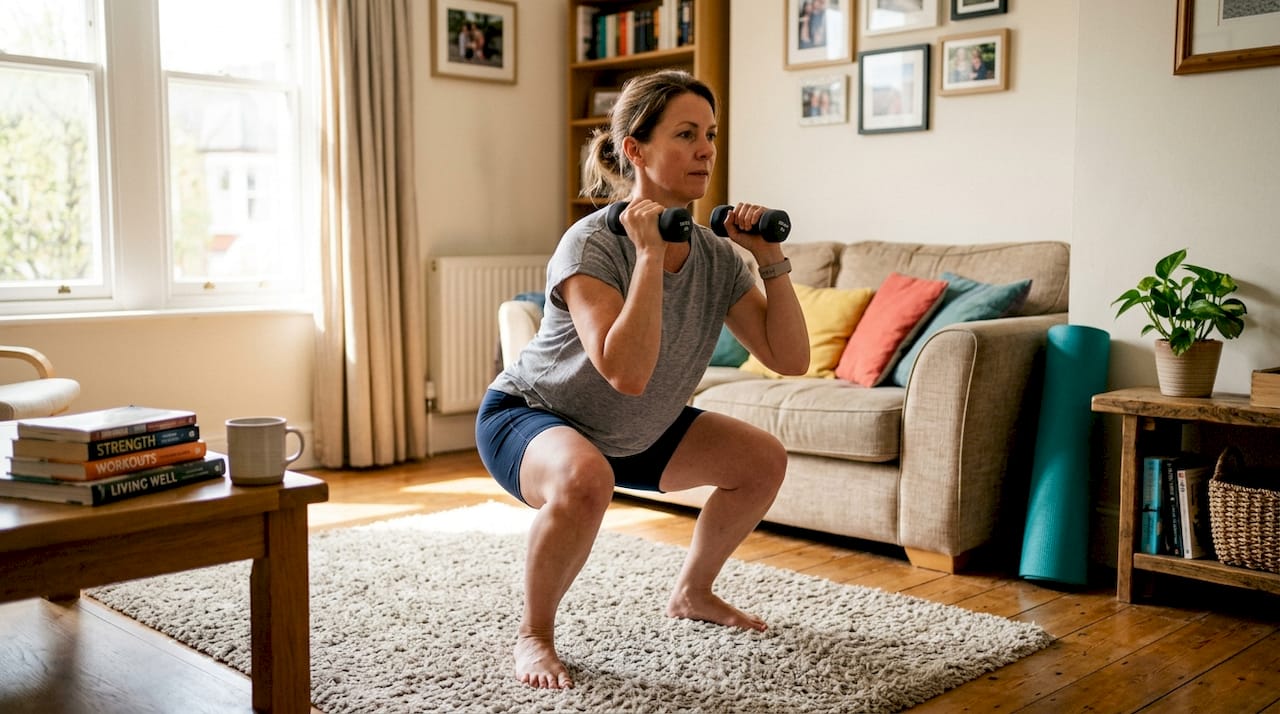
Strength training twice weekly supports metabolism, bone density, posture, and confidence. These are not cosmetic benefits. For women aged 25–45, bone density and metabolic rate both begin to shift, making resistance work the highest-value training modality in a limited schedule.
Two sessions per week is the minimum effective dose. Each session needs to cover compound movements: squats, deadlifts, rows, and presses. These recruit multiple muscle groups simultaneously, which means you get more physiological return per minute than isolation exercises like bicep curls.
Strength sessions do not require a gym. Bodyweight circuits, resistance bands, and a pair of dumbbells at home remove the travel barrier entirely. A 30-minute home strength session delivers the same stimulus as a 45-minute gym session padded with commute and setup time.
3. Use HIIT for time-efficient cardio
15–25 minutes of HIIT delivers cardiovascular benefits comparable to 45–60 minutes of steady-state cardio. That is not a marginal difference. It means you can replace a one-hour run with a 20-minute interval session and achieve the same heart health outcome in less than half the time.
HIIT works by alternating short bursts of maximum effort with brief recovery periods. The format suits working women because it is time-capped, requires no equipment, and can be done at home before the school run or during a lunch break. For a full breakdown of the method, Useinterval covers HIIT for women in detail.
| Workout type | Duration | Primary benefit |
|---|---|---|
| HIIT | 15–25 minutes | Cardiovascular fitness, calorie burn |
| Strength training | 30–45 minutes | Muscle, metabolism, bone density |
| Yoga or mobility | 10–20 minutes | Recovery, flexibility, stress reduction |
| Steady-state cardio | 45–60 minutes | Endurance, low-intensity active recovery |
| Bodyweight circuit | 20–30 minutes | Full-body conditioning, no equipment |
4. Align sessions with your energy cycles
The best time to train is when your energy is naturally highest. For most working women, that is either early morning before the workday begins or during a lunch break before the afternoon slump sets in. Evening sessions work for some, but cortisol and adrenaline from a demanding day can interfere with sleep quality if training finishes too late.
Scheduling workouts around energy rather than convenience produces better performance and higher consistency. A 6am session you complete at 70% effort beats a 7pm session you cancel because you are exhausted. Map your typical energy curve across the week and place your two hardest sessions, usually strength days, at your two highest-energy windows.
- Monday and Thursday work well for strength sessions for most nine-to-five schedules
- Wednesday is a natural midweek slot for a short HIIT session or active recovery walk
- Friday can serve as a flexible slot: upgrade to a full session or downgrade to mobility work
- Weekends offer longer windows for sessions that require more setup or travel
Pro Tip: Treat workout slots like client meetings. Block them in your calendar with a location and a session type. Vague intentions do not survive a busy week.
5. Add ambient movement without extra gym time
Daily ambient movement, including walking, taking stairs, and aiming for 8,000–10,000 steps, is the highest-return behaviour for stress management and recovery. It requires no kit, no schedule, and no recovery time. That makes it the most practical fitness tool available to working women.
Walking meetings replace seated calls and add movement without stealing time. A 20-minute lunchtime walk contributes to your daily step count, lowers cortisol, and improves afternoon focus. These are not substitutes for structured training. They are the connective tissue between sessions that keeps your body active and your stress levels manageable throughout the week.
Stair climbing at the office, parking further away, and standing during phone calls each add up across a full working day. The cumulative effect on cardiovascular health and energy expenditure is meaningful, particularly on days when a structured session is not possible.
6. Choose the right plan structure for your week
The two most practical structures for working women are a full-body three-day plan and an upper/lower four-day split. The right choice depends on how many reliable training days you have each week.
Muscle protein synthesis returns to baseline within 48–72 hours after training. This means each muscle group needs stimulating at least twice per week to support growth and maintenance. A full-body three-day plan achieves this efficiently because every session hits every major muscle group.
| Plan structure | Frequency | Best for | Limitation |
|---|---|---|---|
| Full-body three-day | 3 days per week | Unpredictable schedules | Lower volume per session |
| Upper/lower four-day split | 4 days per week | Consistent weekly availability | Requires four reliable slots |
| Two-day full-body | 2 days per week | Extremely busy periods | Minimum maintenance only |
| Push/pull/legs | 3–6 days per week | Advanced trainees | Too rigid for variable weeks |
Active recovery belongs in the plan too. A 20-minute walk or a yoga session on a rest day accelerates muscle repair without adding training stress. Deload weeks, where you reduce volume by roughly half every four to six weeks, prevent cumulative fatigue and keep training sustainable across months rather than just weeks.
7. Build systems, not motivation
Motivation dependence is unreliable. Donna McDermott makes this point clearly: sustainable fitness for busy women comes from repeatable systems and clear expectations, not from feeling inspired. Motivation spikes on a Monday and disappears by Wednesday. A system works regardless of how you feel.
Habit stacking is the most practical system available. Attach a workout to an existing daily behaviour: lay out kit the night before, train immediately after dropping children at school, or do a 10-minute bodyweight session before your morning shower. The existing behaviour acts as the trigger. For more on building this kind of consistency, Useinterval’s guide on staying consistent in 2026 covers the mechanics in full.
- Set a non-negotiable minimum: even two minutes of movement counts on the worst days
- Remove friction: keep kit visible, sessions pre-planned, and equipment accessible
- Track completion, not performance: a tick in a diary builds identity faster than chasing personal bests
- Remove guilt from missed sessions: one skipped workout does not break a habit. Three consecutive skips might.
Short sessions of 10–30 minutes are more likely to be repeated than longer ones. Lower psychological barriers produce higher completion rates. A 15-minute session you do every week beats a 60-minute session you do once a month.
8. Fuel your sessions to get more from less time
Training quality matters more than training volume when time is limited. A 25-minute HIIT session performed at full intensity produces better results than a 40-minute session where energy drops off after the first ten minutes. Nutrition before and during training directly affects output.
Useinterval’s workout fuel guide for women covers pre-session nutrition in detail. The short version: a small carbohydrate and protein source 30–60 minutes before training sustains intensity. Electrolytes during sessions lasting over 30 minutes prevent the performance drop that comes from even mild dehydration. For high-intensity work specifically, natural pre-workout ingredients like those in Useinterval’s formulas support output without the crash that synthetic stimulants produce.
Managing fatigue is also a scheduling issue. Research from Evo Youthful on clinical fatigue solutions confirms that exercise timing, sleep quality, and recovery nutrition interact directly. Working women who train on poor sleep and skip post-session nutrition accumulate fatigue faster than their schedule can absorb.
Key takeaways
The most effective workout schedule for working women combines flexible session lengths, twice-weekly strength training, and daily ambient movement to build consistency without burnout.
| Point | Details |
|---|---|
| Flexibility beats rigidity | Pre-plan sessions at three lengths and swap intensity rather than skipping entirely. |
| Strength training is non-negotiable | Two sessions per week supports metabolism, bone density, and posture for women aged 25–45. |
| HIIT saves time without sacrificing results | 15–25 minutes of HIIT matches the cardiovascular benefit of 45–60 minutes of steady-state cardio. |
| Systems outperform motivation | Habit stacking and pre-planned sessions produce consistency that motivation alone cannot sustain. |
| Ambient movement adds up | Targeting 8,000–10,000 daily steps improves recovery and stress management without gym time. |
What I actually think about workout consistency for working women
The fitness industry sells perfection. Six-day programmes, macro tracking, and two-hour gym sessions designed for people with no jobs, no children, and no competing demands. Most working women try one of these plans, fail by week three, and conclude that they lack discipline. They do not. The plan was wrong for their life.
The research backs a simpler model, and so does my experience watching women navigate this. Three sessions per week, done consistently for six months, produces better results than six sessions per week done inconsistently for six weeks. The maths is not complicated. The hard part is accepting that a 15-minute session on a chaotic Wednesday is not a failure. It is the whole point.
What I find most useful is removing the concept of a perfect week entirely. There is no perfect week. There is only this week, with its specific constraints, and the question of what the best available version of training looks like within those constraints. That reframe alone removes most of the guilt that causes women to abandon routines altogether.
Be kind to yourself about the missed sessions. Be firm about the minimum. Two sessions per week, every week, is a fitness habit. One session per week is maintenance. Zero sessions per week is where the guilt spiral starts. Pick your floor and protect it.
— Tom
Useinterval’s Starter Bundle: built for busy training weeks
Working women need kit that matches the reality of short, high-intensity sessions rather than long, leisurely gym visits.
Useinterval’s Starter Bundle is designed for exactly that. It combines a natural-ingredient pre-workout with electrolytes formulated to support high-intensity sessions of 20–40 minutes. The pre-workout delivers clean energy without the crash that derails an afternoon of meetings. The electrolytes maintain performance through the session and accelerate recovery afterwards. Both products use natural ingredients, which matters when you are training four days a week and need your body to recover between sessions rather than process synthetic additives. If you are building a flexible, time-efficient routine, the Starter Bundle removes the nutrition guesswork from every session.
FAQ
How many times per week should working women train?
The recommended frequency is 3–4 sessions per week, each lasting 30–45 minutes. Two of those sessions should include strength training.
What is the shortest effective workout for a busy day?
Ten minutes of exercise, including HIIT or yoga, produces measurable physiological and cognitive benefits. It also maintains the neurological habit on days when longer sessions are not possible.
Is HIIT better than running for time-pressed women?
Yes. 15–25 minutes of HIIT delivers cardiovascular benefits equivalent to 45–60 minutes of steady-state running, making it the more time-efficient choice for most working women.
Should I train on days when I feel exhausted?
Swap the session rather than skip it. Dr Lucy Demaine recommends replacing a planned hard session with a 10-minute low-intensity movement session to preserve the habit without adding stress to a depleted body.
How do I stop relying on motivation to work out?
Donna McDermott’s advice is to build a system rather than wait for motivation. Repeatable routines with clear, manageable expectations produce consistency that motivation spikes cannot.