


Electrolyte ratios explained: optimise hydration for Hyrox
TL;DR:
- Electrolyte ratios indicate mineral proportions but actual milligram intake per hour is crucial for performance.
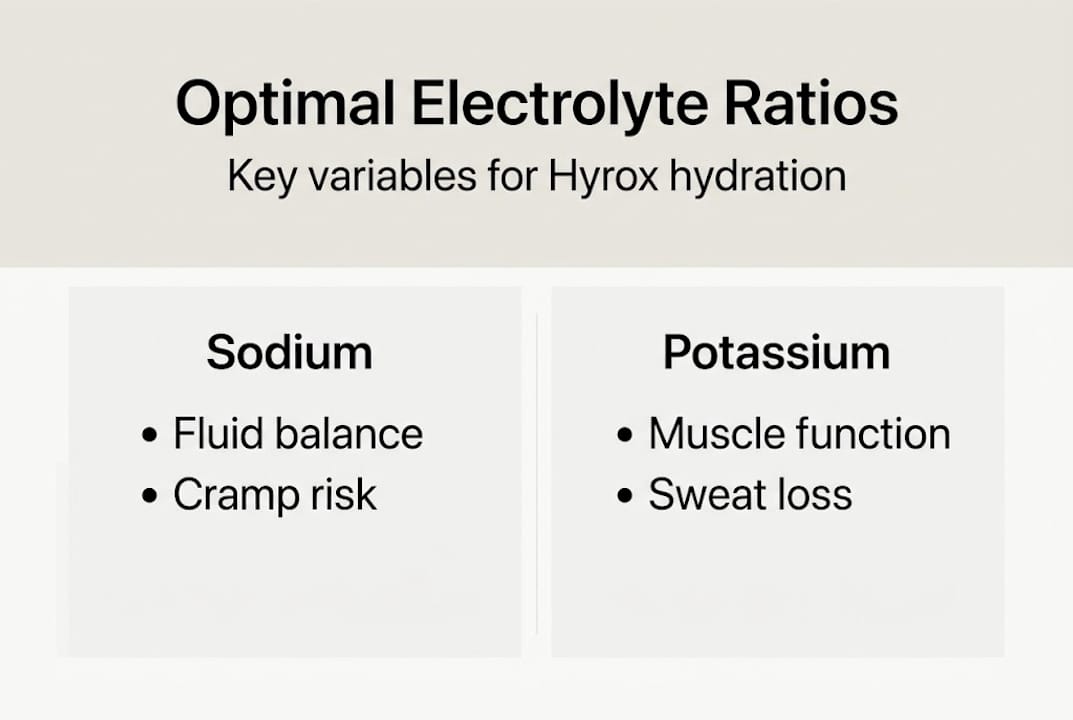
- Sodium and potassium serve different roles, with sodium outside cells and potassium inside, both essential for hydration.
- Individual sweat rate and conditions determine optimal electrolyte ratios, making personalized data more effective than fixed formulas.
Most Hyrox athletes know they need electrolytes. Far fewer understand what an electrolyte ratio actually means, and that gap costs them more than they realise. Sports drink marketing throws around terms like “4:1 sodium-to-potassium ratio” as though one number unlocks peak performance for every athlete in every condition. It doesn’t. Your sweat rate, race duration, heat exposure, and individual physiology all shift what your body actually needs. This guide strips back the jargon, explains the science in plain terms, and gives you a practical framework for dialling in your own hydration strategy before your next competition.
Table of Contents
- What does electrolyte ratio really mean?
- How your body uses electrolytes during high-intensity exercise
- Decoding optimal electrolyte ratios: sweat loss and context matter
- Avoiding common electrolyte mistakes: hyponatremia, cramps, and overcorrection
- Why the ‘perfect’ electrolyte ratio is a myth (and what actually matters)
- Ready to optimise your hydration?
- Frequently asked questions
Key Takeaways
| Point | Details |
|---|---|
| Ratio clarity | Electrolyte ratio reflects sodium and potassium balance per serving or litre, but actual mg intake matters most. |
| No universal formula | There’s no single best ratio—tailor your approach to sweat rate, workout intensity, and conditions. |
| Balanced replacement boosts recovery | Replacing both sodium and potassium improves rehydration after intense exercise more than just one alone. |
| Data beats dogma | Tracking your losses and symptoms helps you adapt ratios far better than generic product claims. |
What does electrolyte ratio really mean?
When a product claims to have an “optimal electrolyte ratio”, what does that actually mean? At its core, electrolyte ratio refers to the balance between sodium, potassium, magnesium, and other minerals in a hydration solution, not just one nutrient in isolation. Think of it like a recipe: the ratio tells you the proportions, but not the total quantity of food on your plate.
This is where most athletes get tripped up. A ratio of 4:1 sodium to potassium sounds precise and scientific, but it says nothing about the actual milligrams of each mineral you’re consuming per hour. Two products can share the same ratio yet deliver wildly different amounts. For a Hyrox athlete working at high intensity, the actual intake in mg per hour is what drives real physiological outcomes.
“The clinically relevant part is the actual amounts you ingest over time (mg/hour or mg/L), not the marketing shorthand.”
Here’s a quick comparison to put it in context:
| Metric | Ratio label | Actual intake (mg/500ml) |
|---|---|---|
| Product A | 4:1 Na:K | Sodium 400mg / Potassium 100mg |
| Product B | 4:1 Na:K | Sodium 200mg / Potassium 50mg |
| Average sweat (per litre) | Variable | Sodium 900mg / Potassium 200mg |
As you can see, the same ratio can mask very different delivery amounts. For a balanced electrolytes guide built around athletic needs, what you want to scrutinise is the milligram value per serving, cross-referenced against your typical sweat losses.
Key things to look for on any electrolyte label:
- Sodium content per serving (in mg, not just % of RDA)
- Potassium content per serving alongside sodium
- Magnesium and calcium listed separately if included
- Serving size so you can calculate per-litre intake accurately
- Whether the electrolyte label advice references actual performance research
The ratio is a starting point. The mg values are what you act on.
How your body uses electrolytes during high-intensity exercise
Now that the concept is demystified, let’s explore what purpose these ratios serve in training and competition. The short version: sodium and potassium govern completely different fluid compartments in your body, and you need both working in sync.
Sodium is the dominant electrolyte in the fluid outside your cells. It pulls water into the bloodstream, maintains blood volume, and keeps nerve signals firing correctly. Potassium, on the other hand, controls fluid inside the cells. Superior rehydration outcomes come from combining high sodium and potassium rather than relying on either alone, because you need both compartments restored after heavy sweat loss.
Here’s what happens in sequence during a Hyrox race:
- Sweat output begins within minutes of intense effort, carrying sodium, potassium, and trace minerals with it.
- Blood volume drops as fluid leaves the extracellular space, increasing perceived effort at the same power output.
- Intracellular balance shifts as potassium leaks from fatigued muscles, affecting nerve conduction and contraction efficiency.
- Performance deteriorates if neither electrolyte is replaced: reaction time slows, cramping risk rises, and output falls.
- Hydration restores function when both sodium and potassium are consumed alongside fluid, replenishing both compartments efficiently.
| Electrolyte | Primary role | Performance impact when depleted |
|---|---|---|
| Sodium | Extracellular fluid balance | Fatigue, low blood pressure, cramps |
| Potassium | Intracellular fluid and nerve function | Muscle weakness, impaired contraction |
| Magnesium | Muscle relaxation, energy production | Cramping, reduced power output |
For athletes serious about electrolyte use for endurance, understanding which compartment each mineral serves is the difference between guessing and being strategic. Optimising your intake also means optimising electrolyte intake around your specific session demands, not just topping up at random.
Pro Tip: Weigh yourself before and after a full Hyrox training session. Every kilogram lost is roughly one litre of fluid. This gives you a real baseline for estimating sweat loss per session, which you can then use to calculate your sodium replacement target.
Decoding optimal electrolyte ratios: sweat loss and context matter
After grasping the physiological basics, it’s essential to recognise individual variability and context. The uncomfortable reality is that no single ratio works for every athlete in every condition. Optimal electrolyte ratios shift with sweat rate, exercise duration, and individual physiology.
Common frameworks suggest a sodium-to-potassium ratio of between 4:1 and 5:1 for sweat-matching during prolonged efforts, dropping closer to 2:1 or 3:1 for shorter sessions focused on cramp prevention. But these are starting ranges, not prescriptions.
| Condition | Suggested Na:K ratio | Notes |
|---|---|---|
| Short session under 60 min | 2:1 to 3:1 | Lower sweat loss, less sodium needed |
| Moderate session 60 to 90 min | 3:1 to 4:1 | Standard replenishment range |
| Long event over 90 min or heat | 4:1 to 5:1 | Higher sweat rate, salty sweater needs |
| Hot weather Hyrox comp | Up to 6:1 | Maximum sodium priority |
Athletes doing events in electrolytes in heat conditions need to skew sodium higher as a proportion of intake, not just drink more fluid. Fluid without extra sodium in hot races accelerates the dilution of blood sodium, which is the opposite of what you want.
Factors that shift your ideal ratio:
- Individual sweat rate (some athletes lose twice as much as others at the same intensity)
- Sweat sodium concentration (“salty sweaters” can lose 1,500mg sodium per litre of sweat or more)
- Session length (longer sessions compound losses and demand explicit planning)
- Ambient temperature and humidity (heat and humidity amplify fluid and sodium losses significantly)
- Training status (fitter athletes sweat more efficiently but still lose substantial sodium)
Pro Tip: Invest in a single formal sweat test if you consistently cramp or fade in the final third of your events. Some labs and apps can estimate your sodium loss concentration, letting you build a ratio that’s actually yours, not borrowed from a generic product label.
For athletes wanting to understand the mechanics behind buffered electrolytes guide, the formulation matters as much as the ratio on the label.
Avoiding common electrolyte mistakes: hyponatremia, cramps, and overcorrection
Having mapped out frameworks for tailoring your ratio, the risk lies in misapplication. Here’s what to watch out for.
The most dangerous mistake is overdrinking water without adequate sodium. Mismatching fluid and sodium intake can cause hyponatremia, where blood sodium drops to a level that triggers nausea, confusion, and in severe cases, seizures. This is not a rare edge case. It happens to well-intentioned athletes who drink aggressively from water-only stations during long events.
The three most common mistakes Hyrox athletes make:
- Blindly copying generic ratios from product labels without knowing their own sweat sodium concentration, leading to consistent under-replacement in salty sweaters.
- Neglecting sweat data entirely, relying instead on thirst or colour of urine as a proxy for electrolyte status, which misses sodium balance completely.
- Overcorrecting with sodium tablets after a bad race without adjusting fluid intake to match, which can swing the balance the other way and cause gut distress.
“Adding sodium to your fluid during endurance keeps plasma sodium from dropping too much, lowering cramp risk and sustaining output through the final stations.”
Pro Tip: For any event lasting more than two hours, write your sodium plan in grams per hour before race day. Don’t leave it to instinct on the course. A target of 800mg to 1,200mg sodium per hour is a reasonable starting range for most Hyrox athletes in moderate conditions, adjusting upward for heat.
Building on fast-acting electrolytes that absorb quickly is particularly useful in the later stages of a race when gut tolerance can dip. Pair this with a structured hydration routine advice to lock in consistent habits across both training and competition.
Why the ‘perfect’ electrolyte ratio is a myth (and what actually matters)
The sports nutrition industry thrives on the promise of perfect formulas. Every brand has a “clinically researched ratio” that’s supposedly optimal for athletes. Here’s the honest truth: there is no universal perfect ratio, because your needs on a cold November morning in Manchester are categorically different from your needs racing in a 28-degree competition hall in August.
Your ideal ratio shifts daily. It changes with sleep quality, diet the day before, how long you worked on your feet, even your stress levels. Chasing a fixed number misses this entirely.
What actually moves the needle is building your own data set. Track your weight changes across sessions. Log when cramps hit and what you’d taken in beforehand. Notice whether your late-race output holds or drops. These patterns are far more valuable than any ratio printed on a tin.
“Personalising your strategy beats chasing universal formulas every time.”
For female Hyrox athletes, hormonal cycles add another layer of variability that generic ratios simply can’t account for. Strategies explored in resources like electrolyte workflow strategies highlight how tailoring intake to individual conditions consistently outperforms rigid formula adherence. Experiment. Adjust. Let your own performance data lead.
Ready to optimise your hydration?
If this has shifted how you think about ratios and real-world intake, the next step is trying a formulation actually built around athletic performance rather than mass-market compromise.
Interval’s electrolyte products are developed around research-backed mineral ratios designed specifically for high-intensity training and competition. They’re made with natural ingredients and built for athletes who want to stop guessing. The Starter Bundle is the ideal way to test your own optimal intake across different session types without committing to a full protocol straight away. Explore the full Interval’s full range for resources, tips, and formulations that match your training demands.
Frequently asked questions
Why does the recommended electrolyte ratio vary between athletes?
Electrolyte needs change with sweat rate, exercise intensity, heat, and individual physiology, so no single ratio applies universally. Matching your ratio to your specific conditions is what drives results.
What happens if I overhydrate without enough electrolytes?
Drinking excessive water without adequate sodium can lead to hyponatremia, where blood sodium is diluted to dangerous levels, causing fatigue, confusion, and serious health risk.
How can I calculate the best electrolyte ratio for my needs?
Start by tracking your body weight before and after training to estimate sweat loss, then align your sodium and potassium intake with those losses. Research confirms that sweat loss tracking is the most reliable basis for personalising electrolyte replacement.
Do I need to worry about magnesium and calcium in my electrolyte mix?
Sodium and potassium are the primary drivers of hydration performance. Sodium and potassium should take priority; magnesium and calcium are worth including but matter less acutely unless you have a specific deficiency or high cramping tendency.
Recommended
- Dietary electrolytes: boost female Hyrox performance – Interval
- Electrolyte Stacking: Unlocking Peak Hyrox Performance – Interval
- Why Hyrox Athletes Need Electrolytes for Performance – Interval
- Easy Electrolyte Workflow for Female Hyrox Athletes – Interval
- Electrolyte Stamina Tablets 90 Tablets | Healthspan Holistic