


How to avoid jitters pre-race: a Hyrox guide
TL;DR:
- Pre-race jitters are common physiological responses to stress that can impair performance if unmanaged. Building mental and physical routines, such as controlled breathing, visualization, and tapering sleep, help normalize arousal levels and reduce anxiety. Using natural supplements like phosphatidylserine and L-theanine can support cortisol regulation, while reframing arousal as excitement enables athletes to channel energy positively.
You know that feeling. Heart hammering before the start corral even fills up, hands slightly shaky, mind cycling through every possible thing that could go wrong. Pre-race jitters are real, they are remarkably common, and if you do not have a plan for them, they will quietly rob you of the performance you trained months to deliver. For female Hyrox athletes in the 30-50 age group, the stakes feel particularly high because you have balanced work, family, and training to get to this start line. This guide covers how to avoid jitters pre-race using mental techniques, race day routines, nutrition timing, and natural supplements that actually have evidence behind them.
Table of Contents
- How to avoid jitters pre-race: understanding why they happen
- Pre-race preparation: building mental and physical tools
- Race day execution: timing, nutrition, and routines to reduce jitters
- Natural supplements to support pre-race calm and focus
- Reframing jitters: a fresh perspective for female Hyrox athletes
- Prepare with confidence: support from Interval’s Starter Bundle
- Frequently asked questions
Key Takeaways
| Point | Details |
|---|---|
| Pre-race jitters are normal | Understanding nervous system responses helps you manage physical and mental symptoms effectively. |
| Build a mental toolkit | Combine breathing, mantras, body scans, and reframing anxiety to excitement over several weeks. |
| Perfect race day routines | Arrive 90 minutes early, eat a tested meal 2-3 hours before, warm up properly, and time caffeine carefully. |
| Use natural supplements wisely | Phosphatidylserine and herbal blends support cortisol balance and focus but require consistent use and safety checks. |
| Mindset impacts performance | Accepting and redirecting jitters as preparation enhances readiness and race-day flow. |
How to avoid jitters pre-race: understanding why they happen
Your nervous system does not distinguish between a genuine threat and a Hyrox start line. The moment your brain registers high-stakes stress, it triggers the sympathetic nervous system, flooding your body with adrenaline and cortisol. Heart rate climbs. Palms sweat. Breathing shallows. Thoughts start looping.
This is not weakness. It is biology. The problem arises when arousal levels tip past the point of useful activation and into full-blown anxiety that tanks your decision-making, wastes energy, and makes the first few stations feel like chaos.
Common signs to watch for include:
- Racing heart rate well before warm-up begins
- Excessive sweating or cold hands despite normal temperatures
- Shaking or trembling in the hands and legs
- Intrusive catastrophic thoughts (“what if I fail the sled push?”)
- Nausea or an urgent need to visit the toilet repeatedly
- Difficulty focusing on your race plan or coach’s instructions
The good news is that deep breathing lowers heart rate and deactivates the nervous system, which directly addresses the physiological driver of jitters. Understanding the mechanism matters because it tells you exactly which tools to reach for. Techniques grounded in evidence-based anxiety reduction work precisely because they interrupt the stress response at its source, not just mask the symptoms.
Now that you know why jitters happen, let’s explore how to prepare well in advance.
Pre-race preparation: building mental and physical tools
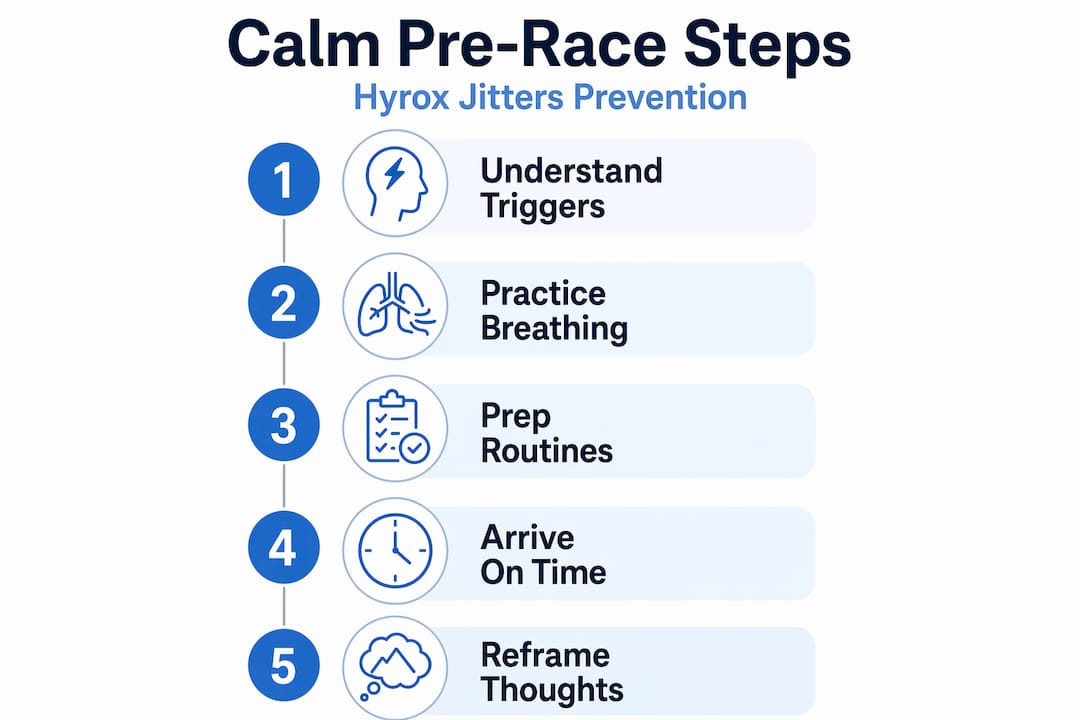
The athletes who manage race anxiety best are not the ones who feel less of it. They are the ones who have built a reliable toolkit and practised it until it runs on autopilot. Here is how to construct yours.
Mental techniques to build now, not on race morning:
- 4-7-8 breathing. Inhale for four counts, hold for seven, exhale for eight. Use it the night before a race, during the drive to the venue, and at the start corral. It activates the parasympathetic nervous system within minutes.
- Personalised mantras. Choose a phrase that genuinely resonates with you, something like “calm and ready” or “I have done the work.” Repeat it daily, not just before a race. Positive phrases build self-belief neural pathways over six to ten weeks of consistent use, which means starting this a month or two before your event is not optional, it is the strategy.
- Body scan relaxation. Lying in bed the night before, scan from head to toe, deliberately releasing tension in each muscle group. Most athletes discover they are clenching their jaw, shoulders, or quads without realising it.
- Warm-up strides. A ten-minute easy jog followed by four to six strides (short accelerations at race pace) burns off excess adrenaline and signals to your body that it is time to perform, not panic.
Physical tools to layer in:
- Consistent sleep routine in the week before the race, not just the night before
- Reducing training volume (tapering) in the final 7-10 days to lower baseline stress
- A pre-workout routine for women that you have tested in training and trust completely
Avoid relying on a single technique. The athletes who cope best combine three or four approaches, so that if one feels less effective on a given morning, others are there to support it.
Pro Tip: When you feel anxiety rising, name it out loud or in your head. “I am anxious and that is normal.” Naming an emotion activates the prefrontal cortex and reduces the intensity of the feeling. Then redirect: “This energy is going into my performance.”
With mental and physical preparations in place, strategic race day execution is the next step.
Race day execution: timing, nutrition, and routines to reduce jitters
The way you structure your race morning has an enormous bearing on how calm you feel. Most jitters are made significantly worse by too much idle time at the venue. Here is a race day framework that minimises anxiety buildup.

| Time before race | Action |
|---|---|
| 3 hours | Wake, familiar breakfast (e.g., oats with banana and nut butter) |
| 2.5 hours | Light stretching or yoga, review race plan once |
| 90 minutes | Arrive at venue, register, set up kit |
| 60 minutes | Begin warm-up: easy jog, mobility, strides |
| 45 minutes | Caffeine at usual dose (if part of your routine) |
| 20 minutes | Final breathing exercises, mantra repetition |
| 10 minutes | Light movement to stay warm, settle into corral |
Key rules for race morning nutrition:
- Eat a carbohydrate-rich, familiar tested breakfast at least two to three hours before your start time. This is not the morning to experiment.
- Hydrate steadily but do not overdrink. Excessive fluid intake can increase the urgency to use the toilet and heighten pre-race stress.
- Caffeine at your usual training dose, consumed 45-60 minutes before the start, supports performance without amplifying nerves. Exceeding your regular dose is one of the fastest ways to worsen jitters.
For Hyrox-specific fuelling guidance that accounts for the unique demands of eight stations plus running, the Hyrox pre-race fuelling guide is worth reading before your next event.
Pro Tip: Arriving too early is one of the most underrated causes of race anxiety. Ninety minutes gives you enough time to prepare without leaving you standing around overthinking. If you arrive two-plus hours before your wave, find a quiet spot away from the main buzz and stick to your routine.
Having executed your race day routine, let’s verify results and optimise for future races.
Natural supplements to support pre-race calm and focus
This is where many athletes either ignore the evidence entirely or swing to unregulated, stimulant-heavy products that make jitters worse. Natural supplements with solid research behind them occupy a genuinely useful middle ground. Here is what the evidence actually supports.
| Supplement | Primary benefit | Typical dose | Time to effect | Precautions |
|---|---|---|---|---|
| Phosphatidylserine (PS) | Lowers cortisol and ACTH under stress | 400mg daily | 2-4 weeks | Generally well tolerated |
| Magnolia and phellodendron | Reduces salivary cortisol | 200-400mg daily | 3-4 weeks | Avoid with sedatives |
| L-theanine | Relaxation without drowsiness, improves focus | 100-200mg | 30-60 minutes | Very low risk profile |
| Ashwagandha | Broad stress reduction, improves sleep | 300-600mg daily | 4-8 weeks | Caution with thyroid conditions and pregnancy |
What the research shows:
- 400mg PS daily normalises cortisol and ACTH responses under acute stress, making it one of the most directly relevant options for race-day anxiety in female athletes.
- The magnolia and phellodendron combination reduces salivary cortisol by approximately 18% after four weeks of consistent use, which matters because cortisol is the primary driver of the overwhelmed, out-of-control feeling many athletes describe before a race.
- L-theanine promotes relaxation and focus without sedation, which means it will not slow your reaction time or dull the competitive edge you need on the floor.
- Ashwagandha supports stress reduction effectively but requires caution if you have a thyroid condition or are pregnant, both of which are relevant considerations for women in the 30-50 age group.
The natural supplement guide for female athletes covers dosing protocols and combination approaches in more detail if you want to build a full stack.
Pro Tip: Begin any new supplement at least four to six weeks before your target race. This is not just for safety. Most of these compounds need consistent use to build their effect. Taking ashwagandha for the first time two days before your event will do almost nothing.
With preparation, execution, and supplementation covered, let’s explore a fresh perspective on managing pre-race jitters.
Reframing jitters: a fresh perspective for female Hyrox athletes
Here is something most pre-race anxiety guides will not tell you: trying to eliminate pre-race anxiety entirely is a mistake. Not just an unhelpful goal but an actively counterproductive one.
A complete absence of physiological arousal before a Hyrox race means your nervous system is not primed. You will feel flat. Reaction times suffer. The first station will feel harder than it should. Some level of activation is not just acceptable, it is required for peak performance.
The athletes who consistently perform well under pressure have not learnt to stop feeling nervous. They have learnt to reframe anxiety as excitement, channelling that energy productively rather than fighting it. The physiological signatures of anxiety and excitement are nearly identical. Your brain is interpretable. You can tell it a different story about what those sensations mean.
Here is how to make that shift practical rather than theoretical:
Cognitive offloading two nights before. Write down every anxious thought in a notebook. Not to solve them. Just to remove them from active mental loops. This reduces the cognitive load you carry into race morning and is particularly effective for athletes who describe “brain fog” or excessive planning spirals.
Personal mantras, not generic ones. “I am strong” is fine. “I did 47 training sessions for this” is far more powerful because it is specific and true. Specificity is what activates the pre-workout focus strategies that your brain can actually use under pressure.
Consistent practice creates new neural pathways. This is not motivational language. Mindset shifts, like physical skills, require repetition to become automatic. What feels forced at week one feels natural by week eight. The athletes who dismiss mental training as “soft” are the ones standing in the corral wondering why their legs feel like concrete despite perfect physical preparation.
The goal is not a calm athlete. The goal is a ready athlete. There is a difference.
Prepare with confidence: support from Interval’s Starter Bundle
Everything in this guide works best when you have the right physical support behind it. Managing race anxiety is genuinely easier when your cortisol is already in a better place, your sleep quality is higher, and your focus is sharper from consistent, natural supplementation.
Interval’s Starter Bundle is built for exactly this. It combines phosphatidylserine, herbal blends including magnolia and phellodendron, and supporting compounds designed around the demands of female Hyrox athletes. The bundle addresses cortisol management, mental focus, and emotional balance, the three pillars this guide has covered from start to finish. It also comes with guidance on timing and integration so you are not guessing. With the right mindset and tools in place, you can approach your next Hyrox race calm, prepared, and ready to perform your best.
Frequently asked questions
How long does it take to reduce pre-race jitters with mental training?
New neural pathways from consistent positive thinking begin forming within two to three weeks, and the habits become largely automatic after six to ten weeks of daily practice.
Is it better to prioritise sleep two nights before a Hyrox race rather than the night before?
Yes. Elite runners prioritise sleep two nights before their event because race-eve sleep is often disrupted by adrenaline regardless of how calm you feel, making the earlier night far more restorative.
Can caffeine increase pre-race jitters?
Consuming caffeine at your usual training dose 45-60 minutes before your start is safe and performance-enhancing; going above your regular dose or timing it too late will directly amplify anxiety symptoms.
Are natural supplements like phosphatidylserine effective for managing race-day anxiety?
Yes. Studies show 400mg daily phosphatidylserine normalises cortisol and ACTH responses under acute stress, with herbal blends like magnolia and phellodendron adding additional cortisol-lowering effects after consistent use.
Should I try new anxiety management techniques on race day?
No. Always practise techniques during training first. Race day is for executing what you already know works, not learning new methods under pressure.