


How to start daily supplementing: 2026 guide
TL;DR:
- A structured, consistent supplement routine focused on 1–3 evidence-based products aligned with specific goals can improve health and performance. Starting with a food diary, setting measurable objectives, and anchoring supplements to daily habits ensures long-term adherence. Regular assessment over at least eight weeks helps determine effectiveness by tracking key markers and adjusting accordingly.
A daily supplement routine is a targeted, manageable intake of evidence-based nutrients aligned to your specific fitness goals and confirmed nutrient gaps. Knowing how to start daily supplementing correctly separates those who see real results from those who waste money on products that sit unopened on a shelf. The core principle is consistency over complexity. Supplements like vitamin D3, magnesium glycinate, and probiotics have strong evidence behind them for active adults. Build your routine around 1–3 products, anchor them to existing habits, verify product safety through third-party certifications, and track progress over 8–12 weeks. That is the framework.
How to choose supplements based on your goals
The biggest mistake beginners make is buying supplements based on marketing rather than measurable need. A 3–7 day food diary is the most practical starting point. Log everything you eat across a typical week and look for consistent shortfalls in key nutrients like magnesium, vitamin D, and fibre. This gives you a data-driven reason to supplement rather than a guess.
Blood tests confirm what food diaries suggest. A GP or private clinic can test serum vitamin D, ferritin, and B12 levels in a single appointment. Stool testing, though less common, can reveal gut microbiome imbalances that probiotics directly address. The food-first principle applies here: supplement only where deficiency is documented, not where you assume a gap exists.
Set one measurable goal before you buy anything. Examples include improving sleep quality, reducing afternoon energy crashes, or speeding up post-training recovery. A single, clear objective lets you evaluate whether a supplement is working. Routines built around one goal produce far more useful data than a scattergun approach across six products.
When selecting products, prioritise single-ingredient supplements over proprietary blends. Proprietary blends obscure dosages and make it impossible to know whether you are taking a clinically relevant amount of any ingredient. They also create redundancy risk if multiple blends share ingredients.
- Vitamin D3: Supports immune function, bone density, and mood. Deficiency is widespread in the UK due to limited sunlight.
- Magnesium glycinate: Supports sleep quality and muscle recovery. The glycinate form is better absorbed than magnesium oxide.
- Probiotics: Support gut health and immune regulation. Look for strains with published clinical evidence, such as Lactobacillus acidophilus.
Pro Tip: Check for NSF, USP, or Informed Choice certification logos on any product you consider. These third-party marks confirm that what is on the label is actually in the capsule.
How do you build a supplement routine that sticks?
The evidence is clear: most people quit a supplement regimen within 4–6 weeks, before any meaningful benefit has time to manifest. The solution is not willpower. It is design.

Start small and assess before adding
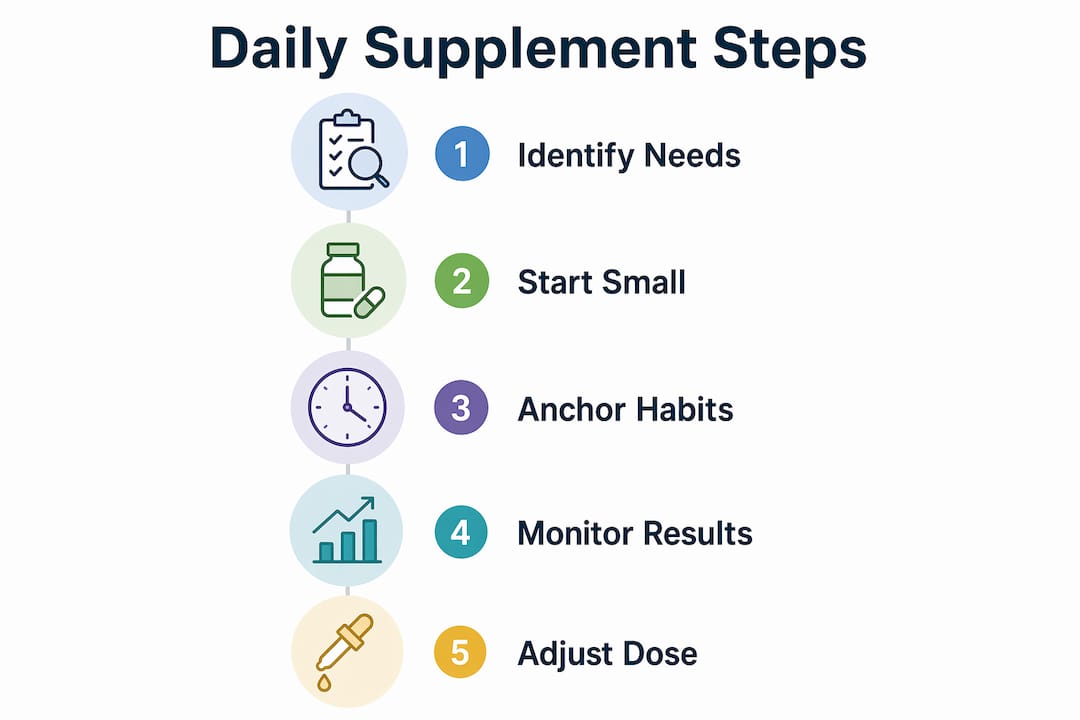
Begin with 1–3 supplements and commit to at least 8 weeks before drawing conclusions. Adding more products before you have assessed the first batch creates noise. You will not know what is working. A manageable starting routine is the single most reliable predictor of long-term consistency.
Follow this sequence when launching your daily supplement regimen:
- Choose 1–3 supplements based on your food diary and confirmed goals.
- Anchor each supplement to an existing habit. Take vitamin D3 with breakfast. Take magnesium glycinate after brushing your teeth at night.
- Select a format you will actually use. Capsules suit most people. Powders work well if you already make a morning shake. Gummies are convenient but often contain lower doses.
- Store supplements visibly. Place them next to your coffee machine, on your bathroom counter, or beside your gym bag. Out of sight means out of mind.
- Log your intake. A simple notes app or a habit tracker like Streaks works well. Consistency data becomes your most valuable asset at the 8-week review.
- Add new supplements only after your initial assessment. Patience here pays off.
Pro Tip: Habit anchoring is the most underused tool in supplement compliance. Anchoring intake to existing habits removes the need to remember and turns supplementing into an automatic behaviour rather than a daily decision.
Here is a simple format comparison to help you choose what suits your lifestyle:
| Format | Ease of Use | Typical Dose Accuracy | Best For |
|---|---|---|---|
| Capsules | High | High | Most adults, travel |
| Powder | Medium | High | Those with morning shakes |
| Gummies | High | Low to Medium | Convenience-focused users |
| Liquid | Low | High | Those with swallowing difficulties |
What are the right doses and timings for fitness supplements?
Dosage and timing are where most beginner supplement routines fall apart. Taking the right product at the wrong time, or in the wrong amount, reduces its effectiveness significantly.
Clinical doses for common supplements
The research points to specific ranges for the most widely used fitness supplements. Probiotics require 10 billion CFUs or more to produce measurable gut health benefits. Magnesium glycinate is effective at 200–400 mg daily for sleep and recovery support. Vitamin D3 is typically dosed at 1,000–2,000 IU daily for maintenance, though deficient individuals may require higher doses under medical supervision.
Fat-soluble vitamins require dietary fat for absorption. Vitamin D3 and omega-3 are best taken with a meal containing fat, such as breakfast with eggs or avocado. Taking them on an empty stomach reduces the amount your body actually absorbs.
Mineral competition is a real issue that most supplement guides ignore. Calcium and iron compete for the same absorption pathways in the gut. Separate them by at least two hours. Taking both at the same time means one will consistently underperform.
Here is a practical morning and evening split for a foundational routine:
| Supplement | Timing | With Food? | Notes |
|---|---|---|---|
| Vitamin D3 | Morning | Yes, with fat | Pairs well with breakfast |
| Probiotic | Morning | Optional | Some strains work better fasted |
| Magnesium glycinate | Evening | Optional | Supports sleep onset |
| Iron (if prescribed) | Morning | Yes | Separate from calcium by 2+ hours |
Pro Tip: Read the label for the serving size, not just the headline ingredient. A product labelled “500 mg magnesium” may contain magnesium oxide, which has far lower bioavailability than magnesium glycinate for recovery.
Key rules to follow on timing and interactions:
- Take fat-soluble vitamins (D3, K2, A, E) with a fat-containing meal.
- Separate calcium and iron supplements by a minimum of two hours.
- Take probiotics consistently at the same time each day to maintain gut colonisation.
- Avoid taking multiple stimulating supplements in the evening.
How do you know if your supplements are actually working?
Evaluating supplement effectiveness requires a baseline. Without one, you are comparing a feeling to a memory. Before you start any new supplement, score yourself on three or four measurable markers: sleep quality (1–10), morning energy (1–10), afternoon energy dip severity (1–10), and post-training recovery time. Write these down.
Then track weekly. A simple spreadsheet or a notes app works. The goal is not perfection. The goal is a data trail that lets you make an objective decision at the 8-week mark. Most people quit prematurely before the 8-week window closes, which means they never know whether the supplement was working.
Follow this evaluation process at the end of your trial period:
- Compare your weekly scores to your baseline across all four markers.
- Review your consistency log. If you missed more than 20% of doses, the data is unreliable. Recommit before drawing conclusions.
- Assess side effects. Digestive discomfort, headaches, or disrupted sleep are signals to adjust dose or timing, not necessarily to stop.
- Decide: continue, adjust, or stop. If scores improved, continue. If results are flat despite consistent use, consider adjusting the dose or switching to a different form of the supplement.
- Remove redundancy. If you have added multiple supplements over time, check whether any overlap in function. Redundancy wastes money and complicates tracking.
Track these markers weekly during your trial:
- Sleep quality score (1–10)
- Morning energy score (1–10)
- Afternoon energy dip severity (1–10)
- Post-training soreness or recovery time
- Supplement intake consistency (percentage of days taken)
The most important insight here is that consistency is the primary determinant of whether a supplement works. Brand and dose matter less than whether you actually take the product every day.
Key takeaways
A successful daily supplement routine depends on identifying real nutrient gaps, starting small, anchoring intake to existing habits, and tracking progress objectively for at least 8 weeks before making any changes.
| Point | Details |
|---|---|
| Start with 1–3 supplements | Limit complexity at the start to maximise consistency and track results clearly. |
| Use a food diary first | A 3–7 day food diary identifies genuine nutrient gaps before you spend money. |
| Anchor to existing habits | Attach supplements to breakfast, coffee, or brushing teeth to automate intake. |
| Respect timing and interactions | Separate calcium and iron by 2+ hours; take fat-soluble vitamins with a fatty meal. |
| Evaluate at 8 weeks minimum | Score sleep, energy, and recovery weekly and compare against your baseline before deciding. |
Why simplicity wins every time with supplements
I have seen a lot of people come to supplementing with the best intentions and a basket full of products they read about online. Within six weeks, half of them have stopped. The routine became a chore. The results were unclear. The cost felt unjustifiable.
The routines that work are boring by design. One supplement at breakfast. One at night. The same two products, every day, for eight weeks. That is it. The people who stick to this approach are the ones who eventually have something useful to report: better sleep, faster recovery, more consistent energy through training.
My honest caution is around proprietary blends. I see them everywhere in the sports nutrition space, and they are almost always a red flag. You do not know what you are taking at what dose. You cannot isolate what is working. You cannot adjust intelligently. Single-ingredient products with transparent labelling are not glamorous, but they are the only way to actually learn what your body responds to.
The other thing I would push back on is the idea that more supplements mean more results. They do not. They mean more variables, more cost, and more confusion. Start with the basics. Get your supplement safety right from the beginning. Reassess every 8–12 weeks with real data. That process, repeated consistently, is what actually moves the needle.
— Tom
Ready to build your routine with Useinterval?
Starting a daily supplement regimen is straightforward when you have products you can trust. Useinterval’s Starter Bundle is built for active adults who want a clean, transparent foundation without the guesswork. Every product uses natural ingredients at clinically relevant doses, with no proprietary blends and no hidden fillers.
The Starter Bundle covers the foundational gaps most active people in the 25–45 age group face: energy, recovery, and performance under intensity. Useinterval formulates specifically for high-intensity sport, which means the doses are built for people who actually train hard. If you are serious about building a supplement routine that works, this is where to start.
FAQ
What supplements should i take first as a beginner?
Start with vitamin D3, magnesium glycinate, and a probiotic. These three address the most common deficiencies in active adults and have strong clinical evidence behind them.
How long does it take for supplements to work?
Allow at least 8 weeks before evaluating results. Most people quit within 4–6 weeks, before benefits have time to manifest.
Should i take supplements with food?
Fat-soluble vitamins like vitamin D3 must be taken with a meal containing fat for proper absorption. Probiotics can be taken with or without food depending on the strain.
How do i know if a supplement is safe?
Look for third-party certification logos from NSF, USP, or Informed Choice on the product label. These confirm that the ingredients and doses match what is stated.
Can i take multiple supplements at the same time?
Most supplements can be combined, but calcium and iron must be separated by at least two hours as they compete for absorption. Always check for interactions before combining new products.