


The role of vitamin C in sports: what athletes need to know
TL;DR:
- Vitamin C acts as a water-soluble antioxidant that supports immune function and collagen synthesis in athletes. High-dose supplementation above 1,000 mg daily can impair training adaptations by disrupting redox signaling. The optimal intake is around 200 mg per day from food sources like fruits and vegetables to support recovery and prevent deficiencies.
Vitamin C is defined as a water-soluble antioxidant that supports immune function, collagen synthesis, and oxidative stress management in athletes. The role of vitamin C in sports is more nuanced than most training guides suggest. Taken at the right dose, it protects connective tissue and keeps your immune system functional during heavy training blocks. Taken in excess, it actively works against the adaptations you are training for. The International Society of Sports Nutrition and recent 2026 research from HumanFuelGuide both confirm this double-edged reality, and understanding it is what separates smart supplementation from wasted effort.
How does vitamin C affect athletic performance and training adaptations?
Vitamin C’s primary performance role is neutralising reactive oxygen species generated during intense exercise. Those free radicals are not purely destructive. Oxidative stress triggers beneficial adaptations including mitochondrial biogenesis and muscle hypertrophy. Flood the system with antioxidants and you suppress the very signals your body uses to get stronger.
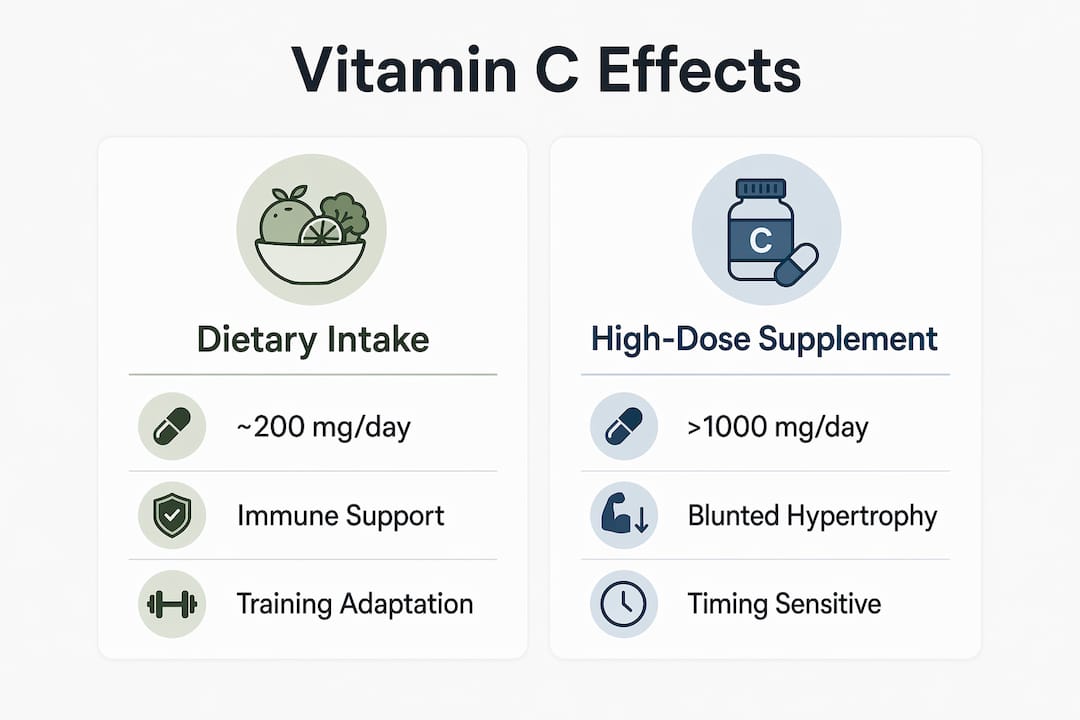
This is where high-dose supplementation becomes a liability. High-dose vitamin C above 1,000 mg/day blunts muscle hypertrophy and strength gains by disrupting redox signalling during training. A 2023 meta-analysis of 14 randomised controlled trials confirmed no meaningful performance enhancement from supplementation at these levels. The typical RDA sits at 75–90 mg/day, and athletes only benefit from higher intakes in specific acute scenarios.
The mechanism matters here. Exercise-induced oxidative stress operates on a hormetic curve. Low-level stress activates adaptive pathways. Excessive antioxidant intake from sources like isolated vitamin C supplements disrupts master switches such as Nrf2/Keap1, reducing the downstream signalling that drives endurance and strength gains. Think of it as muting the training signal your muscles are trying to send.
The table below summarises what the research shows across supplementation levels:
| Supplementation level | Performance outcome | Adaptation effect |
|---|---|---|
| Dietary intake (~200 mg/day) | Neutral to mildly positive | Adaptations preserved |
| Moderate supplement (200–1,000 mg/day, acute) | Context-dependent benefit | Minimal impairment |
| High dose (>1,000 mg/day, chronic) | No enhancement; possible decline | Mitochondrial biogenesis blunted |
| Immediate pre/post-exercise (1g burst) | Slightly slower race times | Mitochondrial adaptation reduced |
Pro Tip: Avoid taking a high-dose vitamin C supplement immediately before or after training. The timing matters as much as the dose.
What are the optimal vitamin C intake levels and sources for athletes?
The optimal intake for athletes is approximately 200 mg/day from food sources. That figure mitigates oxidative damage without suppressing the adaptive responses you need from training. It is equivalent to five or more daily servings of fruits and vegetables, which is achievable without a single supplement.
Food sources deliver vitamin C alongside fibre, polyphenols, and co-factors that isolated supplements cannot replicate. This is why the food-first approach consistently outperforms high-dose supplementation in athlete cohorts. The matrix of nutrients in whole foods supports recovery in ways that a 1,000 mg tablet simply does not.
The best natural sources for athletes include:
- Red bell peppers (190 mg per 100g, the highest of any common food)
- Kiwi fruit (93 mg per 100g, plus vitamin K and potassium)
- Broccoli (89 mg per 100g, also a source of sulforaphane for inflammation)
- Strawberries (59 mg per 100g, easy to add to post-training meals)
- Oranges (53 mg per 100g, widely available and practical)
- Blackcurrants (181 mg per 100g, underused by most British athletes)
Excessive vitamin C intake carries real risks. The upper intake level is 2,000 mg/day. Above that threshold, gastrointestinal distress becomes common and the oversuppression of oxidative stress responses reduces your training returns. Most athletes chasing performance gains are better served by eating more vegetables than by buying a higher-dose supplement.
Pro Tip: Pair vitamin C-rich foods with iron-rich meals. Vitamin C significantly increases non-haem iron absorption, which matters for endurance athletes managing ferritin levels.
How does vitamin C support recovery and immune health for athletes?
Vitamin C’s recovery benefits are most pronounced in two areas: immune resilience under heavy training stress and connective tissue repair. Both are directly relevant to anyone training at high intensity multiple times per week.
On the immune side, vitamin C reduces cold risk by around 50% in athletes under heavy physical stress. That figure applies specifically to athletic cohorts, not the general population, where the preventive effect is much smaller. If you are in a competition block or a high-volume training phase, maintaining adequate vitamin C intake is a genuine protective measure.
Vitamin C is essential for collagen synthesis, which directly supports tendon and ligament integrity. For athletes doing high-load movements, this is not a minor benefit. Connective tissue injuries are among the most common and most disruptive in sport, and vitamin C deficiency accelerates their risk. Keeping intake consistent through diet supports tissue resilience over the long term.
Timing supplementation correctly is where most athletes get it wrong. Taking 1g of vitamin C immediately before or after intense exercise may slow mitochondrial adaptations and has been linked to 0.2-second slower 500m race times in one study. That is a small but measurable cost. If you do supplement, take it well away from your training window, such as with breakfast on a rest day.
The table below compares vitamin C against other recovery-focused antioxidants:
| Nutrient | Primary recovery benefit | Evidence quality | Recommended intake |
|---|---|---|---|
| Vitamin C | Immune support, collagen synthesis | Moderate | ~200 mg/day from food |
| Omega-3 | Inflammation reduction, muscle repair | High | 1,000–6,000 mg/day |
| Tart cherry | Muscle soreness, sleep quality | Moderate to high | 480 mg concentrate |
| Vitamin E | Membrane protection | Low to moderate | Dietary sources preferred |
The ISSN’s 2026 position ranks vitamin C below omega-3 and tart cherry for recovery impact. That does not make it irrelevant. It means you should not rely on it as your primary recovery tool. Use it as part of a broader dietary strategy, not as a standalone fix.
Pro Tip: If you are travelling for competition or entering a heavy training block, a short-term supplement of 200–500 mg/day is a reasonable precaution. Do not make it a daily habit year-round.
What are the common myths about vitamin C supplementation in sports?
Several widely held beliefs about vitamin C and athletic performance do not hold up under scrutiny. Getting these wrong costs you either money, performance, or both.
Myth 1: High-dose vitamin C prevents colds. The evidence is more specific than this. Vitamin C may halve cold risk in athletes under extreme physical stress, but it shows little preventive effect in the general population. If you train recreationally rather than competitively, a 1,000 mg daily supplement is unlikely to keep you healthier.
Myth 2: More vitamin C means better performance. A 2023 meta-analysis of 14 RCTs found no meaningful performance enhancement from high-dose supplementation. Above 1,000 mg/day, the evidence points toward impaired adaptation rather than improved output.
Myth 3: Taking vitamin C around workouts speeds recovery. This is the most counterproductive myth in practice. Burst dosing immediately before or after exercise suppresses the oxidative signals that drive mitochondrial adaptation. You recover slightly faster in the short term but reduce the training stimulus your body needs to improve.
Myth 4: Supplements are equivalent to food sources. Isolated vitamin C tablets deliver ascorbic acid without the co-factors present in whole foods. The food-first approach consistently produces better outcomes because whole foods support multiple recovery pathways simultaneously.
When is supplementation actually appropriate? Short-term use during illness, extreme training blocks, or competition travel makes sense. Chronic high-dose supplementation as a daily habit does not.
Key takeaways
Vitamin C benefits athletes most at around 200 mg/day from food sources, where it supports immunity and connective tissue without blunting the training adaptations that drive performance gains.
| Point | Details |
|---|---|
| Optimal daily intake | Aim for ~200 mg/day from food; five servings of fruit and vegetables achieves this. |
| High doses impair adaptation | Above 1,000 mg/day, vitamin C blunts mitochondrial biogenesis and strength gains. |
| Timing around training matters | Avoid burst dosing immediately pre or post-exercise to protect adaptation signals. |
| Immune benefit is athlete-specific | Cold risk reduction of ~50% applies to athletes under heavy stress, not casual gym-goers. |
| Food beats supplements | Whole food sources deliver co-factors and polyphenols that isolated supplements cannot replicate. |
Why I think most athletes are getting vitamin C completely backwards
I have watched a lot of athletes reach for a 1,000 mg vitamin C tablet the morning after a hard session, convinced they are doing something smart for recovery. The intention is right. The execution is off.
The research on antioxidants and recovery is clear that the oxidative stress from training is not the enemy. It is the signal. When you chronically suppress it with high-dose isolated antioxidants, you are essentially telling your body there was no training stress worth adapting to. That is a poor trade.
What I find more interesting is how few athletes actually hit 200 mg/day from food consistently. That is five servings of fruit and vegetables. Most people doing high-intensity training are under-eating vegetables and over-relying on supplements to compensate. The supplement does not fix the dietary gap. It just adds a new problem on top of it.
My view is that vitamin C supplementation has a narrow, specific use case: short blocks during illness, extreme competition travel, or periods where food quality genuinely drops. Outside of those windows, the money and effort is better spent on food quality, sleep, and the nutrients with stronger recovery evidence, such as omega-3 and tart cherry.
The athletes I respect most treat food as the primary intervention and supplements as a targeted, temporary tool. Vitamin C fits that model well when used correctly. It does not fit when used as a daily insurance policy against a poor diet.
— Tom
Support your training with Useinterval’s natural approach
Useinterval builds supplements around the same principle this article is grounded in: natural ingredients at doses that work with your physiology, not against it. If you are doing high-intensity training and want a foundation that supports antioxidant balance without the risks of isolated mega-doses, the Starter Bundle is built for exactly that. It combines pre-workout and electrolyte support using natural ingredients, designed for athletes who train hard and want to recover properly. No unnecessary fillers, no doses that blunt your gains. Just clean, purposeful nutrition that fits the evidence.
FAQ
Does vitamin C improve athletic performance?
Vitamin C does not directly improve performance at any dose. A 2023 meta-analysis of 14 RCTs found no meaningful enhancement, and doses above 1,000 mg/day can actively impair training adaptations.
How much vitamin C do athletes need per day?
Around 200 mg/day from food sources is the evidence-based target for most athletes. This is achievable through five or more daily servings of fruits and vegetables without supplementation.
Can vitamin C supplementation slow my training progress?
Yes, if taken at high doses around your training window. Burst dosing of 1g immediately before or after exercise suppresses mitochondrial adaptation signals and has been linked to measurable declines in race performance.
Does vitamin C reduce the risk of illness during heavy training?
Research shows vitamin C can reduce cold risk by around 50% in athletes under extreme physical stress. This benefit is specific to high-load athletic cohorts and does not apply broadly to recreational exercisers.
What is the best food source of vitamin C for athletes?
Red bell peppers provide approximately 190 mg per 100g, making them the most concentrated common dietary source. Blackcurrants (181 mg per 100g) and kiwi fruit (93 mg per 100g) are also excellent options for athletes prioritising whole-food intake.