


Supplement testing: enhance performance and safety in 2026
TL;DR:
- Supplement contamination in non-certified supplements poses doping and health risks for female Hyrox athletes.
- Third-party testing and certifications like NSF and Informed Sport help reduce but do not eliminate risks.
- Use verified, batch-specific certified supplements, prioritize diet, and avoid unnecessary products for safety.
You train hard, eat well, and take your recovery seriously. So it might surprise you to know that the pre-workout sitting in your gym bag could contain a banned substance, even if the label says otherwise. High contamination risk in non-certified supplements is not a fringe concern; it is a documented reality that affects female Hyrox athletes at every level. This guide walks you through how supplement testing works, what certifications actually mean, where the gaps lie, and how to make safer choices for your pre-workout and electrolytes without sacrificing performance.
Table of Contents
- Why supplement testing matters for female Hyrox athletes
- How supplement testing works: types, certifications, and what gets checked
- Limitations and edge cases: why even tested supplements carry some risk
- Practical strategies: minimising risk and maximising performance with supplement use
- The uncomfortable truth: no supplement is risk-free
- Explore tested supplement bundles for safe Hyrox performance
- Frequently asked questions
Key Takeaways
| Point | Details |
|---|---|
| Contamination is widespread | Non-certified sports supplements often contain undeclared and prohibited substances, increasing doping and health risks. |
| Testing reduces—but does not erase—risk | Third-party certifications like NSF and Informed Sport minimise exposure to contaminants and banned substances but do not guarantee safety. |
| Certification verification is vital | Always check certification status via public databases to confirm products’ batch-specific safety and compliance. |
| Diet first, supplement only when needed | Experts recommend prioritising balanced nutrition and using supplements only when required, focusing on certified options. |
Why supplement testing matters for female Hyrox athletes
The supplement industry is largely self-regulated, which means brands can make bold claims without independent verification. For female Hyrox athletes competing in drug-tested categories, this is not just a health issue; it is a career risk.
A recent survey found that 35% of supplements contained WADA-prohibited substances, with 57% carrying undeclared ingredients. That is not a small margin of error. That is a structural problem across the industry.
The contamination types most relevant to you include:
- Prohibited stimulants found in pre-workout blends, including DMAA and DMHA
- Heavy metals such as lead and arsenic, particularly in plant-based protein and greens powders
- Microbial contamination from poor manufacturing hygiene
- Pesticide residues in botanical ingredients
- Undeclared anabolic agents in muscle-building and fat-loss products
For Hyrox Pro athletes, a positive doping test carries serious consequences regardless of intent. The ITA athlete supplement guidance is clear: athletes bear full responsibility for what they consume. Ignorance is not a defence.
“The risk of a positive test or adverse health effect from a contaminated supplement is real. Athletes must treat every product as a potential risk until independently verified.”
Beyond doping, the health implications are significant. Chronic exposure to heavy metals affects hormonal function, which is particularly relevant for women in their 30s and 40s managing training load alongside everyday life demands. Understanding supplement purity for UK athletes is not optional if you are serious about long-term performance.
Now that the risks are clear, let us explore how testing works and what certifications actually prove.
How supplement testing works: types, certifications, and what gets checked
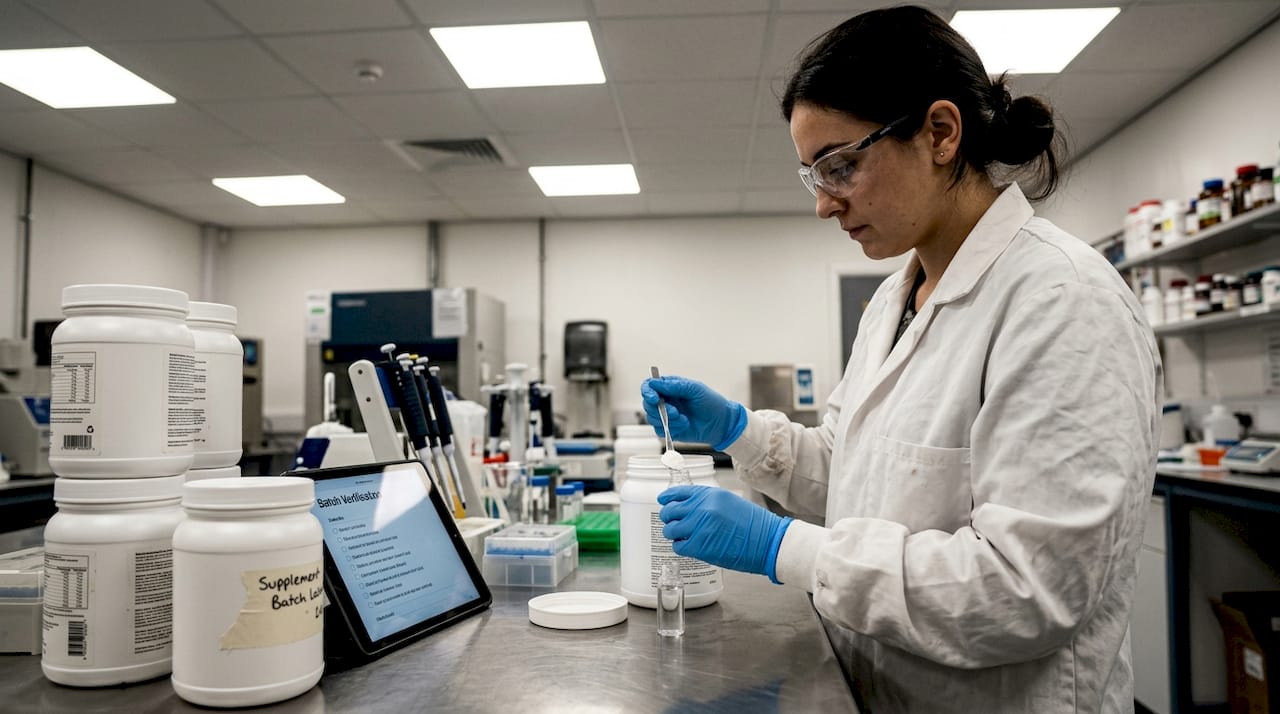
Third-party testing means an independent laboratory, with no financial stake in the product’s success, analyses a supplement before it reaches you. The process is more rigorous than most people assume.
A certified lab will verify label accuracy, confirm ingredient identity, test potency, and screen for 270 to 290 WADA-prohibited substances, heavy metals, microbes, and pesticides. That is a broad safety net, but it only applies to products that voluntarily submit to the process.
The two most recognised certifications for UK and European athletes are NSF Certified for Sport and Informed Sport. Here is how they compare:
| Feature | NSF Certified for Sport | Informed Sport |
|---|---|---|
| WADA substances screened | 270+ | 250+ |
| Batch testing | Yes | Yes |
| Manufacturing audit | Yes | Yes |
| Public database | Yes | Yes |
| Origin | USA | UK/Global |
| Recognised by WADA | Yes | Yes |
Both are credible. Informed Sport tends to be more common among UK-based brands, while NSF is dominant in North American markets. Either is a strong signal of intent.
The typical testing process follows these steps:
- The manufacturer submits a product sample to the third-party lab
- The lab analyses the sample against label claims for ingredient identity and potency
- The product is screened for prohibited substances and contaminants
- The manufacturing facility undergoes an audit for hygiene and process standards
- If the product passes, it receives certification and a batch-specific certificate
- Ongoing batch testing continues throughout the product’s commercial life
Pro Tip: When buying a certified pre-workout or electrolyte, always check the specific batch number against the certification database. A product can hold a certification while an individual batch fails, so batch-level verification matters.
Looking for products that meet these standards? Our guide to clean label supplements UK covers what to look for on the label before you buy. The safe supplement guide also walks through practical selection criteria for high-intensity athletes.
With a practical view of testing and certifications, it is vital to understand what these certifications mean for safety and doping risk reduction, and where they fall short.
Limitations and edge cases: why even tested supplements carry some risk
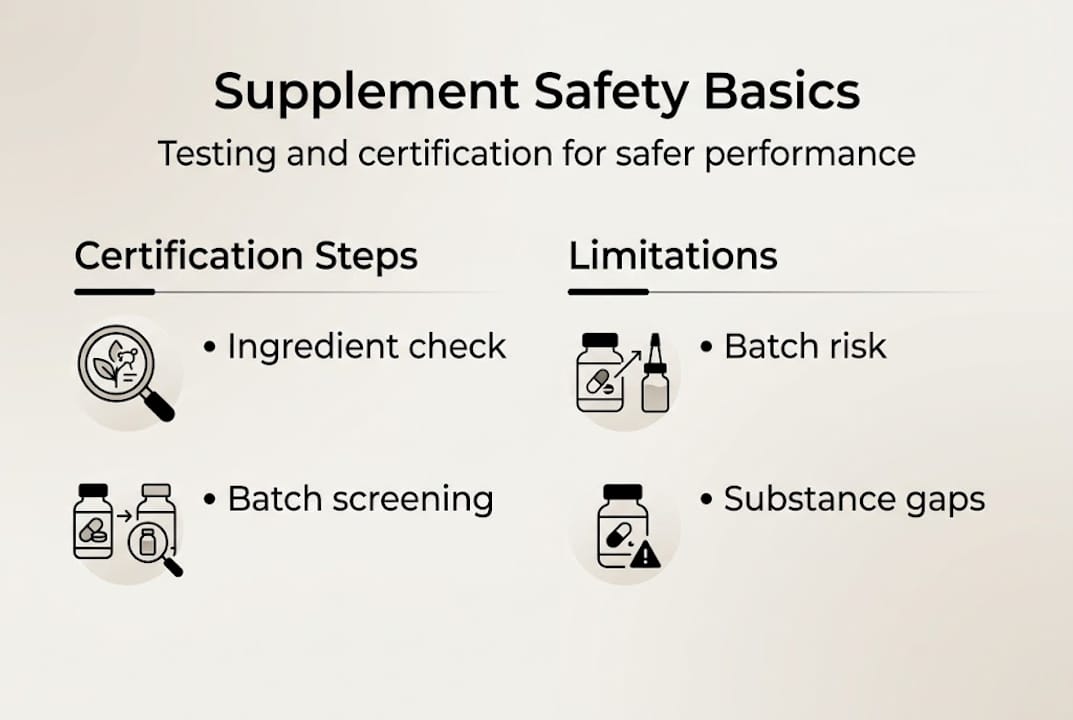
Certification is not a guarantee. It is a risk-reduction tool, and there is an important difference.
The ITA athlete supplement hub acknowledges that certification programmes cannot provide a 100% guarantee due to emerging prohibited substances, batch-to-batch variability, and the fact that efficacy is never tested. A product can be certified as safe and still not deliver the performance outcomes claimed on the label.
Here is a summary of where current certification programmes have known limitations:
| Risk factor | Covered by certification? | Notes |
|---|---|---|
| WADA-listed prohibited substances | Mostly yes | Depends on substance list version |
| Emerging/novel substances | Rarely | Lists updated periodically, not in real time |
| Batch variability | Partially | Only tested batches are covered |
| Efficacy claims | No | Not within scope of safety testing |
| Natural botanical contaminants | Inconsistently | Difficult to distinguish from adulteration |
Botanicals deserve special attention. Ingredients like ashwagandha, rhodiola, and bitter orange naturally contain compounds that can resemble or interact with prohibited substances. Distinguishing a naturally occurring alkaloid from deliberate adulteration is analytically complex, and not all labs perform this level of scrutiny.
“Even the most rigorous third-party certification cannot account for every emerging substance or every batch produced. Athletes must layer their risk management, not rely on a single certification as a full safety net.”
The third-party certification features research published in the American College of Sports Medicine journal confirms that voluntary certification programmes are valuable but structurally limited.
Pro Tip: Before each competition block, re-check the certification database for your specific product batch. Certifications can lapse, and new batches are not automatically covered by previous approvals.
For female athletes using botanically sourced ingredients, our natural supplement intake guide provides specific guidance on which plant-based compounds carry higher risk profiles.
Given these limitations, the focus for athletes should shift towards practical risk reduction strategies.
Practical strategies: minimising risk and maximising performance with supplement use
The goal is not to avoid supplements entirely. It is to use them intelligently, with verification at every step.
USADA and ITA both recommend using certified supplements only when necessary, with diet as the primary foundation. For female Hyrox athletes, pre-workout and electrolytes are the two categories where supplementation offers the clearest performance benefit and where certified options are most readily available.
Follow these steps before purchasing or using any supplement:
- Identify whether the supplement is genuinely necessary for your training or competition goals
- Search the product on the NSF or Informed Sport public database before buying
- Cross-reference the specific batch number on the certificate once the product arrives
- Check the certificate expiry date; outdated certifications are not valid
- Avoid products purchased through third-party marketplaces, even if the brand is familiar
- Consult the testing supplement database for a broader view of certified products
For pre-competition periods, apply additional caution:
- Avoid introducing any new supplement within four weeks of a Hyrox event
- Stick to products you have used consistently and verified previously
- Do not share supplements or accept products from training partners without checking certification yourself
- Prioritise electrolytes with simple, identifiable ingredient lists over complex multi-ingredient formulas
- Be especially cautious with any product marketed for weight loss or extreme energy, as these carry the highest contamination rates
Our guide on natural supplement steps for Hyrox athletes covers how to build a minimal, effective supplement stack without unnecessary risk. For those thinking about the environmental impact of their choices alongside safety, sustainable Hyrox supplements is worth reading too.
With a comprehensive strategy in place, let us consider an expert perspective that challenges common beliefs about supplement safety and testing.
The uncomfortable truth: no supplement is risk-free
Here is what years of working with high-intensity athletes has taught us: the biggest risk is not the contaminated product. It is the athlete who assumes that a certification badge means they no longer need to think critically.
Certification provides risk reduction but no absolute guarantee, and it does not verify whether the supplement actually works as claimed. We have seen athletes stack four or five certified products, none of which were necessary, and wonder why their recovery was suffering.
The diet-first principle is not a cliché. It is the recommendation of every credible sports nutrition body because food provides context that isolated supplements cannot replicate. Supplements should fill specific, identified gaps, not replace the fundamentals. Our perspective on whole-food supplement insights explores this in more depth.
Verify every batch. Question every claim. And only use what you genuinely need.
Explore tested supplement bundles for safe Hyrox performance
If you have read this far, you already know more about supplement safety than most athletes in your next race. Now it is time to put that knowledge to work.
At Interval, we formulate our pre-workout and electrolytes with natural ingredients and transparent labelling, designed specifically for high-intensity athletes like you. Our starter supplement bundle is built around the principles covered in this guide: clean ingredients, honest dosing, and products you can verify. Pair that with our blog resources and you have everything you need to supplement with confidence, not guesswork.
Frequently asked questions
What is third-party supplement testing?
Third-party testing uses independent laboratories to check supplements for ingredient accuracy, prohibited substances, and contaminants, resulting in certifications like NSF or Informed Sport. It screens for 270 to 290 WADA-prohibited substances, heavy metals, microbes, and pesticides.
Are certified supplements completely risk-free?
No. Certification significantly reduces risk but cannot account for emerging substances, batch variability, or efficacy. As the ITA supplement hub confirms, no programme provides a 100% guarantee.
How can I check if my supplement is certified?
Search the product and batch number on the NSF or Informed Sport public databases before use. The third-party testing database also provides a broader listing of verified products across certifications.
What supplements carry the highest doping and contamination risk?
Pre-workouts, fat burners, and muscle builders purchased online carry the highest contamination rates, reaching 34 to 53% in non-certified products. Always prioritise independently tested options in these categories.