


Gluten-free supplements: what Hyrox athletes need to know
TL;DR:
- A 2025 study found no performance benefits for non-coeliac athletes following a gluten-free diet during high-intensity training. Most athletes without medical gluten restrictions gain nothing from gluten-free supplements, which often lack proof of advantage. Prioritizing overall nutrition, training, and food quality is far more effective than focusing solely on gluten status in supplements.
You’ve probably seen “gluten-free” stamped on everything from protein powders to electrolyte drinks, and assumed it signals a cleaner, better-performing product. Many female Hyrox athletes make that same assumption. But a 2025 pilot trial comparing a six-week gluten-free diet with a mixed diet during sprint interval training found no clear performance advantage for non-coeliac athletes. That result challenges one of the most persistent beliefs in sports nutrition, and it means your supplement choices deserve more thought than simply reaching for the gluten-free version.
Table of Contents
- Why gluten matters in supplements for Hyrox athletes
- Evaluating the evidence: does gluten-free mean better performance?
- Smart strategies for choosing gluten-free supplements
- Integrating gluten-free choices into your performance and recovery routine
- What most guides miss about gluten-free supplements and athletic performance
- Finding high-quality gluten-free supplements for Hyrox athletes
- Frequently asked questions
Key Takeaways
| Point | Details |
|---|---|
| Performance impact limited | Research has not shown gluten-free supplements improve results for most athletes. |
| Certification is essential | Only third-party certified gluten-free supplements provide verified allergen safety for coeliac or sensitive athletes. |
| Focus on nutrition basics | Prioritising carbohydrates, protein, hydration, and sleep is more important than gluten-free labelling for performance. |
| Practical selection steps | Read labels, check certifications, and balance supplement choices with core nutrition needs. |
Why gluten matters in supplements for Hyrox athletes
Gluten is a group of proteins found in wheat, barley, and rye. In supplements, it can appear as a hidden ingredient through fillers, maltodextrin derived from wheat, flavourings, or manufacturing cross-contamination. Most athletes who avoid it do so for one of three reasons: a diagnosed medical condition, a suspected sensitivity, or a belief that going gluten-free will sharpen their performance.
The medical reasons are well established. Coeliac disease is an autoimmune condition where gluten damages the small intestine. Non-coeliac gluten sensitivity causes digestive discomfort without the same intestinal damage. For anyone in these groups, consuming gluten through a supplement can trigger symptoms that directly undermine training quality, recovery, and gut health. Removing gluten is not optional for them; it is essential.
The performance angle is more complicated. Real food supplements built on evidence-based ingredients consistently outperform trend-driven formulations, and the science on gluten-free for non-coeliac athletes reflects that pattern clearly. For athletes without coeliac disease, gluten-free diets show no proven performance advantage in controlled research settings.
Top reasons athletes remove gluten from their supplement routine:
- Diagnosed coeliac disease or confirmed gluten sensitivity
- Persistent gut discomfort during or after training sessions
- Skin, joint, or inflammatory symptoms linked to gluten consumption
- Cross-contamination risk when training at an elite or competitive level
- Personal preference based on food philosophy or broader dietary approach
“For athletes without coeliac disease, the evidence does not yet support gluten-free diets as a performance-enhancing strategy. The data shows no significant benefit over a mixed diet during high-intensity training.” — 2025 sprint interval training pilot trial
Understanding why you are considering gluten-free supplements matters enormously. If your reason is medical, it is the right call. If you are chasing a performance edge based on marketing, the research simply does not support that expectation.
Evaluating the evidence: does gluten-free mean better performance?
The honest answer is no, not for most Hyrox athletes. The 2025 pilot study tracked athletes across six weeks, comparing a strict gluten-free protocol with a standard mixed diet, both combined with sprint interval training. The researchers measured performance outcomes directly. The conclusion was unambiguous: no significant performance benefit was found for non-coeliac participants following the gluten-free protocol.
Here is how the key findings compare:
| Factor | Gluten-free diet group | Mixed diet group | Study conclusion |
|---|---|---|---|
| Sprint performance | No significant change | No significant change | Equivalent outcomes |
| Recovery markers | Comparable | Comparable | No group advantage |
| Gut comfort (non-coeliac) | Marginal variation | Marginal variation | No clear benefit |
| Coeliac/sensitive athletes | Significant benefit | Symptoms reported | Medical necessity confirmed |
| Overall training adaptation | Similar | Similar | Diet type not a differentiator |
What this table illustrates is that the difference between gluten-free and mixed diets, for athletes without a medical need, is essentially negligible in terms of what matters on race day. The performance gains you are looking for come from other places: training load, flavourings and supplement formulation, carbohydrate timing, sleep quality, and consistent fuelling.
The myth that gluten-free equals cleaner or more effective persists because the wellness industry has done an excellent job of conflating medical necessity with performance optimisation. Gluten-free packaging looks purposeful and health-conscious. It feels like a serious athletic choice. But in practice, for the majority of Hyrox athletes without a sensitivity, it is simply a different formulation with no proven edge.
That said, checking supplement certifications matters regardless of whether you need to avoid gluten specifically. Certifications signal transparency, testing rigour, and manufacturing quality that benefits everyone.
Pro Tip: Before buying a supplement based on its gluten-free label, ask yourself why you actually need to avoid gluten. If you do not have a medical reason, redirect that focus to macronutrient timing, total protein intake, and ingredient quality instead.
Smart strategies for choosing gluten-free supplements
If you do need to avoid gluten, either because of coeliac disease or a confirmed sensitivity, then the selection process becomes genuinely important. Not all “gluten-free” claims are equal, and the difference between a certified gluten-free product and an uncertified one can have real consequences for your gut health and training consistency.
Here is a direct comparison:
| Factor | Certified gluten-free | Uncertified “gluten-free” claim |
|---|---|---|
| Third-party allergen testing | Yes, independently verified | Not confirmed externally |
| Manufacturing contamination control | Verified protocols in place | Unknown or unverified |
| Label transparency | Detailed, traceable | Variable quality |
| Allergen risk | Low | Moderate to high |
| Trust for coeliac athletes | High | Uncertain |
| Ingredient sourcing clarity | Typically disclosed | Often vague |
The gap between these two columns is where athletes with genuine medical needs get let down. A product can carry a gluten-free label based solely on the manufacturer’s own testing or simply because the recipe does not include obvious gluten-containing ingredients. That does not account for shared production lines, ingredient suppliers with cross-contamination issues, or inconsistent batch testing.
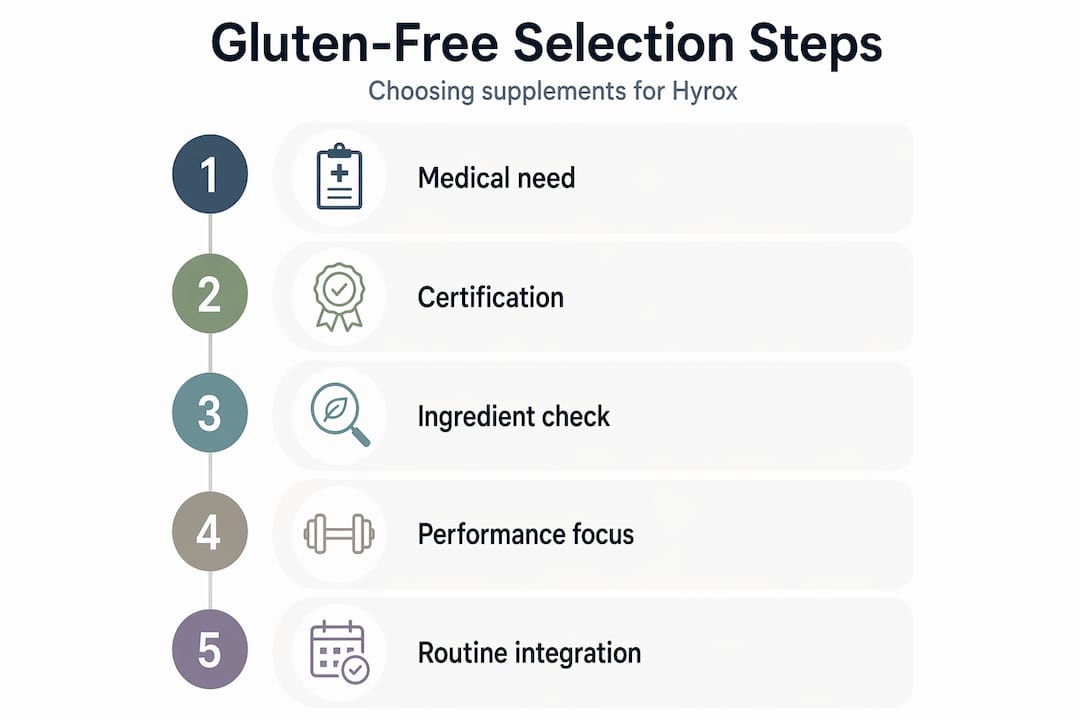
Step-by-step approach to gluten-free supplement selection:
- Confirm your actual need. Get tested if you suspect coeliac disease or sensitivity before overhauling your entire supplement routine.
- Look for third-party certification. NSF Certified for Sport independently verifies allergen controls, including gluten, which gives you far stronger assurance than a brand’s self-declared label.
- Read the full ingredient panel. Look for wheat-derived fillers, malt extract, or hydrolysed wheat protein lurking in binding agents or flavourings.
- Check allergen disclaimers. “May contain traces of wheat” signals a shared production line and is a red flag if you are coeliac.
- Contact the manufacturer directly. Ask about their allergen management protocols and batch testing frequency. Reputable brands will answer clearly.
- Review clean label supplements with minimal, traceable ingredients. Fewer components mean fewer opportunities for hidden gluten sources.
- Cross-check with supplement purity resources to identify brands with documented quality standards.
Learning how to read supplement labels as a female athlete is one of the highest-return skills you can develop. It takes ten minutes to learn and saves you from products that undermine your health and performance repeatedly.
For Hyrox athletes specifically, the physical demands of the event make gut stability critical. Combining heavy running with functional fitness stations means your digestive system is under real stress. Any supplement that triggers a reaction mid-race or in the 48 hours before competition has a direct performance cost. That is reason enough to treat allergen verification seriously.
Pro Tip: Do not assume a product is safe because it lists “natural flavours” and no obvious gluten ingredients. Natural flavouring can be wheat-derived. Check with the manufacturer and prioritise certified products if your medical situation demands it.
Integrating gluten-free choices into your performance and recovery routine
Gluten-free supplement selection is a risk-management strategy, not a performance strategy. That distinction matters when you are planning your nutrition approach for Hyrox training and competition. The real drivers of your performance and recovery are not about what you are removing from your diet; they are about what you are consistently putting in.
The research is direct on this: prioritise carbohydrate availability, total protein, hydration, and sleep before worrying about gluten status in your supplements. These are the fundamentals that move the needle. Gluten-free selection sits within a broader framework, not at the top of it.
Key elements of an effective performance and recovery routine for Hyrox athletes:
- Carbohydrate fuelling: Adequate carbohydrate intake before, during, and after training is non-negotiable. Smart carb loading strategies are particularly relevant in the build-up to competition.
- Total protein: Hitting your daily protein targets supports muscle repair and reduces injury risk. This matters more than whether your protein powder is gluten-free or not.
- Electrolyte balance: High-intensity Hyrox training causes significant fluid and mineral loss. Electrolyte replenishment is critical for sustained output across all eight stations.
- Sleep quality: No supplement overrides poor sleep. Recovery happens predominantly overnight, and sleep is where adaptation from your training sessions is consolidated.
- Consistent fuelling timing: Pre-workout nutrition and post-workout recovery windows are specific and worth planning deliberately.
- Gut health management: If you have sensitivities, use gluten-free selection as a tool to protect gut stability, which in turn supports nutrient absorption and training consistency.
Incorporating whole-food supplement benefits into this routine means choosing products that support these fundamentals rather than distract from them. Applying smart marathon recovery strategies adapted for Hyrox specifically can also accelerate your return to training after hard sessions.
Think of gluten-free supplement selection as you would tyre pressure on a race car. It matters enormously if you get it wrong and have a medical need. But adding the perfect tyre pressure to a car with a failing engine does not win races. Your engine is your carbohydrate fuelling, protein intake, sleep, and training volume.

What most guides miss about gluten-free supplements and athletic performance
Here is the uncomfortable truth: the fitness industry has made “gluten-free” into a status signal rather than a medical tool, and a lot of athletes are paying a premium for something that does not apply to their situation.
Most articles written on this topic carefully acknowledge the research showing no benefit for non-coeliac athletes, then spend the remaining 80% of their content helping you optimise your gluten-free supplement stack anyway. That is a contradiction driven by commercial interest, not athletic outcomes.
Our perspective is more direct. If you do not have coeliac disease or a confirmed gluten sensitivity, then the mental and financial energy you are spending on finding the perfect certified gluten-free pre-workout is energy that would deliver far greater returns if applied to your carbohydrate periodisation, sleep hygiene, or training programme design.
Consider two athletes preparing for Hyrox. The first spends considerable time sourcing certified gluten-free supplements, carefully checking every label, and paying a premium for that assurance. She has no diagnosed sensitivity. Her carbohydrate intake is inconsistent, and she regularly under-fuels before morning sessions because she does not want to feel heavy during the run. The second athlete uses straightforward, high-quality supplements without a gluten-free focus, but she has her carbohydrate and protein intake dialled in, sleeps seven to eight hours consistently, and hydrates deliberately. The second athlete will consistently outperform the first, and it has nothing to do with gluten.
We also recommend looking critically at non-GMO supplements claims with the same scepticism. Many of the same marketing dynamics apply. The question to ask in every case is: does the evidence support this claim for athletes in my situation?
The genuinely useful application of gluten-free thinking is this: if you have a medical need, treat it seriously and use certification to protect yourself properly. If you do not, focus your attention on the variables that actually drive performance improvements in high-intensity sport.
Finding high-quality gluten-free supplements for Hyrox athletes
You have done the hard work of understanding the evidence. Now it is about applying that knowledge practically and efficiently.
At Interval, we build our pre-workout and electrolyte formulations around natural ingredients and transparent labelling, specifically for athletes competing at high intensity. Our products are designed with purity and performance in mind, so whether you need genuinely certified allergen control or simply want to know exactly what you are putting into your body before a Hyrox session, we have got you covered. Start with the Starter Bundle to experience the quality difference, or browse the full range at the Interval shop to find the formulations that fit your training needs and dietary requirements.
Frequently asked questions
Do gluten-free supplements help most Hyrox athletes perform better?
No. Existing evidence does not support gluten-free supplements as a performance-enhancing strategy for athletes without coeliac disease or gluten sensitivity.
How can I tell if a supplement is truly gluten-free?
Look for products carrying NSF Certified for Sport status, which independently verifies allergen safety, and always check the full allergen disclaimer section on the label rather than relying on front-of-pack claims alone.
What is the main reason female athletes might avoid gluten in supplements?
Medical necessity, specifically coeliac disease or confirmed non-coeliac gluten sensitivity, is the primary rationale. The research confirms this is where gluten avoidance delivers real protective value.
Is gluten always listed on supplement ingredient labels?
Not always. Gluten can be present through wheat-derived fillers, malt extracts, or manufacturing cross-contamination without being explicitly named. Look for allergen disclaimers and use products with third-party allergen testing if avoiding gluten is medically important to you.