


How flavourings in supplements boost your performance
TL;DR:
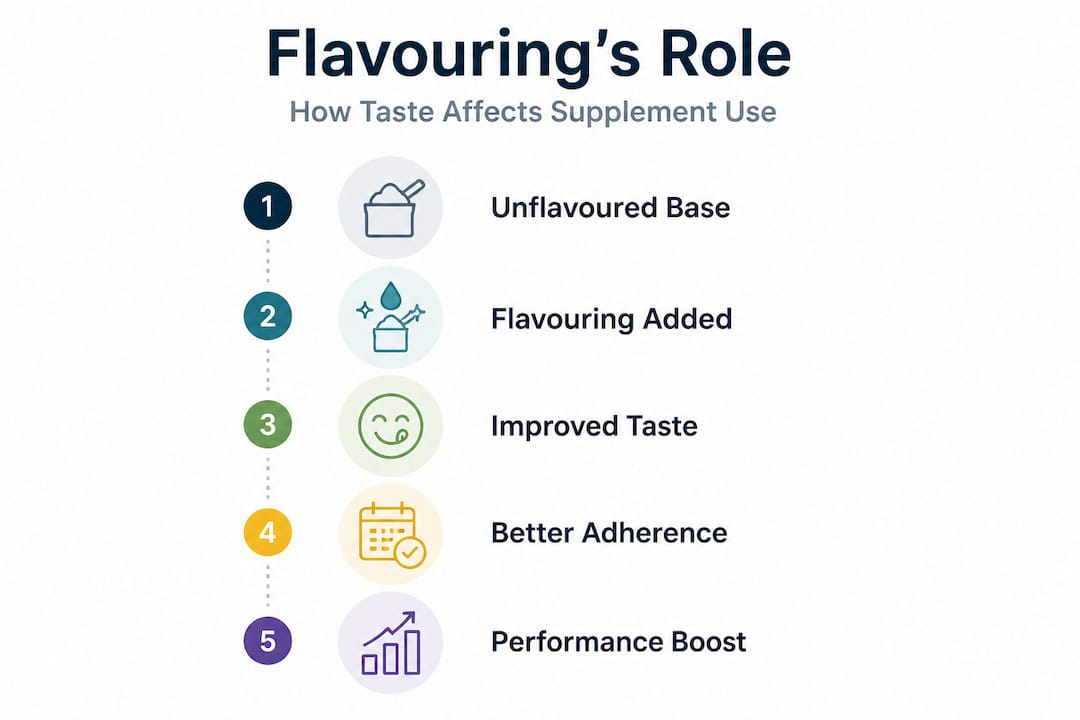
- Flavourings are crucial in sports supplements because they enhance palatability and improve adherence, leading to better athletic results. Poor taste can cause athletes to skip doses, reducing recovery and training effectiveness, especially for female athletes with tighter nutritional windows. Understanding sensory mechanisms and ingredient transparency helps athletes select products that support consistent use and long-term performance.
Flavourings in sports supplements are rarely discussed beyond marketing copy, yet they play a far more significant role in your athletic results than most brands admit. If you have ever abandoned a pre-workout or electrolyte mid-tub because the taste was unbearable, you have experienced exactly how flavour failure undermines your progress. Supplement palatability directly impacts adherence, meaning missed doses translate directly into missed recovery windows and blunted training gains. For female athletes aged 30 to 50 competing in high-intensity sport, where consistency is non-negotiable, understanding the real function of flavourings could be the difference between a podium finish and a plateau.
Table of Contents
- Why taste matters: Palatability, adherence, and athletic outcomes
- Sensory mechanisms: How flavourings actually mask unwanted notes
- Sweeteners and flavour adjuncts: What female athletes need to know
- Flavour choice: Impact on performance studies and real-world outcomes
- Why female athletes should demand ingredient transparency and flavour validation
- Explore supplement solutions tailored for female athletes
- Frequently asked questions
Key Takeaways
| Point | Details |
|---|---|
| Taste enhances adherence | Flavourings in supplements improve palatability, helping athletes stick to their regimen. |
| Masking is multi-modal | Flavour systems mask undesirable tastes differently depending on sensory modality and individual variation. |
| Sweeteners: indirect impact | Non-nutritive sweeteners drive adherence, though their physiological effects in athletes are still unclear. |
| Transparency matters | Female athletes should demand ingredient transparency and independent flavour validation from supplement brands. |
| Confounding in studies | Flavour choices can affect outcomes in supplement research and real-world performance so they should guide product selection. |
Why taste matters: Palatability, adherence, and athletic outcomes
Flavourings in supplements are not decoration. They exist primarily to solve a formulation problem: many of the most effective performance and recovery ingredients taste genuinely awful on their own. Creatine carries a chalky, acrid edge. Branched-chain amino acids are intensely bitter. Magnesium oxide has a metallic harshness that is hard to ignore. Without carefully designed flavour systems, these ingredients would be nearly impossible to consume consistently.
The core function of flavourings is masking. A well-designed flavour system suppresses the off-notes of functional ingredients and replaces them with something your senses accept, even welcome. As palatability supports consistent intake, this indirectly strengthens every single training outcome that depends on regular supplementation: muscle repair, hydration status, glycogen replenishment, and inflammation management.
For female athletes in their 30s and 40s, recovery is not optional. Oestrogen fluctuations across the cycle affect both muscle damage and repair rates, which means that the window for effective nutritional recovery is tighter than it is for male athletes. A product that sits half-used in a cupboard because it tastes unpleasant is not just a wasted purchase. It is a series of missed recovery doses that accumulate into measurable performance losses over weeks and months.
Here is what poor palatability actually costs you:
- Skipped pre-workout doses mean inconsistent training intensity across the week
- Avoided electrolyte use leads to sub-optimal hydration during hard sessions
- Abandoned protein or amino acid products reduce muscle protein synthesis after training
- Irregular supplementation makes it impossible to assess whether a product is genuinely working
Research confirms that flavourings enable use of functional ingredients by improving tolerability and intake logistics. This matters enormously when you consider that many athletes self-select lower doses of effective products simply because they cannot tolerate the taste at the recommended amount.
| Ingredient | Natural taste | Flavour challenge | Common masking approach |
|---|---|---|---|
| Creatine monohydrate | Chalky, bland | Low intensity but persistent | Citrus or berry flavour systems |
| BCAAs | Intensely bitter | High intensity | Tropical or citrus blends |
| Magnesium | Metallic, sour | Medium to high | Sweet vanilla or chocolate |
| Electrolyte blends | Salty, sharp | Variable | Fruit flavours or mild sweetness |
Understanding how to read a supplement label helps you identify whether a brand has invested in a quality flavour system or is masking ingredients poorly. Check out this guide on reading supplement labels and the broader natural intake guide for practical frameworks to assess what you are actually consuming.
Sensory mechanisms: How flavourings actually mask unwanted notes
Understanding that taste matters leads us to explore how flavourings actually mask undesirable traits, and why this effect can vary so much for female athletes.
Flavour perception is not a single event. It is a multi-stage sensory experience involving three distinct modalities:
- Orthonasal olfaction is the smell you detect before and during drinking, when aroma molecules travel up through your nostrils
- Retronasal olfaction is the aroma experience that happens after swallowing, when molecules travel up from the back of the throat
- Gustatory perception covers the actual taste on your tongue: sweetness, bitterness, sourness, saltiness, and umami
The challenge for supplement formulators is that flavour masking varies by modality. A flavour system that perfectly suppresses bitterness on the palate may do nothing to prevent a harsh aftertaste once the product is swallowed. This is why a supplement can smell inviting, taste acceptable at first sip, and then leave an unpleasant lingering note that puts you off finishing the serving. If you have ever struggled to get through a full dose of an amino acid product despite initially enjoying the flavour, you have experienced exactly this modality mismatch.

Genetic variation adds another layer of complexity. Roughly 25% of the population are classified as supertasters: people with a higher density of taste receptors, making them significantly more sensitive to bitter compounds. Female athletes are more likely to fall into this category than their male counterparts, which is one reason that flavour experiences with identical products can differ so sharply between athletes. A product that a training partner finds perfectly palatable may taste overwhelmingly bitter to you, and that is not a perception problem. It is a genetic reality.
Sensory strategies must account for formulation constraints and individual differences in bitterness perception, or masking can fail for specific athletes or product formats. This means a brand that only tests palatability in a small panel may not catch the bitter breakthrough that affects supertasters.
Pro Tip: If you find a supplement consistently leaves a bitter aftertaste despite a pleasant initial taste, try a product using natural fruit acids alongside the flavour system. Citric acid and malic acid can reduce bitterness perception at the retronasal stage. Understanding natural flavour constraints will help you identify brands that have done the sensory work properly.
Sweeteners and flavour adjuncts: What female athletes need to know
Having unpacked masking mechanisms, it is important to distinguish flavourings from sweeteners and adjuncts, and tackle their implications for female athletes competing at high intensity.
Non-nutritive sweeteners (NNS) such as sucralose, acesulfame potassium, and stevia are ubiquitous in sports supplements. They allow brands to hit a pleasant sweetness level without adding sugar or calories, which is particularly relevant for athletes managing body composition alongside performance. However, physiological effects in athletes remain under-researched and extend beyond taste. Questions remain about their effects on gut microbiota, glycaemic response, and appetite regulation in training populations.
The risk-benefit calculation for NNS is nuanced:
- Benefit: They enable low-calorie, high-palatability formulations that improve adherence
- Benefit: Regulatory approval in the UK and EU covers typical supplement intake levels
- Risk: Individual gut tolerance varies, and some athletes experience digestive disruption with specific NNS, particularly at higher doses
- Risk: Effects on insulin sensitivity and microbiome health in chronically stressed athletic populations are not yet fully characterised
- Consideration: Natural alternatives such as stevia and monk fruit extract have their own flavour challenges, including a distinct liquorice-like aftertaste at higher concentrations
“Flavorings and sweeteners can affect perceived tolerability and intake logistics, which matters for recovery because missed doses reduce realised benefit.”
Flavour adjuncts are a separate and often overlooked category. Ingredients such as dark chocolate, added not purely as a flavour but as a functional component, bring both palatability and bioactive compounds such as flavanols and theobromine. Evidence suggests that dark chocolate influences recovery-related outcomes through a combination of sensory acceptability and bioactive activity, making it a genuinely dual-purpose addition in certain formulations. The distinction matters: you are not just improving taste, you are potentially adding anti-inflammatory and vasodilatory compounds with real physiological relevance.
| Sweetener type | Caloric? | UK regulatory status | Common athlete concern |
|---|---|---|---|
| Sucralose | No | Approved | Gut tolerance at high doses |
| Acesulfame K | No | Approved | Blending bitterness |
| Stevia (steviol glycosides) | No | Approved | Liquorice aftertaste |
| Monk fruit extract | No | Approved | Limited availability |
| Natural sugars | Yes | Approved | Calorie contribution |
When choosing a sugar-free electrolyte, look beyond the label claim. Assess which sweetener is used, at what concentration, and whether the brand discloses sensory testing data. Brands committed to clean label choices typically document their sweetener rationale and favour options that align with supplement purity standards. This is precisely the kind of decision that sustainable supplementation is built on: thoughtful formulation that supports your training year after year, not just for a 30-day cycle.
Pro Tip: If your current electrolyte or pre-workout leaves you bloated or causes mid-session stomach discomfort, swap to a product using stevia or monk fruit at lower concentrations rather than sucralose. Many athletes find their tolerance threshold is dose-dependent rather than ingredient-specific.
Flavour choice: Impact on performance studies and real-world outcomes
To round out the picture, flavouring’s influence extends not just to individual adherence, but even to how supplement studies are interpreted. This is something every savvy female athlete should understand before putting stock in a brand’s claimed research backing.
Most supplement research uses blinded study designs to isolate the effect of an active ingredient. The problem is that flavour and sweetener choices can break blinding unintentionally. If a placebo tastes noticeably different to the active product, participants may correctly guess which group they are in. This partial unblinding introduces expectancy effects: the belief that you have taken a performance-enhancing product can itself alter perceived effort, pain tolerance, and even objective performance metrics.
Flavour and sweetener choices can confound ergogenic effects in multi-ingredient pre-workout trials, making it difficult to attribute performance changes to active ingredients alone. As a female athlete evaluating supplement claims, this means you need to ask more than “does this product have research backing?” You need to ask how the research was designed and whether flavour variables were controlled.
Here is a practical framework for evaluating supplement claims with flavour variables in mind:
- Check the placebo design. Did the study use a taste-matched placebo? If not, performance differences may reflect expectancy rather than active ingredients.
- Look at blinding verification. Did the researchers test whether participants could identify their group? A study that confirms successful blinding is substantially more credible.
- Assess dose transparency. Proprietary blends obscure whether active ingredients reach clinically relevant doses. Full disclosure formulations let you connect research to real-world serving sizes.
- Identify consistency data. Did participants take the product as directed throughout the study? High adherence rates often correlate with better-flavoured formulations and vice versa.
- Seek independent sensory testing. Brands that publish or share third-party sensory evaluation data are demonstrating confidence in their flavour system that goes beyond marketing.
Understanding how sugar management in pre-workout connects to both flavour design and performance outcomes will sharpen your ability to evaluate products critically. The pre-workout checklist is a practical starting point for building this kind of product literacy.
“The most undervalued performance strategy for female athletes is not a new active ingredient. It is choosing a product you will actually take every single day.”
Pro Tip: Before committing to a new supplement, take a single serving on a rest day with nothing else. Assess the taste across all three stages: the initial sip, the mid-drink experience, and the 10 minutes after finishing. This simple test reveals whether the flavour system holds up across all modalities, or whether it breaks down in the retronasal or aftertaste phase.
Why female athletes should demand ingredient transparency and flavour validation
Here is an uncomfortable truth the supplement industry rarely discusses: most brands have never conducted rigorous sensory panel testing. They develop flavours in-house, rely on their own team’s palates, and release products without accounting for the genetic taste variation that affects a significant portion of female athletes. Then they wonder why repeat purchase rates are lower than expected.
The evidence around sweeteners is genuinely nuanced. Regulatory approval tells you a compound is not dangerous at typical intake levels. It does not tell you how it behaves in athletes training twice daily with elevated gut permeability, hormonal fluctuations across the menstrual cycle, or chronic low-grade inflammation from heavy training loads. The research gap here is real, and any brand that dismisses it with a blanket “it is approved, therefore it is fine” is prioritising convenience over intellectual honesty.
What we believe, built on industry experience and a genuine commitment to natural ingredient formulation, is that female athletes deserve far more than a great-tasting product. They deserve to know why it tastes the way it does. That means full ingredient transparency, documented flavour masking approaches, and honest communication about sweetener choices and their rationale. Check out our position on clean label supplements and the standards we hold ourselves to on supplement purity to see what this looks like in practice.
The female athletes who consistently perform well over a multi-year competitive career are not always the ones with the most optimised training plan. They are often the ones who build habits that stick, who take their electrolytes before every hard session and their recovery nutrition without fail. Flavour is not a luxury variable in that equation. It is a fundamental enabler of the consistency that produces long-term athletic results.
Explore supplement solutions tailored for female athletes
If this article has shifted how you think about flavourings and supplement adherence, the logical next step is choosing products that actually reflect these standards.

At Interval, we have built our pre-workout and electrolyte formulations around natural ingredients, transparent labelling, and genuine flavour validation because we know that a product you enjoy taking is a product you will take consistently. That consistency is what drives real performance and recovery gains for high-intensity female athletes. Explore our starter supplement bundle to see how we approach flavour design alongside functional ingredient quality. Or browse all Interval supplement solutions to find formulations built around your specific training demands.
Frequently asked questions
Do flavourings in supplements actually help performance?
Flavourings mainly help by improving supplement adherence, so athletes are more consistent, which indirectly supports training outcomes through regular intake of functional ingredients.
Are non-nutritive sweeteners bad for female athletes?
Research confirms their use is safe within regulatory guidelines, but physiological effects in athletes remain an active research gap, so moderation and product-specific evaluation are wise.
Can flavourings mask all unwanted tastes in supplements?
Not always; effectiveness depends on how the flavour interacts across taste, aroma, and aftertaste stages, and genetic sensitivity to bitterness means masking may fail for some athletes even with well-designed systems.
Are flavourings or sweeteners responsible for direct ergogenic effects?
Their main performance pathway runs through adherence and tolerability rather than direct physiology, and sweetener effects in athletic populations are still being characterised by researchers.