


Antioxidants and Hyrox: boost performance and recovery naturally
TL;DR:
- Getting antioxidants right for Hyrox involves strategic timing and sources that support recovery without hindering training adaptations. High-dose synthetic vitamins can blunt beneficial oxidative signals, especially in women, due to hormonal influences, so natural polyphenol-rich foods are preferable post-exercise and on recovery days. An individualized, food-first approach that aligns antioxidant intake with training cycles enhances performance, reduces muscle damage, and supports sustained progress.
You train hard. You fuel carefully. You track your sleep. Yet the question of antioxidants still trips up a lot of female Hyrox athletes, because the default advice is to simply take more. More vitamins, more supplements, more protection from the damage your training creates. The truth is considerably more interesting, and considerably more useful. Getting antioxidants right for Hyrox is not about quantity. It is about strategy, timing, and choosing sources that work with your physiology rather than against it.
Table of Contents
- Why antioxidants matter in high-intensity workouts
- Evidence: how antioxidants influence performance and recovery
- Natural sources vs high-dose supplements: getting the balance right
- Timing your antioxidants for Hyrox training success
- The truth most guides miss: strategic antioxidants for real-world Hyrox gains
- Boost your Hyrox recovery with proven natural supplements
- Frequently asked questions
Key Takeaways
| Point | Details |
|---|---|
| Strategic use is key | Timing and source of antioxidants impact growth, recovery, and performance in Hyrox athletes. |
| Natural food sources win | Polyphenol-rich foods like tart cherry support recovery without blocking adaptation. |
| Avoid high-dose C/E pre-workout | Synthetic antioxidant megadoses before training can blunt fitness gains. |
| Women benefit from tailored timing | Female Hyrox athletes aged 30-50 require personalised antioxidant strategies for best results. |
Why antioxidants matter in high-intensity workouts
Every time you push through a Hyrox event, your body generates reactive oxygen species (ROS). These are chemically reactive molecules produced during intense exercise. ROS often get a bad reputation because, in excess, they cause oxidative stress and contribute to muscle damage. But here is where most guides get it wrong: not all ROS is harmful.
Your body actually needs a measured dose of ROS to trigger the adaptations that make you fitter. This process is called hormesis, and it describes how a controlled stressor produces a beneficial response. Exercise-induced ROS drives adaptations like improved mitochondrial function and stronger muscles, but excessive antioxidant supplementation can blunt these signals entirely. When you flood your system with synthetic antioxidants before training, you are essentially muting the very messages your cells need to grow stronger.
Hyrox training is particularly demanding from an oxidative standpoint. A single race combines eight functional fitness stations with 1 km running intervals in between, which creates a prolonged, high-intensity stress on your aerobic and muscular systems simultaneously. Your oxidative challenge is not a single sprint. It is sustained and cumulative.
For female athletes, the picture has an additional layer of complexity. Sex-based differences in antioxidant supplementation responses are well-documented, with subgroup analyses showing meaningful heterogeneity between male and female participants. Oestrogen itself has mild antioxidant properties, which means your hormonal environment shapes how your body responds to supplementation. This is why a blanket protocol designed for male athletes will rarely be optimal for you.
Key physiological factors that make antioxidants relevant to female Hyrox athletes:
- Cumulative ROS from repeated high-intensity runs and functional movements
- Hormonal fluctuations that alter baseline antioxidant capacity across your cycle
- Higher relative fat oxidation during endurance phases, which increases lipid peroxidation risk
- Accelerated recovery demands from back-to-back training blocks
“The goal is not to eliminate oxidative stress. The goal is to manage it intelligently, so your body can adapt, recover, and perform when it matters most.”
For a fuller picture of how antioxidants interact with your antioxidant support for Hyrox training blocks, it is worth understanding the specific stressors unique to this sport before making any supplementation decisions.
Evidence: how antioxidants influence performance and recovery
The research on antioxidants and athletic recovery has expanded significantly over the past few years, and the findings are genuinely encouraging for female athletes in the 30 to 50 age bracket. The key is knowing what the evidence actually says rather than what supplement marketing would have you believe.
Antioxidant supplementation significantly reduces post-exercise lactate and creatine kinase levels in athletes. Creatine kinase is a marker of muscle damage, and lactate is linked to fatigue. Lower post-exercise levels of both mean faster recovery between sessions, which matters enormously when you are balancing Hyrox-specific training with life outside the gym.
For those aged 30 and above, there is a compelling bonus. Antioxidants combined with exercise improve leg press strength, walking speed, and walking distance more than exercise alone in older adults. This is not about compensation for ageing. It is about amplifying the return on the work you are already putting in.

One of the most exciting findings for female Hyrox athletes specifically involves tart cherry. Tart cherry accelerates recovery from exercise-induced muscle damage in females, making it one of the most practically useful food-based antioxidants you can use. The anthocyanins in tart cherry reduce inflammation and support faster restoration of muscle function.
| Recovery marker | Effect of antioxidant support | Relevance to Hyrox |
|---|---|---|
| Creatine kinase (muscle damage) | Significantly reduced | Faster recovery between training blocks |
| Blood lactate (fatigue marker) | Significantly reduced | Improved readiness for next session |
| Muscle function post-EIMD | Improved in females | Better race-to-race performance |
| Strength in 30-50 age group | Enhanced with exercise | Sustained competitive output |
Emerging evidence around tart cherry juice effects on recovery also intersects with other natural compounds. Taurine, for instance, plays a complementary role in cellular protection. Understanding how taurine and recovery interact with antioxidant pathways gives you a more complete recovery toolkit.
Pro Tip: Polyphenol-rich foods consistently outperform synthetic supplements in the evidence for female athletes. Tart cherry, pomegranate, and berries offer recovery benefits without the risk of blunting your training adaptations.
Natural sources vs high-dose supplements: getting the balance right
This is where the strategy gets specific. Not all antioxidants are created equal, and the source and timing of what you take makes an enormous difference to your results.
High-dose vitamins C and E are the most commonly recommended antioxidants, but high-dose vitamins C/E taken close to workouts blunt the redox signalling needed for mitochondrial biogenesis and muscle hypertrophy. In plain terms: taking a large vitamin C or E supplement before your Hyrox session may slow down your long-term gains by interrupting the cellular signals that make training worthwhile.
Natural polyphenols such as tart cherry anthocyanins, pomegranate, and curcumin support recovery effectively when timed away from key training sessions. These compounds work differently from synthetic vitamins. They do not simply neutralise ROS in a blunt, indiscriminate way. They modulate antioxidant enzyme activity, reduce inflammatory cytokines, and support cellular repair without disrupting the hormetic benefits of training.
| Source | Type | Best timing | Adaptation risk |
|---|---|---|---|
| Tart cherry concentrate | Polyphenol (anthocyanins) | Post-session or recovery days | Very low |
| Pomegranate juice | Polyphenol (ellagitannins) | Recovery days | Very low |
| Curcumin (from turmeric) | Polyphenol (curcuminoids) | Evening post-training | Very low |
| High-dose vitamin C (1g+) | Synthetic antioxidant | Avoid pre and intra-workout | Moderate to high |
| High-dose vitamin E | Synthetic antioxidant | Avoid during heavy training blocks | Moderate to high |
Practical steps for getting the balance right in your weekly training routine:
- Identify your key adaptation sessions. These are your hardest workouts where you most want to stimulate training gains. Avoid high-dose synthetic antioxidants within four to six hours of these sessions.
- Introduce polyphenol foods post-session. A glass of tart cherry concentrate or pomegranate juice within 30 to 60 minutes of finishing your workout is an effective recovery support strategy.
- Use curcumin on recovery days or evenings. This compound is particularly useful for managing residual inflammation from compound movements and running.
- Reserve synthetic vitamin C for illness prevention. Small daily doses (under 500mg) are unlikely to impair adaptation and support immune function, which matters during intense training cycles.
- Audit your current supplement stack. Many athletes unknowingly stack multiple antioxidant products. If you are taking a multivitamin, a greens powder, and a high-dose vitamin C, you may be overshooting your optimal range significantly.
For broader context on how real food antioxidant supplements perform compared to synthetic versions, and how to apply nutrition steps for female athletes practically, you will find a structured approach works far better than individual supplements in isolation. You can also look at general marathon recovery strategies for cross-sport insight into managing post-event oxidative stress.
Pro Tip: Treat your antioxidant choices the way you treat your training programme. Periodise them. Match the intensity of your supplementation to the demand of your training phase.
Timing your antioxidants for Hyrox training success
Understanding what to take is one thing. Knowing when to take it is where most athletes fall short. The concept you need to know here is redox-adaptive periodisation.
Redox-adaptive periodisation means deliberately timing your antioxidant intake to support recovery on rest days while preserving the adaptive ROS signals during your key training sessions. This is not a complicated protocol. It is simply applying intentionality to when your antioxidants arrive in your body relative to your training stimulus.
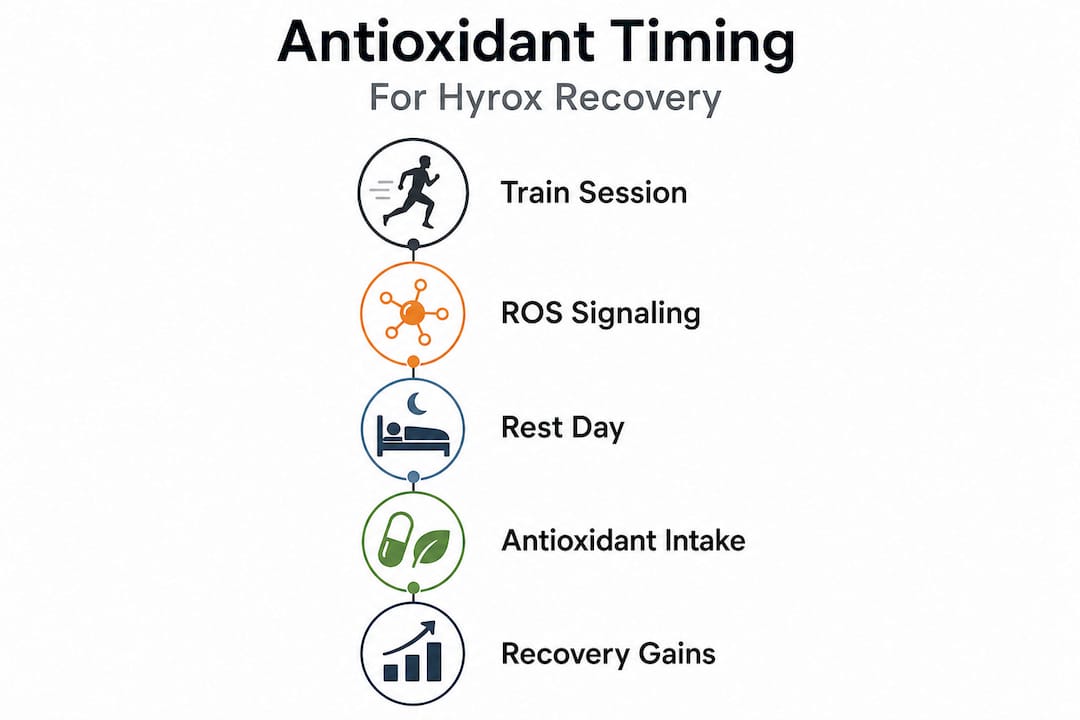
The practical evidence is compelling. Tart cherry juice improves maximal voluntary contraction recovery after exercise-induced muscle damage, with effect sizes ranging from 0.63 at 24 hours to 4.82 at 96 hours post-exercise. It also reduces C-reactive protein, a key inflammatory marker, during early recovery. This means the benefit is not just subjective. You can measure it in the lab and feel it in your legs.
Here is how to structure your antioxidant timing across a typical Hyrox training week:
- Heavy training days: Focus on protein, carbohydrates, and hydration. Avoid high-dose synthetic antioxidants within four hours of training. Small amounts of polyphenol-rich foods are fine and will not impair adaptation.
- Moderate training days: A tart cherry concentrate drink post-session is ideal. This is where you can start layering in recovery-focused antioxidant strategies without compromising your adaptive signal.
- Recovery and rest days: This is your window for higher polyphenol intake. Pomegranate, curcumin, and additional tart cherry all make sense here. Your body is rebuilding and the antioxidant support complements that process without interference.
- Pre-competition week: Scale back high-intensity training and introduce consistent polyphenol support daily. The goal shifts from adaptation to readiness and reducing systemic inflammation before race day.
“Think of your antioxidant intake as a dial rather than a switch. Turn it up on recovery days and dial it back on the sessions where you want your body to feel the productive stress of training.”
Connecting your antioxidant strategy with broader recovery support makes sense too. Essential amino acids for recovery work alongside polyphenols to support muscle protein synthesis after your hardest sessions. For a structured overview of how to integrate everything, the natural supplement intake guide for female athletes in 2026 lays out a practical approach specifically designed for the demands of high-intensity sport.
The truth most guides miss: strategic antioxidants for real-world Hyrox gains
Here is the opinion you will not find on most supplement websites: the majority of female Hyrox athletes are not suffering from antioxidant deficiency. They are suffering from antioxidant confusion. And that confusion is costing them actual performance gains.
The all-or-nothing approach is the real problem. Some athletes avoid antioxidants entirely because they read that ROS is necessary for adaptation. Others take everything available because they believe more protection means faster recovery. Both extremes miss the point and both cost you results.
We see female Hyrox athletes respond best when they treat antioxidants as a precisely timed tool rather than a daily insurance policy. The body is remarkably capable of managing oxidative stress when you fuel it with varied, polyphenol-rich whole foods and add targeted supplementation only where the evidence is clear. Tart cherry is one of those clear cases. Pomegranate is another. A generic antioxidant blend from a budget supplement brand is not.
There is also a patience problem. Antioxidant strategies for recovery do not produce overnight transformations. The athletes who benefit most are the ones who consistently apply a food-first approach, observe how their body responds across training cycles, and adjust rather than abandoning the strategy after two weeks. If you want a practical way to ensure your strategy is actually evidence-based, learning to interpret supplement labels as a female athlete is a foundational skill that most guides skip entirely.
Your physiology is the most important data point you have. More than any study average, more than any generic protocol, how your body recovers across your personal training cycle tells you whether your antioxidant strategy is working. Trust that feedback and adjust accordingly.
Boost your Hyrox recovery with proven natural supplements
The science is clear: strategic, food-based antioxidants timed around your training give you the best shot at faster recovery and sustained performance across your Hyrox season. That means choosing supplements made from real ingredients, not synthetic high-dose vitamins that can work against the adaptations you are training for.

At Interval, our pre-workout and electrolyte formulations are built around natural, evidence-backed ingredients designed specifically for female athletes pushing their limits in high-intensity sport. If you are ready to move from confusion to a clear, practical approach to recovery, our Starter Bundle gives you a foundation rooted in the same food-first, strategic philosophy this guide is built on. Real ingredients, real recovery, real results across your entire training cycle.
Frequently asked questions
Do antioxidants help reduce muscle soreness after Hyrox events?
Tart cherry accelerates recovery from exercise-induced muscle damage in females, making polyphenol-rich foods a practical and evidence-backed option for reducing soreness after Hyrox competition.
Should I avoid all antioxidant supplements before workouts?
Avoid high doses of synthetic vitamins C and E before key sessions, as high-dose vitamins C/E blunt the redox signalling needed for adaptation. Natural polyphenol sources timed away from training are safe and beneficial.
Is there a performance benefit for women aged 30-50?
Yes. Antioxidants combined with exercise improve strength and walking performance more than exercise alone in adults over 50, suggesting meaningful benefits across the 30 to 50 age bracket when strategically applied.
How should antioxidants be timed around Hyrox training?
Use polyphenol-rich foods such as tart cherry or pomegranate after intense sessions and on recovery days. Antioxidant timing should follow redox-adaptive periodisation principles, preserving your training adaptations while accelerating recovery.