


Master fatigue management for peak athletic performance
Fatigue is not simply feeling tired after a hard session. For high-intensity female athletes, it is a complex physiological and psychological signal that, when misread, quietly erodes performance and stalls adaptation. Most athletes treat fatigue as something to push through, but fatigue management is actually about optimising how your body responds to training stress, not eliminating it. This article covers what fatigue management really means, how it affects women specifically, and the practical strategies you can apply right now to train harder and recover smarter.
Table of Contents
- What is fatigue management?
- Common fatigue patterns in high-intensity female athletes
- Core strategies: Periodised training and recovery protocols
- Monitoring and customising your fatigue management plan
- Edge cases: Overtraining, mental fatigue, and strategy limitations
- Next steps: Resources for female athletes
- Frequently asked questions
Key Takeaways
| Point | Details |
|---|---|
| Fatigue is layered | Fatigue differs from fatigability and requires specific management for optimal athletic adaptation. |
| Cycle matters | Tracking menstrual phases is crucial for female athletes to adjust training and nutrition for reduced fatigue. |
| Polarised training advantage | Polarised periodisation minimises fatigue and enhances endurance more than threshold methods for most athletes. |
| Basics outperform tech | Sleep, nutrition, and hydration have greater impact on fatigue management than wearable gadgets or advanced tools. |
| Customisation boosts results | Monitoring and adapting plans based on individual feedback leads to sustainable fatigue management and peak performance. |
What is fatigue management?
Fatigue management is the ongoing process of monitoring and balancing training-induced fatigue to optimise adaptation without tipping into breakdown. It is not about doing less. It is about doing the right amount at the right time.
Before going further, it helps to separate two terms that are often confused. Fatigue is the temporary decline in your ability to produce force or sustain effort. Fatigability is your individual susceptibility to that decline. Two athletes can complete the same session and experience very different levels of fatigue, and that difference matters enormously when designing a training plan.
One useful framework is the Fatigue Score, which combines training load, session intensity, and recovery quality into a single number. The components look like this:
| Component | What it measures | Why it matters |
|---|---|---|
| Training load | Volume x intensity | Total stress placed on the body |
| Recovery quality | Sleep, nutrition, hydration | Capacity to absorb training |
| Perceived effort | RPE score | Subjective fatigue signal |
| Cycle phase | Hormonal context | Modifies fatigue response |
Why does careful fatigue management matter? Because adaptation, the process that makes you fitter and stronger, only happens when fatigue is present but controlled. Too little stress and you plateau. Too much and you regress. Getting boosting athletic focus right depends on this balance as much as physical output does.
Key benefits of structured fatigue management include:
- Reduced injury risk from accumulated overload
- Better session quality because you arrive recovered
- Faster progress through consistent, sustainable training blocks
- Improved mood and motivation across the training week
Pro Tip: Start tracking your Rate of Perceived Exertion (RPE) on a simple 1 to 10 scale after every session. It costs nothing and gives you a reliable window into how your body is actually responding to load.
Common fatigue patterns in high-intensity female athletes
Female athletes aged 30 to 50 experience fatigue differently to their male counterparts, and ignoring that difference is one of the most common training mistakes. Hormonal fluctuations across the menstrual cycle create predictable shifts in how fatigue feels and how well you recover from it.

The luteal phase, the two weeks before your period, is particularly significant. Perceptual fatigue effects are amplified during this phase, meaning the same session feels harder even when your actual output is unchanged. Core temperature rises, carbohydrate oxidation increases, and sleep quality often dips. All of this compounds fatigue accumulation.
Interestingly, women cycle 17% longer before reaching exhaustion in endurance tasks compared to men, yet report higher levels of mental fatigue throughout. This means your physical resilience is genuinely impressive, but your perception of effort and your cognitive load need active management too.
Here is a comparison of the two fatigue types most relevant to your training:
| Fatigue type | Primary cause | Key symptoms | Management focus |
|---|---|---|---|
| Physical fatigue | Muscle damage, glycogen depletion | Soreness, reduced power output | Sleep, nutrition, load management |
| Perceptual fatigue | CNS stress, hormonal shifts | High RPE, low motivation, brain fog | Cycle tracking, mental recovery |
To manage cycle-related fatigue effectively, follow these steps:
- Track your cycle symptoms weekly using an app or journal
- Note RPE scores alongside cycle phase each session
- Identify your personal high-fatigue window, usually days 19 to 28
- Reduce session intensity or volume during that window proactively
- Prioritise sleep and carbohydrate intake in the luteal phase
“Menstrual cycle awareness is not a limitation. It is a performance tool. Athletes who track and respond to cycle-related cycle symptom impact consistently outperform those who ignore it.”
For more on protecting your long-term health, explore these burnout prevention tips and the latest guidance on overtraining syndrome prevention.
Core strategies: Periodised training and recovery protocols
Once you understand your fatigue patterns, the next step is structuring your training to work with them. Two approaches dominate the evidence base: polarised training and threshold training.
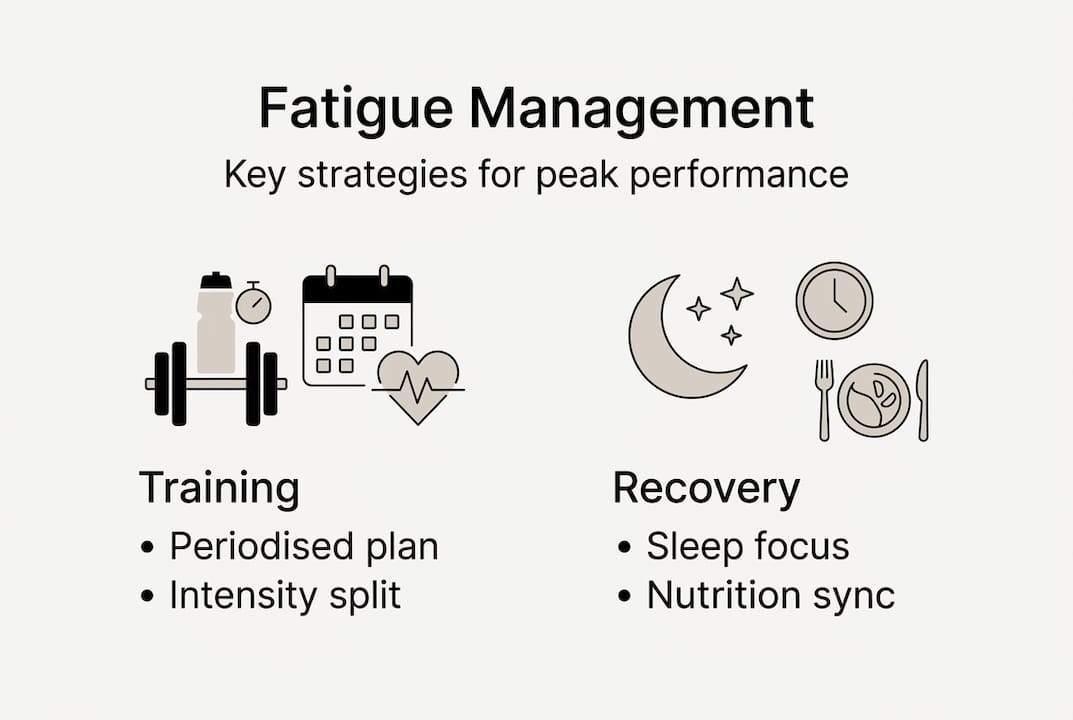
Polarised training splits your sessions roughly 80% low intensity and 20% high intensity, with very little time in the moderate zone. Double the effect size for VO2max and endurance improvements compared to threshold methods, with significantly less fatigue accumulation. That is a compelling case for most high-intensity female athletes.
Key differences between training models:
- Polarised: High VO2max gains, lower fatigue, suits athletes with busy lives
- Threshold: Moderate gains, higher fatigue risk, suits those with structured recovery time
- Pyramidal: Middle ground, useful for building base fitness before intensifying
Beyond training structure, recovery is where adaptation actually happens. Three non-negotiables:
Sleep is your most powerful recovery tool. Aim for 7 to 9 hours. Even one night of poor sleep measurably reduces power output and increases perceived effort the next day.
Nutrition must match your training demands. Research on polarised training research highlights that female athletes who fuel adequately around high-intensity sessions show measurable performance gains, including a 0.97% improvement in swim performance in periodised groups.
Hydration and electrolytes are often underestimated. Sweat losses during high-intensity sessions deplete sodium, potassium, and magnesium, all of which affect muscle contraction and mental sharpness. Learn how to optimise muscle recovery and follow a structured approach to post-workout recovery steps to close the gap between sessions.
Pro Tip: In the luteal phase, add 20 to 30g of carbohydrates before your high-intensity sessions and top up with electrolytes after training. This simple adjustment can meaningfully reduce perceived fatigue and support faster recovery.
Monitoring and customising your fatigue management plan
No two athletes respond to training identically. A plan that works brilliantly for your training partner may leave you chronically fatigued or under-stimulated. Customisation is not optional. It is the difference between a plan that works and one that looks good on paper.
The basics outperform gadgets when it comes to fatigue monitoring. Consistency with simple tools beats sporadic use of expensive technology every time. Here is a practical monitoring sequence:
- Log RPE daily after every session, including rest days where you note general energy levels
- Track HRV (heart rate variability) each morning before getting up, using a free app if needed
- Record cycle phase alongside training data to identify hormonal patterns over time
- Review weekly by comparing RPE trends, HRV dips, and performance outputs
- Adjust the following week based on what the data tells you, not what the plan says
Individual fatigue benchmarks matter here. If your HRV drops more than 10% below your personal baseline for three consecutive days, that is a clear signal to reduce load. If your RPE for a standard session climbs by two or more points without a change in the session itself, your body is telling you something.
For female athletes, cycle-aware customisation adds another layer. Align your hardest sessions with the follicular phase (days 1 to 14) when oestrogen supports recovery and pain tolerance. Use the luteal phase for technique work, lower-intensity volume, and active recovery.
Support your monitoring with solid nutrition steps for women, get your protein timing details right, and consider antioxidant recovery support to reduce oxidative stress after intense blocks. An electrolyte workflow for women can also make a significant difference to how you feel between sessions.
Pro Tip: Pick two metrics and track them every single day for four weeks before adding more. Consistency with two data points beats inconsistency with ten.
Edge cases: Overtraining, mental fatigue, and strategy limitations
Even the best fatigue management plan has blind spots. Knowing where the common pitfalls are helps you avoid them before they cost you weeks of training.
Overtraining syndrome is the most serious risk. It occurs when cumulative fatigue exceeds your body’s ability to recover, leading to CNS fatigue and persistent performance decline. Unlike normal training fatigue, overtraining does not resolve with a rest day or two. Symptoms include:
- Persistent soreness that does not improve after 48 hours
- Declining performance despite consistent training
- Disrupted sleep and elevated resting heart rate
- Mood changes, irritability, and loss of motivation
- Frequent illness due to suppressed immune function
Mental fatigue is a separate but equally important concern. High cognitive load, whether from work, stress, or decision-making, impairs vigilance and explosive power even when your muscles are physically fresh. A hard week at work can genuinely compromise your sprint session, and that is not weakness. It is physiology.
On training strategy limitations: threshold training risks higher fatigue accumulation and is not always inferior to polarised methods for sub-elite athletes. Context matters. If you are not competing at elite level, a pyramidal or threshold approach may suit your schedule and recovery capacity better than a strict polarised model.
“The fitness-fatigue model reminds us that fatigue is not the enemy. It is the signal that adaptation is happening. The goal is to manage its magnitude, not eliminate it entirely.”
For detailed guidance on recognising and addressing overtraining early, visit our overtraining prevention resource.
Next steps: Resources for female athletes
You now have a clear framework for understanding, tracking, and managing fatigue in a way that actually fits how your body works. The next step is putting it into practice with the right support behind you.
At Interval, we have built our products specifically for high-intensity female athletes who need clean, effective fuel without compromise. Our natural pre-workout and electrolyte formulas are designed to support your hardest sessions and your recovery between them. If you are ready to take a structured approach to fatigue management, our starter fatigue management bundle gives you everything you need to begin. Explore the full range of tools, guides, and products at useinterval.co.uk and start training with your physiology, not against it.
Frequently asked questions
How can I tell if I’m experiencing training-induced fatigue versus overtraining?
Training-induced fatigue is temporary and resolves with a day or two of recovery, while overtraining presents as persistent performance decline alongside mood changes and disrupted sleep that linger for weeks.
How should I adjust my training during my menstrual cycle to manage fatigue?
In the luteal phase fatigue risk is highest, so lower your reps, extend rest periods, and add pre-session carbohydrates and electrolytes to support output and recovery.
Does polarised training work for all athletic levels?
Polarised training delivers strong results for elite athletes, but not always superior for sub-elite athletes, where threshold or pyramidal models may be a better fit depending on your schedule and recovery capacity.
What simple tools can I use to track fatigue and recovery?
RPE scores, HRV monitoring, and cycle charts are the most practical options. RPE and fatigability scores used consistently will give you more actionable data than any expensive gadget used sporadically.